Federal Regulation
EPA Proposes to Ease Coal Ash Waste Storage and Reuse Rules

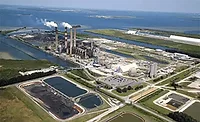
Coal ash impoundment accident in 2008 at Tennessee Valley Authority coal fired plant in Kingston, Tenn., triggered contamination over 300-sq-mile area and costs reaching into the billions.
The U.S. Environmental Protection Agency has proposed relaxing federal regulations for disposal and management of coal combustion residuals from power plants, also called coal ash—opening the door to easing disposal site cleanup and monitoring requirements at both operating and decommissioned coal-fired facilities as the Trump administration pushes to have more of them producing power, often against owner, utility and community priorities.
The agency’s proposed changes, announced April 9, include repeal of the legacy site surface Impoundment rule, implemented in the Biden administration, that broadened disposal site closure and cleanup requirements for toxic contaminant-laden ash at older and inactive facilities. EPA's new proposal says it seeks to eliminate what the administration describes as “infeasible and impractical” regulatory requirements enacted in 2024 that utilities have claimed burden energy production.
Other revisions would provide state authorities greater leeway to tailor groundwater monitoring, corrective action, impoundment closure and post-closure requirements to site-specific risks and factors, and use new technologies.
Another provision would revise the definition of “beneficial use” of residuals for manufacturing materials such as cement and drywall "by eliminating the requirement for an environmental demonstration for the non-roadway use of more than 12,400 tons of unencapsulated [residuals] on land" and exclude from federal regulation ash used in cement manufacturing at cement kilns and flue gas desulfurization gypsum used in wallboard and in agriculture.
EPA claims the revisions would potentially reduce need for coal ash disposal while “improving the strength, durability, and workability of the resulting cement and concrete.”
A public comment period will last until June 12, with two information webinars on April 15 and 16, and a public hearing set for May 28, says EPA.
Coal-Ash Spill Disasters Spurred Rulemaking
Looking for quick answers on construction and engineering topics?
Try Ask ENR, our new smart AI search tool.
Ask ENR →
Although coal ash makes up the nation’s second-largest stream of industrial waste, it took major ash impoundment collapses to spur regulation—such as at a TVA site in Tennessee in 2008 that spewed 5.4 million cu yd of hazardous sludge across 300 acres and into the Emory River, with an estimated $2 billion in cleanup, settlement and new construction expense over the next four years, according to a 2025 U.S. Securities and Exchange Commission filing. Also in 2014, a Duke Energy site accident in North Carolina disbursed 39,000 tons of ash and 27 million gallons of ash pond water into the Dan River, with a short term remediation tab of more than $295 million and longer term costs also estimated in the billlions.
EPA in 2015 enacted minimum standards for safe disposal of coal ash in landfills and surface impoundments, including requirements for groundwater monitoring, structural integrity checks and closure procedures for leaking sites.
Power companies vigorously opposed Biden administration efforts to expand the cleanup mandate to facilities exempted by the 2015 rule. An early January 2025 letter to Lee Zeldin, then-EPA Administrator nominee, which was co-signed by 10 electric power companies, authorities and cooperatives, identified “the unprecedented expansion” of federal coal ash regulations.
“States and power companies have challenged these rules as exceeding EPA’s statutory authority,” the letter said. The new administration "should decline to defend these unlawful rules and should seek their immediate recission.”
Now characterizing the proposed amendments as “commonsense changes” that reflect the administration push for "American energy dominance ... and accommodating unique circumstances at certain [coal ash] facilities,” Zeldin stated that the revised rule “will increase transparency and promote resource recovery while continuing to protect human health and the environment."
Environmental groups counter that the proposed changes are a concession to coal industry priorities at the expense of requirements needed to protect groundwater and drinking water supplies from future ash contamination, particularly at older dump sites that still lack protective lining and monitoring systems.
Under EPA proposed amendments, disposal site owners would be allowed to test for groundwater contamination at a distance of about 500 ft or more from disposal areas, rather than at the site’s edge as now required, “effectively permitting a zone of contamination,” said environmental law non-profit group Earthjustice.
Coal Power Providers Seek Flexibility
Since the initial coal ash rules were put in place, power providers have sought greater flexibility in administering cleanup programs and reducing compliance costs, including what the 2025 letter to Zeldin called “burdensome, one-size-fits-all closure requirements.” The letter criticized the EPA so-called legacy rule, including an “after-the-fact” risk assessment based on “incomplete data, inappropriate methodologies and unreasonable assumptions.”
Scott Brooks, spokesperson for utility Tennessee Valley Authority, operator of the Kingston, Tenn., power plant where the 2008 spill occurred, says the agency “supports efforts to ensure that coal ash regulations are grounded in sound science,” and believes “a site-specific, science-driven approach results in the safest and best outcomes for the communities we serve.” He adds that TVA officials "are reviewing EPA’s proposal and look forward to continued engagement as the rulemaking process advances."
Duke Energy, whose senior vice president for enterprise safety and generation services, Jessica Bednarcik, was one of the 2025 letter signatories, told a North Carolina media outlet that the proposed coal ash revisions would have no effect on what she says is a multi-billion-dollar utility coal ash cleanup program initiated under a 2021 settlement with state regulators and environmental groups.