HDR Agreed to $12M Settlement With Miami Bridge Design-Build Team
Archer Western-de Moya battles to collect much more from insurers
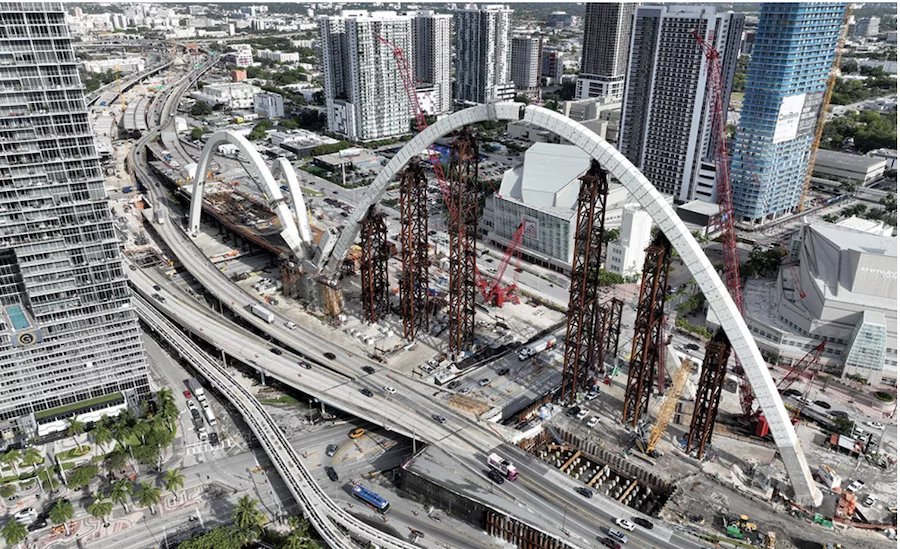
The difference between preliminary design wind loads and final design wind loads, and timing of the design-build joint venture's final guaranteed price on Miami's Signature Bridge, became critical elements of the dispute between the Archer Western-de Moya Group and its principal engineering subcontractor HDR.
HDR last year agreed to pay $12 million to the design-build construction contractor Archer Western-de Moya Group to settle its claims that the engineer had incompletely designed and under-designed Miami's new Signature Bridge when the joint venture committed to a fixed price prior to construction in 2018.
As part of the April 2025 settlement of the negligence, gross negligence and breach-of-contract lawsuit, Archer Western-de Moya released $30 million in fees it had been withholding from the Omaha-based engineer.
The pact put to rest the joint venture's lawsuit in federal district court in Miami against HDR, first filed in 2022. Because gross negligence was ruled out by the judge, HDR would not be liable for more than the $10 million limit in its project-specific professional liability policy with Berkley Assurance Co.
HDR said in a statement that the legal matters "were resolved by mutual agreement more than a year ago and are considered closed. Our focus continues to be on supporting our partners, clients and the citizens of Miami to deliver this Signature Bridge."
But a new legal front opened several months after the HDR settlement, when Archer Western-de Moya filed a new lawsuit against a handful of insurers that had issued the contracting joint venture its own protective professional insurance policies. These could apply to costs from errors that Archer Western-de Moya's design subcontractor, HDR. allegedly committed.
Archer Western said in court filings that it had a primary layer of that type of insurance issued by Berkley and first through fifth excess policy layers by other insurers.
The contracting joint venture accused the insurers of refusing to pay under the policies that the joint venture believes should be triggered now that HDR's policy limit was completely eroded by the engineer's legal defense costs. Altogether, Archer Western-de Moya claimed it suffered extra costs related to HDR's alleged errors totaling about $400 million.
The insurers are pushing back.
Looking for quick answers on construction and engineering topics?
Try Ask ENR, our new smart AI search tool.
Ask ENR →
In a motion to dismiss many of the counts against them, they argue that an arbitration is needed of the terms of any indemnity coverage for economic loss caused to others. They also claim that Archer Western-de Moya had not yet complied with all policy provisions, including those that apply to rectification coverage for fixing work tied to HDR's alleged errors. In addition, they argue that Archer Western-de Moya's legal expenses are not covered by the policy.
An attorney for Archer-Western-de Moya could not immediately be reached for comment.
The controversies are the latest involving a large design-build infrastructure project on which the contractor looks to insurance policies to make up for project cost overruns or errors.
Over Budget and Behind Schedule
Over budget and behind schedule, the expected completion date of the $866-million Miami Signature Bridge project is now 2029, years past the original 2024 target that the Archer Western-de Moya had aimed for in 2019. That's when the joint venture started construction on the one-of-a-kind, six-arch bridge and surrounding interstate highway reconstruction project.
The effort to build the unusual structure has been compared to a "painstaking battle." Unlike more standard precast segmental bridges, the vast majority of the arches’ 345 precast segments are so different from each other that it was next to impossible for a precaster to standardize their construction.
But until recently, what had been described as a purely technical and physical challenge to build the unusual structure was not understood to include legal conflict on the design-build team. The team disputes had appeared in legal news services but only emerged into broader public view in a local television media report in February.
Archer Western-de Moya, in its lawsuit in federal court in Miami, had blamed HDR for added project costs based mainly on the allegation that the engineer had failed to calculate wind loads, including drag coefficients—a quantity that relates the wind pressure on an object to its size and wind speed—on the unusual arched bridge structure. In Archer Western-de Moya's lawsuit, the joint venture claimed HDR had failed to retain a wind engineering consultant soon enough for the information to be accounted for in preparing a guaranteed maximum price to the Florida Dept. of Transportation.
The agency is paying for the bridge but not the related approach roads.
In its lawsuit against the insurers filed a year ago, Archer Western-de Moya claims that the contract documents it signed with HDR required that the engineer complete key design criteria including wind loads by the time the final price to the Florida Dept. of Transportation was guaranteed.
"HDR did not engage its wind consultant, RWDI USA, LLC, until August 2018, after the JV had executed the Design-Build Contract" and with design in theory completed to the 60% level, Archer Western-de Moya alleged.
In December of that year, HDR informed Archer Western-de Moya that the wind calculations had changed, the contractor claimed. By the time HDR's proposed changes were approved by FDOT, months had been lost on the project schedule, dramatically increasing the cost.
But HDR had a story of its own to tell.
The firm claimed in reply to Archer Western-de Moya that the joint venture—without informing HDR—had cut short to 341 days what HDR believed was a needed and agreed-to 608-day schedule for design. In addition, HDR charged, the joint venture began making changes unilaterally to the bridge foundation and arch erection methods.
"There is no dispute that final wind load calculations were performed during design development in Phase II to complete the final design," the engineer argued, and that the preliminary wind loads used were exclusively for the preliminary design.
In its counterclaim against Archer Western-de Moya, HDR sought $48 million in withheld fees and extra costs of its own.
The federal judge in the case made an important ruling in January 2025, saying that HDR's performance did not amount to gross negligence. If gross rather than simple negligence was involved, the cap on the limitation of liability in the engineer's insurance policy could have been exceeded.
With that ruling, Archer Western-de Moya was prevented from immediately collecting any money beyond the $10-million cap because HDR's legal defense costs in the lawsuit had already used up all of the $10 million in its insurance limit.
That set the stage for Archer Western-de Moya and HDR to negotiate a settlement.