ENR 2026 Top Owners ‘Byte’ Down on AI Boom
April 8, 2026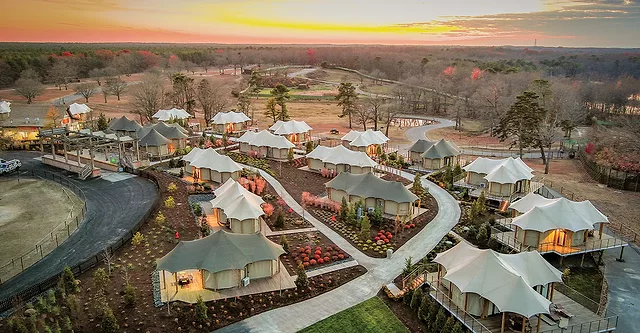
ENR 2026 Top Owners ‘Byte’ Down on AI Boom
April 8, 2026Six Flags' Savannah Sunset Resort and Spa is nestled inside the 350-acre Wild Safari Park in Jackson Township, N.J. Accommodations are borne by a custom pile-supported timber deck system, with structures elevated to allow wildlife to roam freely beneath.


Related Link:
ENR 2026 Top Owners Review + (PDF)
(Subscription Required)
Nvidia CEO Jensen Huang says the company expects to exceed $1 trillion in revenue through 2027. He made the announcement at the chipmaker’s annual developer conference last month, which included a flurry of new tech releases that meant to assure economists that the U.S. artificial intelligence capital buildout was only just beginning.
According to Nvidia, about 60% of those future revenue sales are expected to come from its “hyperscaler” cloud customers, such as Amazon, Alphabet, Meta, Microsoft and Apple as they race to scale up their data center infrastructure to meet the cloud processing demands of their customer database and operations.
“AI is no longer a single breakthrough or application—it is essential infrastructure,” Huang added. “From energy and chips to infrastructure, models and applications, every layer of the stack is advancing at once.”
Comparing AI infrastructure development to a “five-layer cake,” embedded in the first layer of that stack is the construction industry and the “enormous” labor demand needed to drive the buildout forward, Huang wrote in a March 10 blog post leading up to his conference keynote.
“AI factories need electricians, plumbers, pipefitters, steelworkers, network technicians, installers, and operators,” he wrote. “These are skilled, well-paid jobs and they are in short supply.”
Market in Focus: Manufacturing | By James Leggate
$1B Amkor Arizona Chip Plant Starts Work
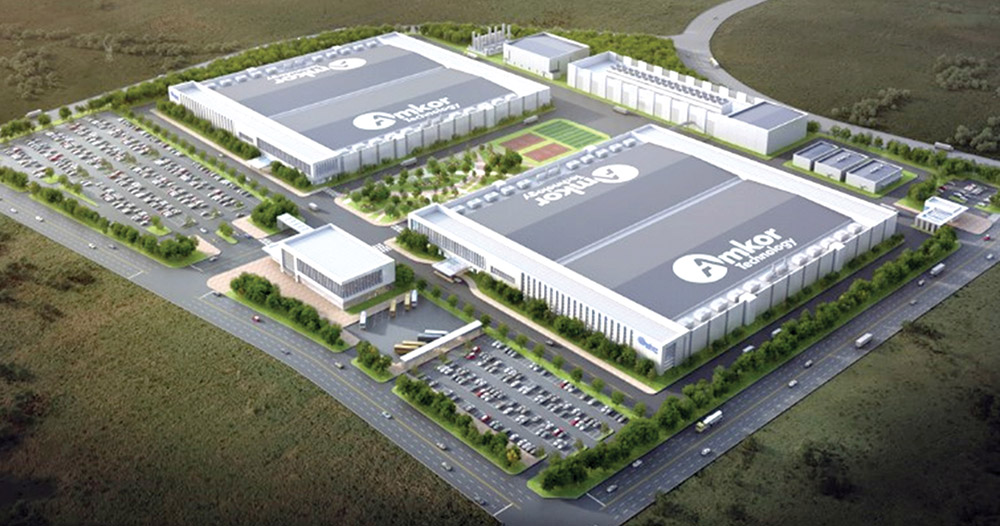
Image courtesy of Amkor Technology Inc.
While high-profile funding announcements following enactment of the 2022 CHIPS and Science Act have stopped, projects supported by its $39-billion program to incentivize construction, expansion and modernization of semiconductor chip plants are advancing.
Construction started in January on the $1-billion first phase of Amkor Technology Inc.’s Peoria, Ariz., semiconductor advanced packaging plant. It was the second-largest nonresidential project to break ground that month nationally, following the $1.2-billion New York Presbyterian Cancer Center, according to Dodge Construction Network.
The U.S. Commerce Dept. has pledged $407 million in direct funding to support the project. Amkor’s project team includes engineers SSOE Group and contractor Okland Construction. The project is estimated to involve more than 2,000 construction workers, according to the department.
The company’s plans for the site have grown from its original proposed facility with 500,000 sq ft of cleanroom manufacturing space. This plant now marks just the first phase of what Amkor says could be a 104-acre manufacturing campus with 750,000 sq ft of cleanroom space and a total investment of $7 billion, generating up to 3,000 high-tech jobs when operation begins. This initial phase is scheduled to complete in mid-2027 for production starting in early 2028. The campus is set to be one of the largest advanced packaging facilities in the world.
Amkor says its packaging plant will complement a nearby Taiwan Semiconductor Manufacturing Co. (TSMC) wafer fabrication plant and other production plants in the area.
“We’re building a facility to meet our customers’ most advanced needs that will help shape the future of semiconductor manufacturing in the United States,” Amkor President and CEO Giel Rutten said at a ceremonial groundbreaking last fall. He noted that Arizona “offers the right mix of talent, infrastructure, and industry presence, and we’re proud to deepen our roots here.”
The state has long been home to chip manufacturing with Intel, and more companies are building in the state. Federal officials have awarded $7 billion to semiconductor projects in Arizona through the CHIPS and Science Act program, including $6.6 billion to chip manufacturer TSMC and $3.8 billion to Intel.
Stacking Up Challenges
Although data centers and energy-related production projects have become “noteworthy exceptions” driving the construction economy forward early this year, Associated Builders & Contractors Chief Economist Anirban Basu noted a “confluence of factors” suppressing construction activity in hospitality, multifamily, entertainment and commercial development segments.
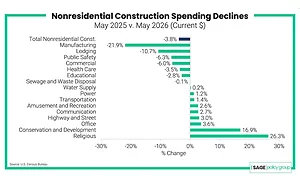
“These factors include stubbornly high interest rates, rising materials prices, a deceleration of construction, wage growth and uncertainty—whether related to conflicts in the Middle East, other policies emanating from Washington, D.C., or various state capitals,” he says. “As a result, deal flow is actually fading. Non-residential approach spending actually has been declining, generally speaking, in recent months, and that’s particularly true if one adjusts for inflation.”
Another noteworthy exception, according to Basu, is public works construction projects propelled by the Biden administration’s $1.2-trillion Infrastructure Investment and Jobs Act package of 2021.
Looking for quick answers on construction and engineering topics?
Try Ask ENR, our new smart AI search tool.
Ask ENR →

The total value of construction-in-progress for ENR’s Top 425 Owners rose 12.5% between 2024 and 2025 to $670.01 billion, with that growth concentrated in the largest firms.
Median construction-in-progress for the Top 425 dropped slightly to $310.5 million in 2025, from $313.2 million in 2024, while the total for firms ranked in the Top 100 rose 15% when compared to last year’s equivalently ranked firms. The Top 10 firms rose 21.8% in that same span, while the bottom 100 firms saw an 8.2% decrease in their total construction-in-progress.. Only 11.2% of firms ranked in the bottom half of the 425 had a higher level than the equivalently ranked firms from last year.
“We’re Building a facility to meet customers’ most advanced needs that will help shape the future of semiconductor manufacturing in the U.S.”
—Giel Rutten, CEO, Amkor Technology Inc.
Beyond the numbers, projects tied to public works, data centers and energy generation “are the segments that are still generating net new opportunities for contractors, but many other construction segments are fading in terms of momentum,” says Basu, adding, “what’s happening is that deals are not penciling out.”
In those cases, he says the future of such projects for owners become “uncertain from the perspective of what revenues,” or returns on investment owners can expect in current economic times. On some projects, recent spikes in diesel fuel prices tied to disruptions along the Strait of Hormuz, a crucial shipping lane for oil in the Middle East, have only added to cost volatility.
“The increases do not help,” says Basu, but “certainty” continues to be a main driver of project decision-making. He adds, “We can say with some certainty that for the foreseeable future, the data center construction boom is in full force.”
Focus on Markets: Buildings | By Bruce Buckley
HCA Healthcare Starts $1.3B San Jose Hospital Expand
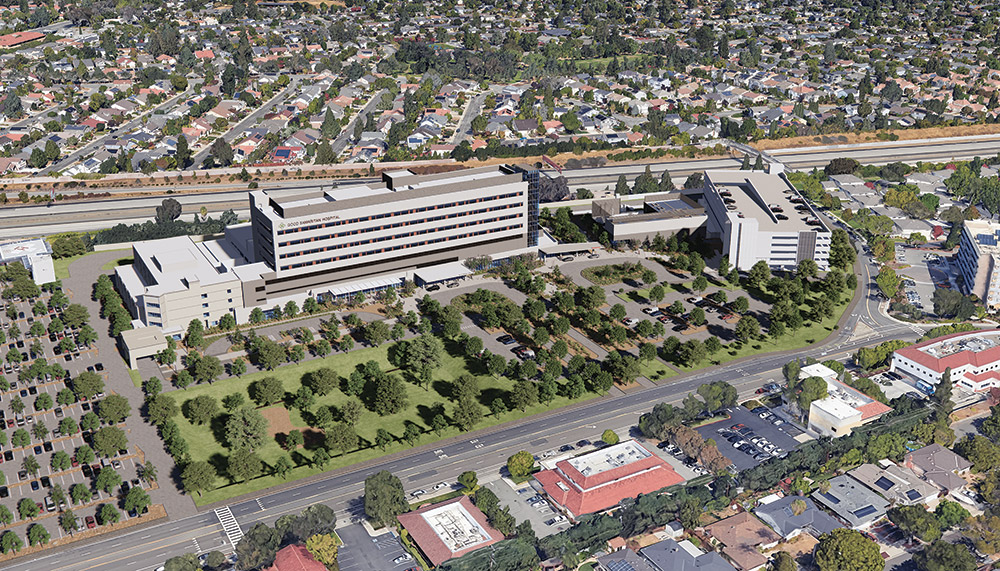
Image courtesy of HCA Healthcare
Good Samaritan Hospital and owner HCA Healthcare broke ground in October on a $1.3-billion expansion and modernization of its San Jose, Calif., campus. The project—set to complete by the end of 2032—will add 715,144 sq ft of construction, including a 469,920-sq-ft patient tower with 234 inpatient rooms, 339 total operating beds and expanded surgical, cardiac catheterization and diagnostic areas. Expansion also includes new shell space for future patient and emergency care, surgery and imaging suites.
Good Samaritan Hospital opened in 1965, with HCA Healthcare completing an acquisition of the acute care facility and its regional health system in 1996—a deal that included four hospitals and marked the owner’s major move into the California market.
The scope of the current project expansion also includes a new central utility plant and 658-space parking garage. Other improvements will be made in campus infrastructure upgrades designed to enhance access, safety and patient experience, while ensuring compliance with California’s 2030 seismic safety standards.
“Our new patient tower ensures that Good Samaritan Hospital will meet California’s stringent seismic standards and remain operational after earthquakes,” said Patrick Rohan, Good Samaritan Hospital CEO, in a statement. “A new inpatient building allows us to have an earthquake-safe hospital operational sooner than a remodel of our older towers and, most importantly, allows us to have a facility with a longer lifespan than our current aging hospital.”
The project will be built in three phases. Phase one will deliver the parking garage, followed by the central utility plant in phase two and the patient tower as the final phase. Layton Construction is general contractor for the hospital and central utility plant. Perkins & Will is architect.
McCarthy Building Cos. will build the parking garage, with architect Gresham Smith. Initial demolition work is underway to prepare the site for construction of the parking garage, which is a key early phase. Across the entire scope, the project is expected to support 1,550 construction jobs.
The expansion aims to address a lack of sufficient hospital beds in Santa Clara County. Currently, there are 2.01 beds per 1,000 people, below the national average of 2.35 beds per every 1,000 people, according to California Health and Human Services data.
Busting the ‘AI Bubble’
Data from research consulting firm McKinsey estimates investment in data center infrastructure could reach a cumulative $6.7 trillion globally by 2030 to meet booming AI demand.
In recent months, hyspercalers Oracle, Meta, Microsoft and Amazon have all made headlines after announcing thousands in cuts to their head count in order to double down on their AI investment. However, for some economic analysts, the layoffs have stoked fears of fragility in terms of how quickly things can change at companies pursuing AI ambitions.
“What if the hyperscalers start to realize that they’re investing a lot of money but that the revenue potential is not what they deemed it to be?” poses Basu, comparing the potential for a downshift in AI investment to automakers moving away from electric vehicle production development.
“The internal combustion engine is coming back with a vengeance in some context and so it’s conceivable that this interest and surge in investment in artificial intelligence will begin to wane as people’s minds begin to change about its true revenue potential that’s absolutely possible,” he explains.
Above all, “I think we can all agree there is a data center construction boom presently, but will it last? And if it’s going to last, how long will it last? Now we’re in the world of almost pure speculation,” says Basu. “We suspect that it will last through this year. Why is that? Because the commitments by these so-called hyperscalers have already been made.”
Basu calls the race for AI dominance among hyperscaling companies “unlike anything we’ve observed in our lives and perhaps in all of human history.” He adds, “It’s not just the U.S. construction industry that depends upon data centers to drive activity. It’s the overall U.S. economy. There’s not that much [else] driving the U.S. economy forward right now.”
Market in Focus: Power | By Jim Parsons
Feds Loan $26.5B to Boost Southern Co. Units' Generation
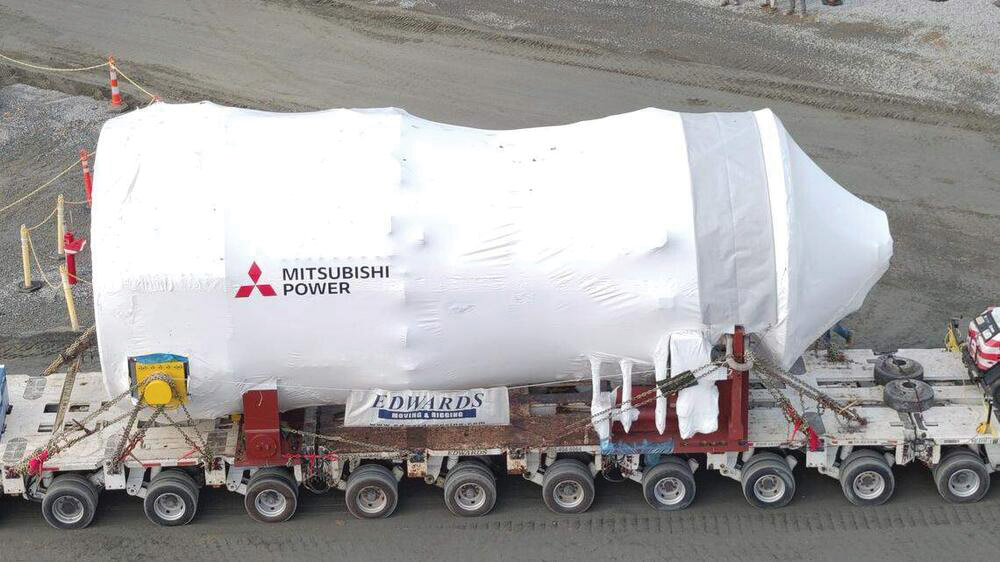
Turbine being delivered to Georgia Power Plant Yates. Image courtesy of Georgia Power
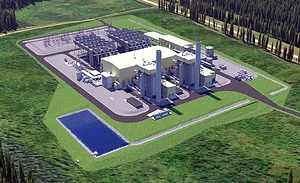
A $26.54-billion loan package just approved by the U.S. Dept. of Energy will enable two Southern Co. subsidiaries to finance more than 16 GW of “firm” power generation and more than 1,300 miles of transmission infrastructure and grid enhancement across the Southeast.
The two 30-year loan agreements to the utility company’s state units—$22.4 billion to Georgia Power and $4.1 billion to Alabama Power—comprise the largest single loan commitment in department history, officials said.
According to a department fact sheet, the loans will support over 200 individual energy projects across the utilities’ regulated service territories, including 5.3 GW of new gas generation and nearly 500 MW in gas capacity upgrades.
Specific projects include a 1.3-GW, three-turbine (see above unit being delivered), expansion at Georgia Power’s Plant Yates in Coweta County, set to be online by the end of 2027. Three of the utility’s other generating stations are also set to incorporate capacity upgrades by the end of 2030. In addition, the loans will support 6.3 GW in nuclear license renewals and capacity upgrades, and hydropower modernization, battery storage systems and grid enhancement projects totaling 1 GW. According to the department, the new funding package will aid Southern Co. expansion plans in reducing annual interest costs by $300 million over the life of the loans.
Closing of the loans follow Southern Co.’s recent announcement of a five-year, $81-billion capital investment plan to support 10 GW of large-load service commitments that are already in place and under construction. Most of those are expected to support efforts to sustain data center development in the region. Commercial real estate firm CBRE estimates that the Atlanta metropolitan area’s nearly 706 MW of new data center capacity in 2025 marked a 76% increase over the previous year.
According to executives’ presentation materials from the company’s fourth-quarter 2025 financial results call in February, most of the projects will support demand growth at its state-regulated utilities, including modernization and uprates of existing generation facilities.
CFO David Poroch said about $19 billion would fund new generation capacity using thermal, battery storage and renewables.
Shifting Economic Prospects
In a March 4 proclamation, the Trump administration pledged to back the development of data center infrastructure to “ensure that Americans do not become reliant on foreign industries.” The proclamation added that “large-scale data center infrastructure and AI must occur here at home, with American workers and engineers leading the way.”
The pledge complemented an event in which representatives from Microsoft, Amazon, Meta Platforms, xAI, Oracle and OpenAI signed a “Rate Payer Protection Pledge” to protect consumers from rising power prices connected to their data centers operations.
Associated General Contractors of America Chief Economist Ken Simonson says contractors were much more optimistic about business prospects as the Republican president won a second term with full control of Congress, but he believes sentiment has quickly changed.
“I think they wound up disappointed because tariffs and other things made economic growth erratic and mostly made a lot of owners hold off on making final decisions,” he says. “I think that has still been true in the first quarter of this year, though the employment numbers for January and March were certainly encouraging.”
After recorded construction hiring fell to its slowest rate on record in February, the U.S. Bureau of Labor Statistics reported April 3 that contractors added an estimated 26,000 positions in March; specialty contractors added an estimated 15,100 positions; building contractors added 7,600 positions, and heavy and civil engineering firms added an estimated 3,800 new workers.
Market in Focus: Oil and Gas By Debra K. Rubin
Equinor, BP Move on Canada's $10B Bay du Nord
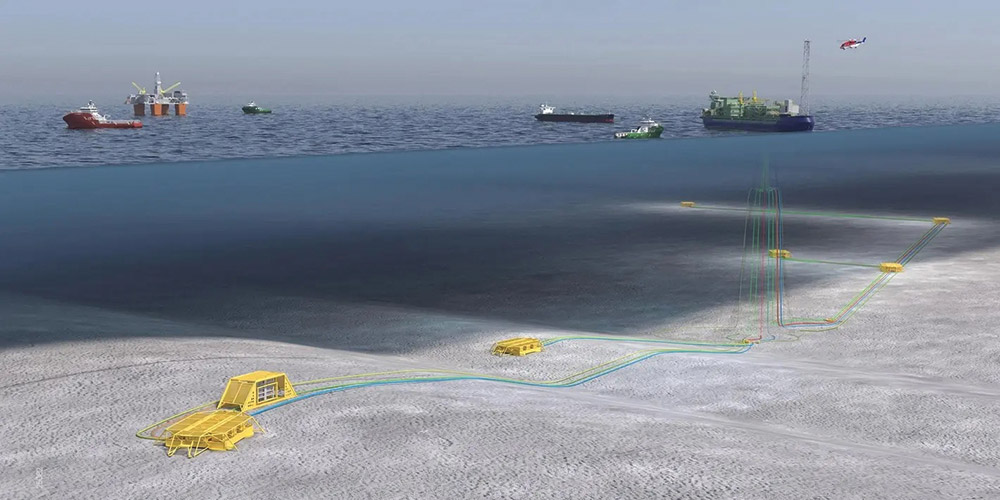
Image courtesy of Equinor
Equinor and BP, partners in the paused $10.25-billion Bay du Nord floating oil drilling project off the coast of Atlantic Canada, last month announced a framework agreement with the province of Newfoundland and Labrador to propel restart of development.
A final investment decision is eyed for 2027, with the first oil to be produced in 2031. “It represents a generational opportunity for Canada’s offshore—one that could open a new deepwater basin and shape the province’s energy industry for decades to come,” said Equinor in a statement.
The Norway-based energy company describes the project as a phased subsea development tied back to a floating production, storage and offloading vessel (see diagram above).The Bay du Nord oil field, discovered in 2013 in the Flemish Pass Basin, has about 430 million barrels of recoverable oil in its initial phase. Owners halted project development in 2023 for up to three years, citing uncertain market conditions and inflation, and worked to cut costs.
A front-end design and engineering contract was awarded to a KBR unit in Canada and Ontario-based Hatch Ltd. Bay du Nord is the first such project outside the country’s exclusive economic zone, and its first in deep water, located about 500 kilometers east of St. John’s, Newfoundland, in water depth between 600 and 1,200 m, owners said.
Bay du Nord is Canada’s first “life-of-field benefits agreement for an oil and gas project, to help ensure benefits continue throughout the project’s 25-year life, not just during development,” said the developers. Under the agreement, the project is set to generate more than 31 million work-hours over 25 years, giving the province preference in contracting, procurement and hiring, as well as a project equity stake of up to 10% and $4.6 billion in direct revenue in the first phase.
It also has targets to employ skilled trade apprentices—10% for construction and 15% for onshore operations—and a commitment of at least 1.9 million work-hours in engineering, project management and procurement management, says a project fact sheet.
A minimum of 95% of Bay du Nord subsea components also must be fabricated in Newfoundland and Labrador, with about $143 million earmarked to build a floating dry dock for ships weighing more than 18,000 metric tons, which the province would own. The project also has committed about $72 million to research and development.
Separately, the federal government has agreed to an unspecified level of compensation to cover U.N. project fees estimated by media to be more than $720 million, since Bay du Nord work will be in international waters. Payments, to begin after five years of production, are opposed by environmental advocacy groups and others concerned about spill risks and lack of public hearings related to use of federal tax dollars. The project gained government environmental approvals in 2022.
“Further work is required before determining the potential financial contribution associated with this project,” a spokesman for Finance Minister François-Philippe Champagne told Canada Press. “Any payment … would be subject to negotiations.”
Intensifying Regional Conflicts
Amid the ongoing U.S. and Israeli war with Iran, Simonson says its potential impact on the U.S. economy is uncharted territory.
“I don’t think we can generalize or count on past episodes as being similar to this one,” he says. “What’s unique about this is so much of the world’s oil and gas capacity, as well as some other things like fertilizer and aluminum, are now blocked,” referring to Iran’s closing of the Strait of Hormuz.
“Even after hostilities end, I’m reading it will take a long time to restore [shipment operations], so it’s a more severe effect on the global economy than it is on the U.S.,” Simonson says, adding that the U.S. is “fortunate that we have so much oil and gas.” However, “oil and fertilizer are globally traded commodities, so we will feel price effects from that, and, to a lesser extent, from what happens with oil and natural gas and the plastics that are made from it.”
As for how it all translates to project owners, Simonson says he predicts they will hold off on commitments. “We want to see how severe this damage is to the global economy, or the U.S. economy, in terms of our consumers losing buying power. Are they going to have to tighten their spending on the things that we thought they would come to our facility for?” he asks.
Simonson says lodging and some types of entertainment facilities have the most exposure to impacts, and owners in those sectors will “be looking at what their revenue base is and is that going to shrink because U.S. consumers are spending more on gasoline and food? Or [they] depend on visitors from the Middle East or from East Asia, and those folks are suddenly seeing a big loss in income. So they’re not going to come spend a week at a resort.”
Simonson predicts the manufacturing sector could also see growth impacted by the regional conflict.
“If they had been exporting successfully, they may say, ‘Wait a minute, my growth prospects in Europe have really dropped off.’ Or, ‘I can’t export to the Emirates anymore or other countries that are cutting back their spending because they don’t have enough fuel to do things and so forth,” he says. “So I think export-facing manufacturers also are going to be holding back.”
Market in Focus:Transportation | By Jim Parsons
Municipal Corporation Pushes $7B Austin Rail Project Start
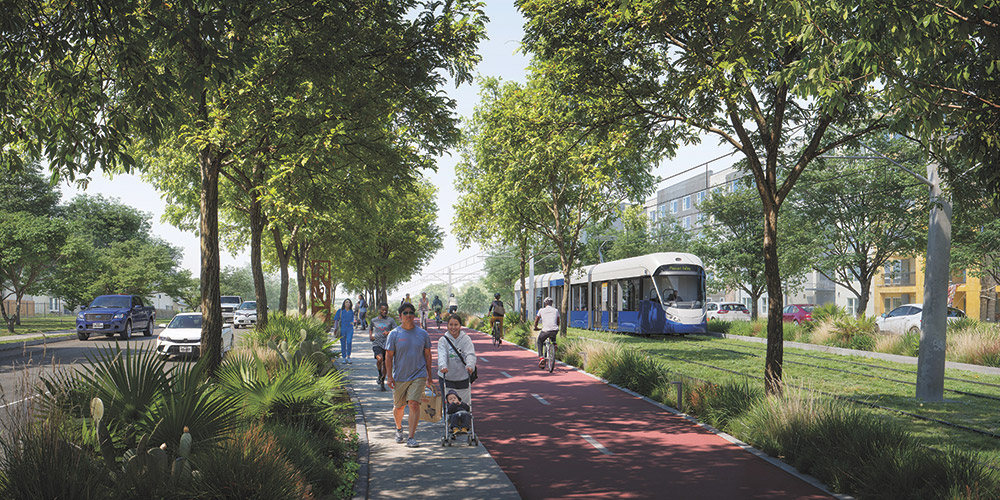
Image courtesy of Austin Transit Partnership
More than five years after being endorsed by voters as part of a comprehensive regional transit program, the initial phase of the still-controversial light rail system in Austin, Texas, run by an independent municipal corporation is progressing toward starting construction in 2027.
In February, Austin Transit Partnership, created in 2020 by the city and Capital Metro to implement the sysem, selected a joint venture of Stacy Witbeck and Sundt Construction as contractor for the 10-mile, 15-station project under a two-phase progressive desig-build procurement. Design, and permitting work for the building team, known as Austin Rail Constructors, will be led by a joint venture of Mott MacDonald and Stantec. Reports cite two other bidding teams, whose members were not disclosed.
The team’s initial $60-million contract calls for finalizing design and beginning pre-construction work, with an eye toward having a construction schedule in place by the end of this year.
Austin Transit Partnership says it will work with the design-build team over the next several months to incorporate community input to refine the project’s scope, schedule, cost, constructability and design innovation.
As design advances and construction packages are authorized, the contractor team will competitively bid portions of the work, with total construction costs expected to top $4 billion. At completion, the light-rail line would have 15 stations and all-electric trains arriving as frequently as every five minutes.
The selection comes one month after the Federal Transit Administration issued its Record of Decision for the line’s final environmental impact statement, allowing Austin Transit Partnership to continue efforts to secure federal support for more than half of the estimated $7-billion initiative, including New Starts grants and a Transportation Infrastructure Finance and Innovation Act loan.
Austin Transit Partnership officials told local media that they don’t expect any funding agreements to be finalized until late 2027 or early 2028, after construction is set to begin. Although the funding is far from assured, the owner corporation notes in a statement that the environmental review process was completed in less than two years, “aligning with the current transit agency goal to streamline and improve how large public infrastructure projects are delivered.”
Other obstacles may further complicate Austin Transit Partnership’s plans to begin light rail operations in 2033, including a lawsuit contending that the current project, downsized from its original 20-mile plan, no longer meets the conditions of the original public vote. The owner partnership must also receive approval to issue bonds to help fund its share of the project.
For now, the owner entity aims to sustain its progress with anticipated selection in April of a contractor for the light rail system’s operations and maintenance facility, which also will be delivered using progressive design-build.
Vying for Resources
Amid AI data center growth across the U.S., power companies and data center operators are increasingly vying for the same pool of skilled technical workers, wrote Deloitte analysts in a March 31 research insight.
The research and professional services firm estimates that data center power demand will jump to more than 176 GW in 2035, from 47 GW in 2025. However, according to Deloitte’s research, “the buildout of power and data center infrastructure depends on some of the same core workforce,” including computer specialists, engineers, technicians, power plant operators and line workers. The analysts add that “rising competition in hiring for those roles is emerging as a strategic risk” for the AI buildout.
After examining U.S. job postings from 2023 through 2025 across power companies and data center developers, Deloitte found that the roles “represent more than 40% of the existing workforce in power companies and data centers.” According to the firm, more than one-third of new postings targeted the same set of workers, “underscoring the degree to which both sectors now lean on the same talent pool.”
The Construction Users Roundtable Executive Vice President Greg Sizemore says there is a challenge from “top to bottom” across the construction industry that is as much a problem for owners as it is for construction contractors.
“It used to be that these data centers,or even a billion-dollar project, was considered a megaproject. Now it’s commonplace,” says Sizemore. “All fantastic, right? Creates jobs, but the challenge is we can’t build well what we’re doing right now in terms of workforce availability. So you add these additional billion-dollar projects, or another $400-million project from another owner that’s setting up, and you’ve got a real problem. The easy button would be to throw it over the fence and say, ‘Not my problem; contractor’s problem.’ But it is the owner’s problem.”
Balancing Risks vs. Rewards
While some projects have dealt with labor woes by offering “more money” to attract workers, not all owners are in that position. “Who loses? The owner. Who wins? The contractor and the work for the worker. They just get more money, and they’re in a bidding war for talent,” says Sizemore. “Some owners capitulate and say we’ve got a must-go project. This is mission critical. This is business critical. So we’ll do what it takes to get us there.”
Amid limited labor resources, Simonson predicts megaproject timelines will need to be stretched out to account for longer material lead times and labor availability.
Expedited project environmental review “aligns with the current agency goal to streamline … how large public infrastructure projects are delivered.”
— Austin Transit Partnership
“While the hyperscalers want them done as soon as possible, that’s just not in the cards when you have long lead times for getting power connected, or the HVAC or plumbing that is needed for these data centers, or the battery backup and generator backup,” says Simonson. “All of these things are likely to face longer lead times and therefore stretch out the completion dates and keep contractors busy for longer.”
Labor availability has been a “never-to-be-solved issue” for the construction industry says Sizemore, adding that technology has only increased the complexity for owners.
“It’s the wild wild west when it comes to AI,” says Sizemore. “I think the owners are somewhat dismayed by the proliferation of available technologies to help them do everything in the world and without a clear protocol for decision-making when it comes to that. Why are they so concerned? They realize that technology can help improve productivity and output. Where is that needed? From the top to the bottom.”
He adds, “And owners, with 100 things to do for their company, are going, ‘How do I make a decision of what’s best for me?’”
During Nvidia’s developer conference, Jacobs’ Data Center Digital Twin offering—available in the Nvidia Omniverse DSX Blueprint and libraries—was mentioned as a speed-to-market solution that enables developers and owners to plan, simulate and optimize gigawatt-scale AI data centers in a virtual environment. According Jacobs, the solution improves time to first revenue, efficient energy performance and resilient long-term operations.
In the Texas-based engineering solutions firm’s first-quarter financial update, CEO Bob Pragada said construction projects tied to AI infrastructure were major “growth engines.” His comments echoed similar sentiments by Skanska, WSP Global and Fluor during their respective Q1 earnings calls—all underscoring the AI boom’s wide-reaching impact, says ABC’s Basu.
“These are often investments that are very large in the short term, and the benefits from that investment transfer over very long-term, could be over the course of decades,” he says. “So you need confidence to expend that kind of capital in the short term. Right now, because of all this uncertainty regarding the near-term and the intermediate-term future, not as much construction work is moving forward. Yet Basu says the pull of artifical intelligence is “so overwhelming that the hyperscalers move forward nonetheless.”
He adds, “We live in an interesting time.”