ENR 2026 Top Professional Services Firms Deepen Depth of Services
June 17, 2026
ENR 2026 Top Professional Services Firms Deepen Depth of Services
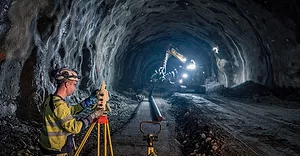
June 17, 2026WSP is Virginia Dept. of Transportation owner’s representative on the $3.9B Hampton Roads Bridge Tunnel expansion project. Designed to nearly double capacity along the Interstate 64 corridor, it includes the state agency’s first bored tunnel and features twin 46-ft-dia tunnels.


Related Links:
ENR 2026 Top 100 Professional Services Firms
ENR 2026 Top 50 Program Management Firms
View Full List with Data and Analysis (PDF)
(Subscription Required)
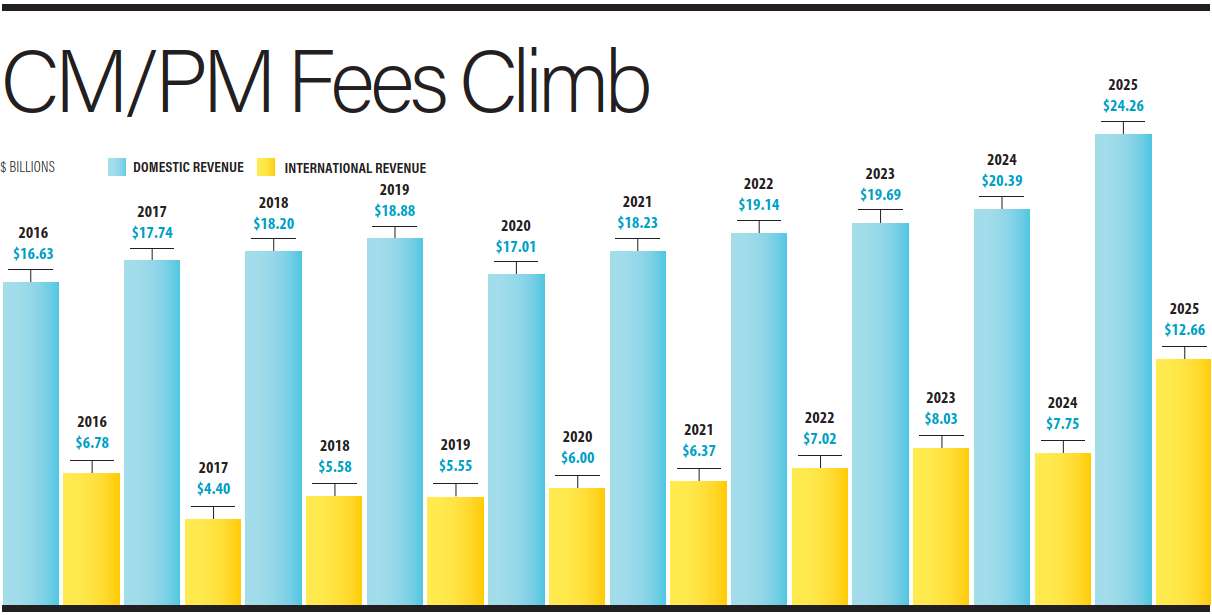
The AI boom’s rising tide has lifted business prospects for Top 100 Professional Services Firms based on this year’s reported $36.9 billion in combined revenue for CM/PM-for-fee services—up 31.2% from last year. But such gains aren’t without risks, firm execs noted in comments to ENR. Facing rapidly shifting owner needs, companies are building capacity to drive more success.
Domestic revenue for Top 100 Professional Services Firms increased 19% to $24.3 billion from 2024 to 2025. Outside the U.S., Top 100 international revenue rose 63.4% to $12.7 billion. Moreover, revenue for both the Top 50 construction management-for-fee (CM) firms and Top 50 program management-for-fee (PM) firms increased, climbing 25.1% and 35.7% respectively.
Behind the Numbers
At the operational level, many high-ranking firms are also driving revenue growth via mergers and acquisitions, internal restructuring and consolidation of regional divisions. In January 2025, Turner & Townsend combined business with its Dallas-based parent company CBRE’s project management division, creating a unified entity that operates as Turner & Townsend; the company is ranked No. 1 on this year’s Top 100 list. CBRE was last ranked on ENR’s Top 100 list in 2023.
Similarly, Mace, ranked No. 8, completed a demerger and divestment announced last year from its U.K.-based contracting parent Mace Group. Backed by a majority investment from Goldman Sachs, Mace CEO Davendra Dabasia tells ENR that the now New York-based firm’s priority is to shore up regional resources that reaffirm its independence. On the subject of potential acquisitions, Dabasia added, “We’ve got an operating model, which is about the six markets that we work in, where we’re going to focus our energies to make sure that we could find the right companies that give us complementary markets.”
Overall, most Top 100 Professional Services Firms saw an uptick in their revenue in 2025. Median Top 100 revenue came in at $83.5 million, up 16.7% from $71.6 million on last year’s list. Of the 92 firms that filed both this year and last, 69.6% reported increased CM/PM-for-fee revenue on this year’s survey.
As data center hyperscalers such as Microsoft, Meta, Alphabet and Amazon Web Services pool construction resources for the buildout of artificial intelligence (AI) infrastructure, Crede Chief Operating Officer Mark D. Fergus says there is an opportunity for larger firms to gain access to key markets through consolidation. “Conversely, this is creating an opportunity for the emerging middle market providers to grow and maintain the personal touch in delivery to clients outside these areas,” says Fergus. Crede is ranked No. 66 this year.
Accenture, ranked No. 7, says acquiring a majority stake in AI data center engineering and consulting firm DLB Associates expanded its design and commissioning capabilities in the market. U.S. Infrastructure and Capital Projects Lead Adam Shaw adds that the firm bought construction consultant Soben to expand its deep cost and schedule capabilities. “The dynamics in the data center market are showing more broadly—especially across power, utilities, water, permitting and federal funding—where many of the real constraints sit,” says Shaw.
Navigating a Two-speed Economy
With data center hyperscalers expected to invest $725 billion in capital expenditures this year—and an estimated $7 trillion by 2030—some economists warn that a two-speed economy is emerging as rising inflation, materials prices and worker shortages shelve some projects while AI-related projects push forward.
Looking for quick answers on construction and engineering topics?
Try Ask ENR, our new smart AI search tool.
Ask ENR →
“Construction input prices surged again in May and are now up nearly 10% year over year,” said Associated Builders and Contractors Chief Economist Anirban Basu in a recent update on construction materials prices. “Contractors remain optimistic that their profit margins will expand over the next six months, according to ABC’s Construction Confidence Index, yet it appears likely that materials price escalation and stubbornly high borrowing costs could eventually weigh on profitability.”
The U.S.-Israel-Iran war adds another layer of complexity to market challenges as a key cause of volatile materials price fluctuations. Basu added, “Oil prices, pushed higher by the ongoing Iran conflict, made a significant contribution to the rise in overall materials prices, yet the greater concern is the continuing price growth in tariff-affected inputs like iron, steel and copper.”
According to the World Bank, fallout from the Iran conflict in the form of increased economic uncertainty and high energy prices will stunt global economic growth expected to be at 2.5% from an originally forecasted 2.9%—the weakest since shutdowns tied to the COVID-19 pandemic. However, the World Bank predicts that the U.S. economy will be mostly spared from the war’s effects, forecasting that America’s economy will experience 2.2% growth, unchanged from a forecast made in January, and up from 2.1% last year.
For professional services firms, it’s a changed market, says Chowdhary S. Gondy, principal and executive vice president at CES Consulting, ranked No. 77. “Winning work now often hinges on demonstrating proven delivery at speed, deep familiarity with standards and the ability to mobilize integrated teams quickly,” he adds.
Scaling Up Resources
In a 2024 report, the U.S. Dept. of Energy found that data centers consumed around 4.4% of total U.S. electricity in 2023 and are expected to account for between 6.7% and 12% of power consumption by 2028. Goldman Sachs Research estimated data center power use will reach 8.5% by 2027.
Gondy says that projected surge in power demand has already created an increased need for skilled labor and expertise in related sectors, adding that it has “tightened the market for certain disciplines—power systems, mission-critical MEP, structural, and commissioning expertise in particular.”
The result is “increased competition for specialized staff,” adds Gondy, driving up compensation, making resource planning more complex, “with firms needing to be selective about which data center clients and regions they target, and how they balance that work against public-sector and infrastructure commitments.”
Cumming Group President and CEO Derek Hutchison adds that demand for data center-related experience has also increased competition for talent among firms. The firm is ranked No. 12.
“These are highly specialized projects, and the pace of investment, which is driven in large part by AI and cloud infrastructure, has outstripped the industry’s ability to develop talent at the same rate,” he says. “As a result, we’re seeing increased competition not just for work, but for people with the right experience to deliver it successfully.”
From a client perspective, Hutchison says such a dynamic is reinforcing the importance for professional services firms to bring proven expertise to projects.
“Owners are placing greater value on partners who have a track record in the sector and can bring experienced teams from day one,” he says. “Our approach has been to build that capability over time. This enables us to respond quickly and credibly to new opportunities, rather than needing to build teams reactively in a rapidly expanding market.”
Raleigh, NC Expanded Convention Center Gets Permanent Theater By Jonathan Keller

Image courtesy of Cumming Group
Cumming Group (No. 12), along with partner Cate Services, is owner’s representative on the $387.5-million expansion of the Raleigh Convention Center in Raleigh, N.C. It is being built by the JV team of Clancy & Theys, Skanska and D.A. Everett. The project includes expansion and relocation of the adjacent Red Hat Amphitheater one block south. Originally added as a way to make productive temporary use of land earmarked for the convention center expansion, the amphitheater proved so successful that a permanent home was incorporated into project plans. The relocated venue topped out on May 26.
Reevaluating Owners Needs
More broadly, Hutchison says Cumming Group is seeing owners award more work to “firms that can combine sector specialization with the ability to scale resources effectively, which is becoming a key differentiator in how work is awarded.”
At MGAC, ranked No. 23, Founder and CEO Mark Anderson says he has not seen such an intense level of accelerated demand for data centers in his 30 years in the construction industry. “But while opportunity is abundant, the reality is that firms can only win and deliver as much work as their people allow,” he says..
Anderson adds that specialized talent is the most “constrained resource, so “winning work today is less about how much opportunity exists and more about whether a firm has the right people in place to execute at scale without compromising quality.”
For professional services firms to deliver projects, Anderson says long-term success is a matter of “balancing growth with discipline—pursuing work strategically, investing in specialized talent and ensuring we can deliver consistently at the level our clients expect. In today’s data center market, capacity and capability are the true differentiators.”
As owners’ needs shift, Hill Advisory President J.P. Villamizar says the firm is now asking more questions about clients’ front-end capital planning, “transactional due diligence, proactive commercial structuring, executive PMO, technology and long-term portfolio management approach.” The firm, as part of Hill International under GISI Consulting Group, is ranked No. 11 this year.
Owners at the helm of data center development projects are looking for partners that provide speed and certainty in light of increasing labor and equipment constraints, says Accenture’s Shaw. “That means delivering programs across multiple sites, providing clear end-to-end visibility and control, and bringing integrated capabilities across the full asset lifecycle.”
At PMA Consultants, ranked No. 52, Managing Director of Operations Amanda DavyRomano says the scale of conversations with owners has evolved.
“Today, we are spending more time understanding the ‘why’ behind the project,” she says. “We are asking what business objective the project is intended to support, what problem it is solving and how the owner plans to define success.”
The executive adds that supply chain and procurement risk have also become “much more prominent discussion points,” explaining that owners are looking for earlier visibility into risk amid uncertainty around lead times, materials availability and pricing volatility.
Evolving Operations
As market conditions evolve and owners’ needs shift, Top 100 Professional Services firms say such developments are also opening doors for more use of new technology such as AI and to reevaluate its value proposition for recruiting and retaining a healthy workforce pipeline.
“The labor market is likely to remain competitive over the next year, particularly for skilled craft professionals, technical specialists and experienced leaders needed to deliver increasingly complex projects,” says Mortenson Executive Vice president Maja Ericksen. “As demand continues across sectors, attracting and retaining these skillsets will require employers to offer a more holistic and compelling value proposition.”
For the ranked No. 72 firm, Ericksen says its approach has been to ensure it can expand benefits for craft team members to better support their long‑term well‑being, financial security and career sustainability. He adds, “These enhancements reflect our belief that our craft professionals are part of who we are as a builder.”
Consertus CEO Roy Block says the ranked No. 22 firm has adopted AI, “but in very targeted, high-impact ways.” He explains, “At the corporate level, AI drives efficiencies across our shared services functions. On the project side, we’re applying it to project management activities, cost control and compliance workflows.” Block says Consertus’ takeaway is that meaningful efficiencies are achievable via AI, “but they require much deeper thinking and more substantial technical effort than most people initially envision,” he says, adding, “There are no shortcuts. The firms that invest seriously in implementation will be the ones that pull ahead.”
At WSP, ranked No 13, U.S. President Joe Sczurko says the company evolved the most last year in how it integrates technical capabilities to deliver value. “However, what is much more important to our clients is the value we bring in delivering integrated solutions,” he says.
As AI adoption accelerates, firms that can clearly define its place in their operations will lead, says Ryan Cross, director of global transmission, distribution and grid automation practices at Actalent Services, ranked No. 58.
“Over the next year, companies will continue to hire for roles that either rely lightly or heavily on AI use,” Cross says, adding that “clearly communicating required skill sets will be essential to attracting the right talent.”