News Analysis
Municipal Water and Sewer Capacity Constrain DHS Detention Buildouts
Design ceilings, 80% planning thresholds and downstream sewer hydraulics emerge as critical factors in high-occupancy warehouse conversions
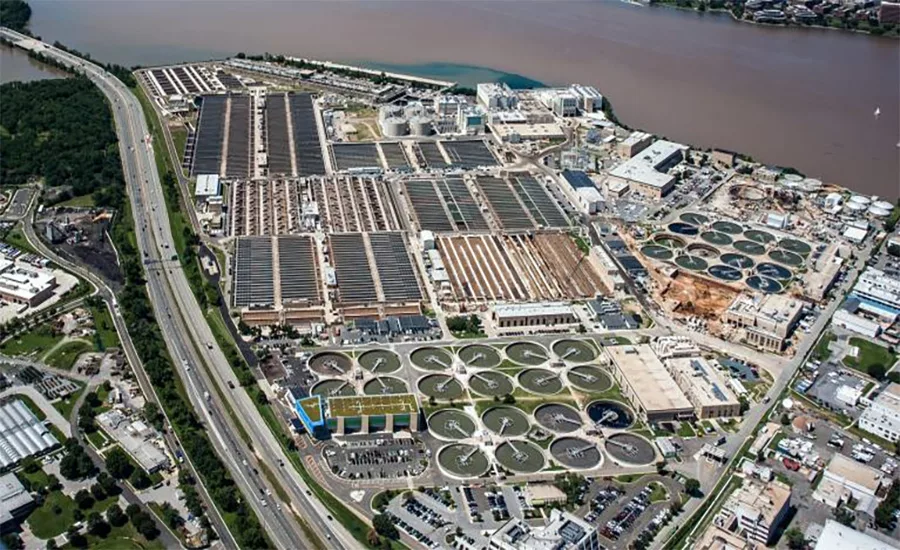
DC Water’s Blue Plains Advanced Wastewater Treatment Plant in Washington, D.C., treats nearly 300 million gallons of wastewater per day. Municipal plants are engineered around specific design capacities and peak-day margins — limits that can shape how communities evaluate proposals for large, high-occupancy facilities.
When federal officials moved this winter to purchase a vacant warehouse at 50 Robert Milligan Parkway in Merrimack, N.H., for conversion into an immigration detention facility, local resistance quickly centered on infrastructure.
Municipal officials argued that the town’s water and wastewater systems were not engineered for a sudden, high-density institutional occupancy layered onto infrastructure already operating near peak conditions.
The Merrimack Village District’s maximum daily water production is 3.8 million gallons per day, according to confirmation from the N.H. Dept. of Environmental Services. A prior sanitary survey reported peak-month average demand of 3.7 mgd, indicating the system has operated close to its production ceiling during high-demand periods.
On the wastewater side, Merrimack’s treatment plant has a design capacity of 4.8 mgd under its NPDES permit. A 2024 permit modification reports a recent maximum daily flow of 4.1 mgd. That leaves roughly 0.7 mgd of peak-day margin between observed flow and the plant’s permitted design capacity.
Utility engineers size systems for maximum daily conditions and wet-weather events, not just annual averages. Planning for expansion often begins well before a facility reaches its permitted ceiling.
In Colorado, for example, the state health department requires wastewater utilities to begin planning expansion once sustained flows reach roughly 80% of design capacity and to initiate construction at about 95%, according to engineering firm Stantec’s review of state policy—illustrating how capital programs are typically triggered by sustained proximity to design limits rather than permit violations alone.
Although DHS ultimately withdrew from the Merrimack site—after significant community resistance and talks with state officials— infrastructure concerns raised there are emerging in other communities where the agency has pursued warehouse acquisitions as part of a broader detention expansion effort.
Looking for quick answers on construction and engineering topics?
Try Ask ENR, our new smart AI search tool.
Ask ENR →
RELATED
Proposed ICE Warehouse Conversion in Merrimack, N.H., Raises Early Construction Uncertainty
From Local Dispute to National Pattern
Across the country, coverage of those disputes reflects a recurring theme: local governments say they often lack sufficient information to fully assess impacts on sewer, water and other public services before federal plans advance.
“Communities fighting ICE detention center conversions say they lack the time or tools to fully assess impacts on local services such as sewer, water and emergency infrastructure,” Stateline reported in a national review of the disputes, adding that the federal siting effort has raised “questions about how federal facilities fit into local planning frameworks.”
National reporting has documented that federal officials have explored or pursued warehouse acquisitions in multiple states as part of efforts to expand detention bed capacity, often targeting large industrial buildings not originally designed for residential-scale occupancy. That approach can compress the timeline for local utility review, particularly when municipal infrastructure planning typically unfolds over multi-year capital improvement cycles rather than rapid conversion schedules.
RELATED
Proposed ICE Detention Center in New Hampshire Draws Criticism from Massachusetts Governor
Small-System Scale and Proportional Impact
In Social Circle, Ga., local officials publicly cited sewer and water limitations in response to a proposed detention facility tied to a warehouse acquisition. The city’s Little River wastewater treatment plant has a permitted design capacity of 0.90 mgd, according to its draft NPDES permit package. On the drinking-water side, the city’s annual water quality report states the treatment plant “can produce one million gallons per day.”
Those figures place Social Circle’s municipal systems below 1 mgd on both the water and wastewater sides—a scale that magnifies proportional impacts.
For context, in Maryland litigation over a proposed 1,500-bed detention conversion near Williamsport, the state alleges that such a facility would generate approximately 90,000 gallons per day of wastewater, compared with about 24,768 gallons per day under warehouse-use assumptions.
A minimal increase of 0.09 mgd would represent roughly 10% of the total design capacity at the Social Circle plant.
Whether Social Circle’s system could absorb that increment would depend on its existing average and peak flows. But the arithmetic illustrates how institutional-scale occupancy can consume meaningful portions of available hydraulic margin in small municipal systems.
When Collection Lines, Not Plants, Become the Constraint
In Washington County, Md., the debate has centered less on treatment-plant capacity and more on collection infrastructure.
The state’s complaint challenging DHS’s purchase of an 825,620-sq-ft warehouse for conversion into a 1,500-bed detention facility alleges that the property is served by a 6-in. lateral connecting to an 8-in. sewer main and that those lines may be insufficient to handle the increased load. The complaint projects wastewater generation of approximately 90,000 gallons per day for detention use.
Washington County’s Conococheague wastewater treatment plant in Williamsport has a 4.1 mgd capacity and historical flows are well below that limit. Rather, state officials argue that localized pipe hydraulics, not plant capacity, is the bottleneck.
National reporting has underscored how rapidly the warehouse-to-detention strategy has advanced. The Washington Post reported that federal officials have explored or pursued warehouse acquisitions in multiple states, often with limited public disclosure about operational details or infrastructure demands before local leaders are asked to respond.
Across the three cases, infrastructure friction manifests differently.
| Community | Proposed Facility Scale | Water System Capacity | Wastewater Design Capacity | Reported Flow / Load | Key Constraint Issue |
|---|---|---|---|---|---|
| Merrimack, N.H. | ICE warehouse conversion (beds not formally filed) | 3.8 MGD max daily production; 3.7 MGD peak-month avg demand | 4.8 MGD | 4.1 MGD recent max daily flow | Peak-day water margin; wastewater peak headroom approx. 0.7 MGD |
| Social Circle, Ga. | Detention conversion discussed locally | 1.0 MGD water plant capacity | 0.90 MGD | Approx. 0.09 MGD incremental load (90,000 gpd reference) | Small absolute system scale; proportional demand impact |
| Washington County, Md. (Williamsport) | 1,500-bed detention facility (per complaint) | Regional system (not central dispute) | 4.1 MGD (Conococheague WWTP) | 90,000 gpd projected detention flow vs. 24,768 gpd warehouse baseline | Collection-system constraint (6-in lateral to 8-in main) |
The common denominator in each is typology.
Modern logistics warehouses are designed for low-occupancy industrial use, with plumbing and domestic water demand assumptions far below those of residential or institutional facilities. Converting those structures into 24-hour detention centers shifts them into a fundamentally different hydraulic demand class.
Hospitals, prisons and large residential developments typically undergo detailed utility impact reviews and phased capacity allocations before construction. Warehouse conversions executed under federal authority can compress those timelines, limiting local review and heightening concern about how incremental demand will be absorbed.
Even where individual projects stall, as in Merrimack, the underlying engineering question persists: how much additional institutional load can existing municipal water and wastewater systems accommodate before design margins, peak-day thresholds or collection constraints require upgrades?
For utilities measured in tenths of a million gallons per day—or for systems already operating near seasonal peaks—that question is not abstract, it's arithmetic.

Bryan Gottlieb is the online editor at Engineering News-Record (ENR).
Gottlieb is a five-time Society of Professional Journalists Excellence in Journalism award winner with more than a decade of experience covering business, construction and community issues, including finance, law and real estate. He has reported for Adweek and the San Diego Daily Transcript and led a community newsroom in Santa Monica, Calif. He served as editor-in-chief of the Detroit Metro Times and as managing editor at Roofing Contractor, where he helped shape national industry coverage. At Engineering News-Record, Gottlieb covers breaking news, large-scale infrastructure and megaprojects, regulatory developments and business trends across the U.S. and global construction sectors.
email: gottliebb@enr.com | office: (248) 786-1591