Federal Review
White House Ballroom Project Heads to Vote by National Capital Planning Commission
Elevations quantify height versus the Executive Residence, while foundations proceed and litigation challenges the project’s legal authority
Updated 4:04 PM EST
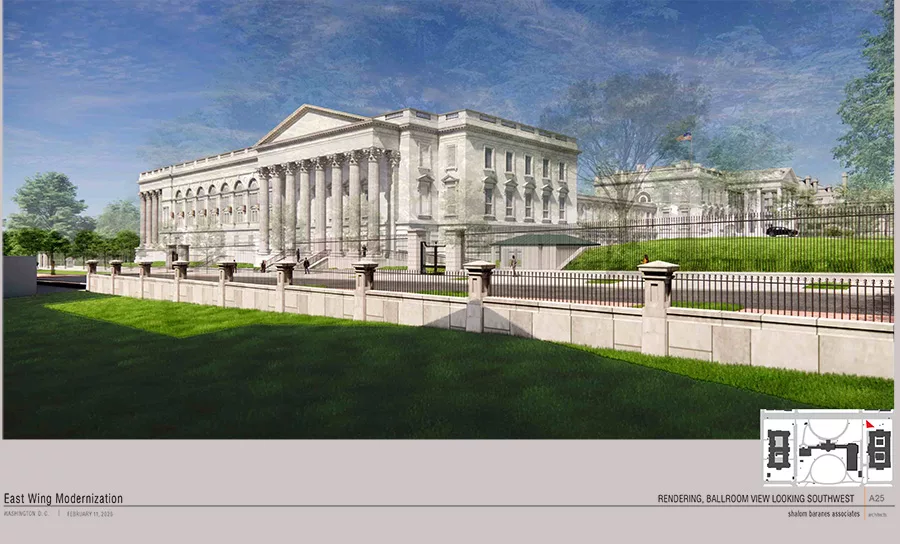
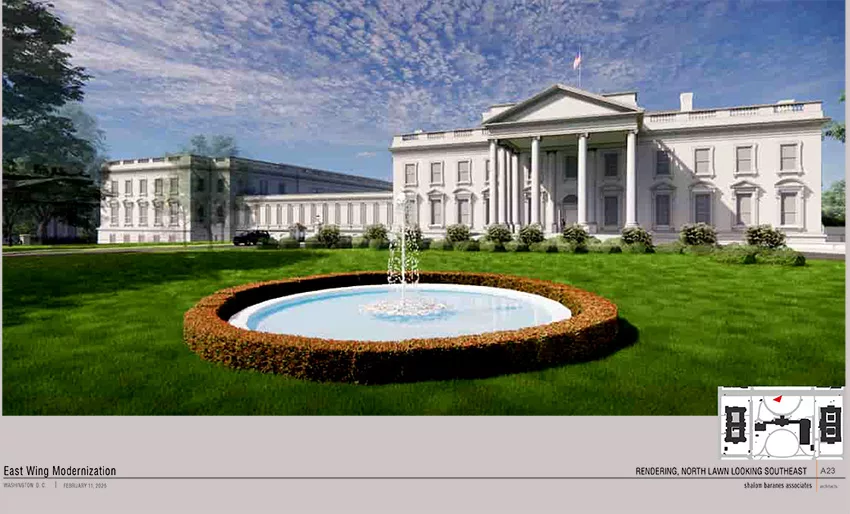
The U.S. Commission of Fine Arts voted Feb. 19 to approve the White House State Ballroom at the concept level, clearing a key federal architectural hurdle as the project advances toward a March 5 vote before the National Capital Planning Commission.
President Donald Trump said in a post on Truth Social that the Commission approved the ballroom 6–0, with one commissioner recusing due to prior professional involvement. The Commission has not yet posted its formal Record of Action from the meeting.
.jpg "Site-Elevation---North-South-(2)")
North and south site elevation renderings submitted to the National Capital Planning Commission show the proposed White House State Ballroom (circled) sitting below the roofline of the White House Executive Residence.
Rendering courtesy of National Capital Planning Commission
The ballroom was reviewed under docket CFA 19/FEB/26-1 at the concept level, according to the published meeting agenda. Concept approval does not authorize construction.
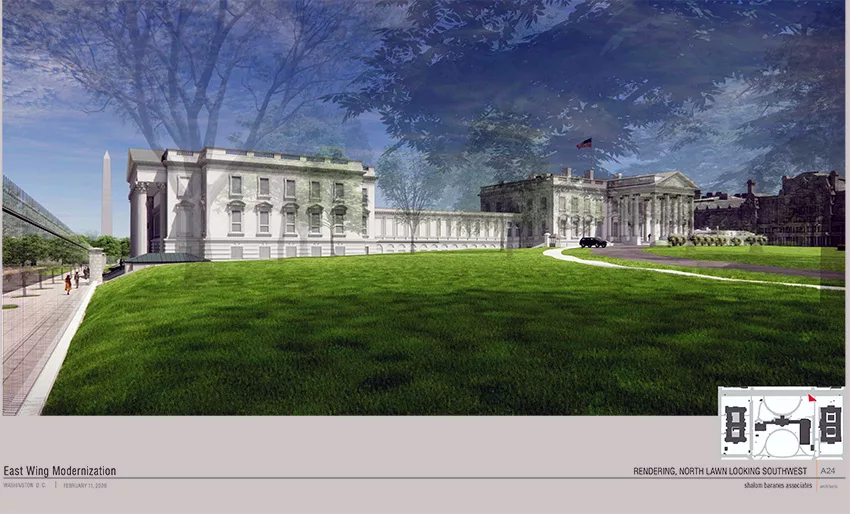
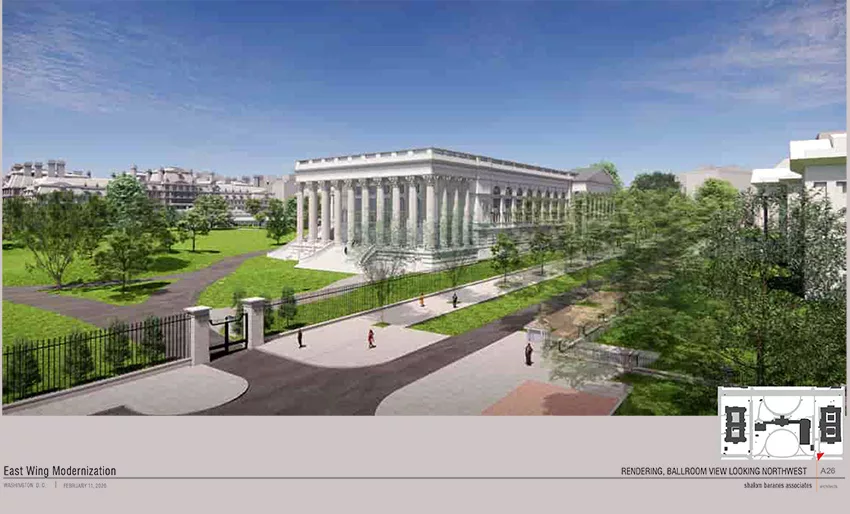
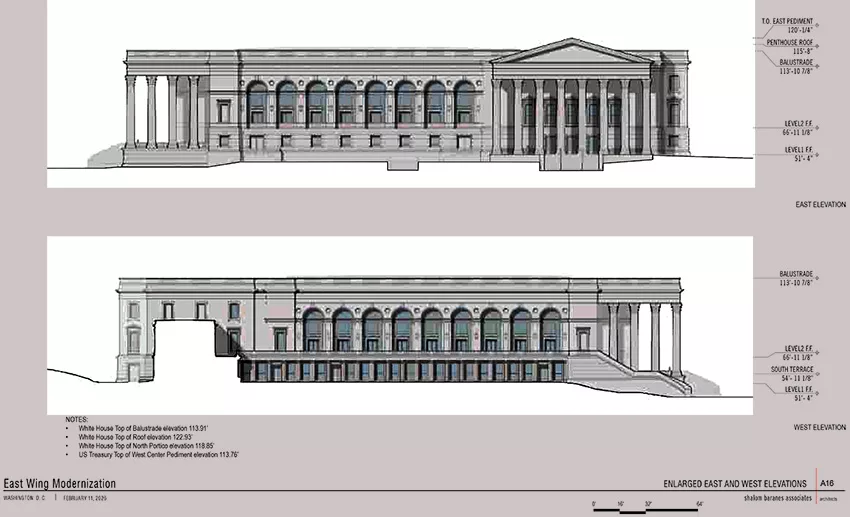
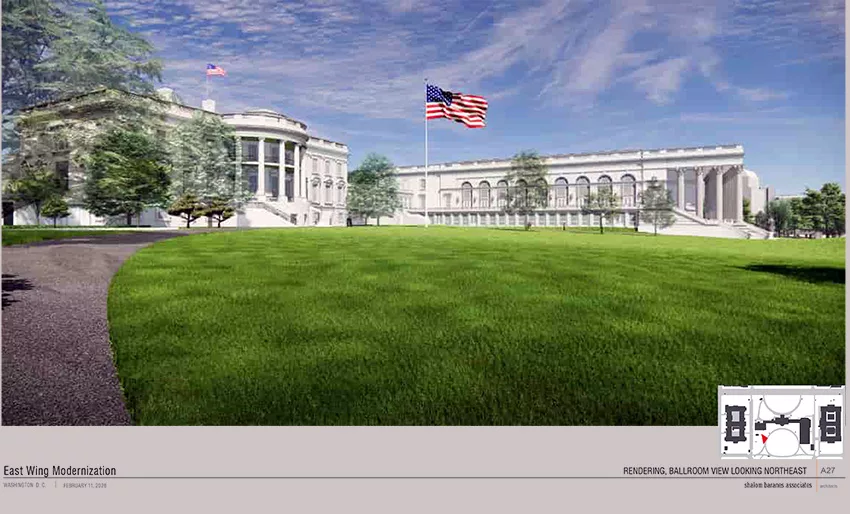
Submission materials filed ahead of the upcoming NCPC vote show the proposed ballroom roof at approximately 88 ft, 11 in. above finished grade, compared with 113 ft, 11 in. at the White House balustrade and 122 ft, 11 in. at the roof ridge of the Executive Residence. In profile, the ballroom would sit materially lower than the historic structure it adjoins.
Sixteen simulated views from vantage points, including Pennsylvania Avenue, Lafayette Square, the Ellipse, the U.S. Capitol and the Jefferson Memorial model the project’s visibility across Washington’s monumental core.
The materials were submitted in response to earlier requests from federal design reviewers for additional context on scale and sight lines.
Looking for quick answers on construction and engineering topics?
Try Ask ENR, our new smart AI search tool.
Ask ENR →

Screenshot courtesy of Truth Social
By placing the ballroom roof more than 20 ft below the White House balustrade and more than 30 ft below the main roof ridge, the design seeks to preserve the Executive Residence's visual dominance in long-range views. Federal design review typically evaluates whether new construction competes with or recedes from historic massing.
The Commission’s action addresses architectural compatibility, height and massing. Final site and building plan approval within the National Capital Region rests with the NCPC; above-grade construction requires NCPC approval.
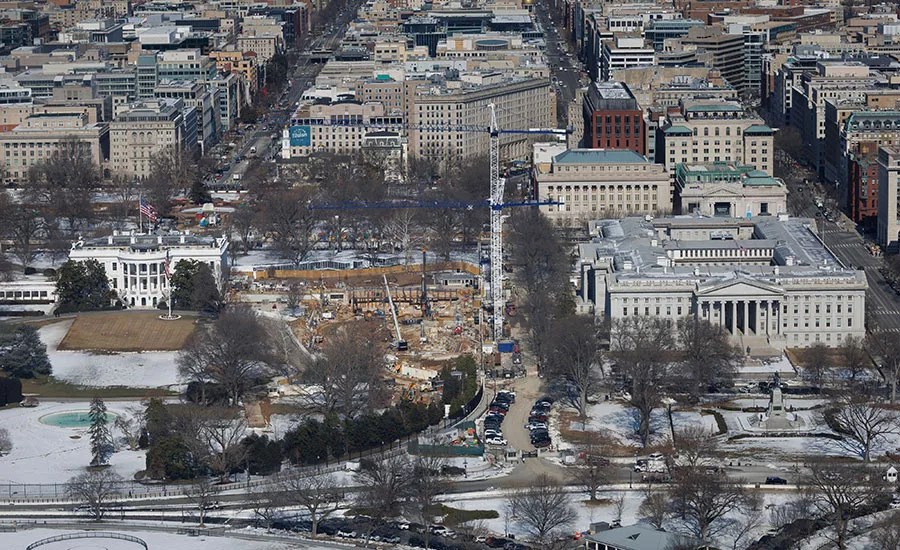
Demolition of the former East Wing was completed last fall. Subsurface work has proceeded under the administration’s interpretation that NCPC jurisdiction attaches at “vertical build.”
In sworn declarations, National Park Service liaison John Stanwich stated that excavation was underway and that footings and structural concrete were expected to begin in January and February.
Below-grade foundation work is advancing while above-grade architectural massing remains under review. Satellite imagery reviewed Feb. 18 shows no visible vertical construction at the site. Above-grade construction has not begun.
The vote follows earlier requests by the U.S. Commission of Fine Arts for additional contextual materials and 3D modeling to assess massing and campus fit.
RELATED
Private Funding May Deliver Trump’s White House Ballroom—but What Pays for the Rest?
CFA Review Under Reconstituted Panel
President Trump dismissed all six CFA commissioners in October 2025, denying the body a quorum to exercise its voting authority. Earlier this year, five new members were sworn in, enabling the commission to continue its formal review of the East Wing proposal.
The reconstituted panel is chaired by White House Staff Secretary Will Scharf and its composition continued shifting during active deliberations. With one seat vacant, the newest appointee, Chamberlain Harris, a 26-year-old White House aide, was sworn in ahead of the Feb. 19 meeting.
The Washington Post first reported that Harris has worked as an executive assistant in the White House and lacks a professional background in architecture or design.
CFA review focuses on height, massing and visual compatibility rather than construction sequencing.
RELATED
White House Ballroom Build Advances as Oversight Gaps Emerge
Court Scrutiny of Legal Authority

As ENR previously reported, the National Trust for Historic Preservation filed suit Dec. 12, 2025, in the U.S. District Court for the District of Columbia seeking to halt the project.
The Trust’s motion for preliminary injunction asks the court to enjoin “any and all actions in furtherance of the physical development of the Ballroom Project,” including demolition, excavation and foundation work, until federal review and congressional authorization requirements are satisfied.
During a recent hearing, U.S. District Judge Richard Leon questioned whether the executive branch has independent authority to proceed with construction absent explicit congressional authorization. According to CNN, Leon appeared skeptical of the administration’s position and pressed government attorneys on the statutory basis for advancing the project without additional legislative approval.
The government has moved to stay any injunction pending appeal and argues that below-grade work does not predetermine above-grade design. The dispute centers on whether the executive branch may fund and advance the ballroom project under existing authority or must first obtain explicit congressional approval.
With CFA concept approval secured, attention now turns to the March 5 NCPC vote, which will determine whether the project receives federal planning authorization to move above grade as construction and litigation proceed in parallel.
The injunction motion remains pending.

Bryan Gottlieb is the online editor at Engineering News-Record (ENR).
Gottlieb is a five-time Society of Professional Journalists Excellence in Journalism award winner with more than a decade of experience covering business, construction and community issues, including finance, law and real estate. He has reported for Adweek and the San Diego Daily Transcript and led a community newsroom in Santa Monica, Calif. He served as editor-in-chief of the Detroit Metro Times and as managing editor at Roofing Contractor, where he helped shape national industry coverage. At Engineering News-Record, Gottlieb covers breaking news, large-scale infrastructure and megaprojects, regulatory developments and business trends across the U.S. and global construction sectors.
email: gottliebb@enr.com | office: (248) 786-1591