Government
White House, Democratic Leaders Still in Deadlock Over Homeland Security Funding
FEMA is caught in the middle of political stalemate

Minneapolis Mayor Jacob Frey, center, said the influx of 3,000 agents had caused significant economic and other negative impacts to the city and its residents.
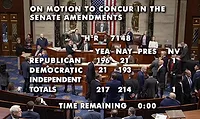
Funding for the U.S. Dept. of Homeland Security lapsed Feb. 13, and lawmakers seem no closer to ending the impasse over requested changes in the federal spending bill related to Immigration and Customs Enforcement practices than they were two weeks earlier when a 10-day stopgap measure was enacted Feb 3.
Caught in the middle is $32 billion for the Federal Emergency Management Agency, which provides funding for U.S. disaster response and cleanup, as well as projects to make infrastructure more resilient to extreme weather events.
“FEMA [funding] is caught up in … the whole immigration issue,” says Chad Berginnis, executive director of the Association of State Floodplain Managers. His organization has long advocated for the agency to live outside of the Homeland Security department, because its priorities are often overshadowed by those of its parent—in the current case, immigration enforcement. Additionally, FEMA must compete with other units within the department to be able to propose new regulations. As a result, the emergency management agency is not “as effective, as nimble or as much of a partner” than it would be as a separate entity, Berginnis told ENR.
The association and other groups say, however, that FEMA’s ability to respond to disasters will not immediately be negatively impacted by the shutdown. According to the National Low Income Housing Coalition, arguments are unfounded that the Homeland Security department must be funded for FEMA resources to be available. The emergency response agency's primary fund to respond to disasters—the Disaster Relief Fund—currently contains about $9 billion, which the groups say is sufficient to cover any near-term disasters.
In addition, lawmakers always have the option to pass a disaster relief supplemental bill if negotiations over Homeland Security department drag out, Noah Patton, the coalition's director of disaster recovery, said in a Feb. 9 memo to members.
Stalemate
Congressional Democrats have asked for more immigration and customs enforcement accountability, body cameras for all agents and no masking, in exchange for their support to pass the department funding bill—the final remaining spending measure for fiscal 2026. Senate Democrats had worked with GOP leaders to craft a spending bill that called for more training for agents but they withdrew their support after two U.S. citizens were killed in Minneapolis at the hands of ICE agents.
On CBS News’ Face the Nation Feb. 22, White House Border Czar Tom Homan said that 1,000 agents have now left the city, with more expected to leave over the next week.
Looking for quick answers on construction and engineering topics?
Try Ask ENR, our new smart AI search tool.
Ask ENR →
But while the Trump administration says the enforcement operation is ending, city officials say their community is still reeling from the nearly two-month onslaught.
In a Feb. 13 press briefing, city Mayor Jacob Frey (Democratic Farmer Labor Party) said the operation’s financial impact in Minneapolis since December had reached $203.1 million as of the end of January.
Construction has been one of the industries affected, said the city’s director of emergency management, Rachel Sayre. According to a preliminary impact assessment, January 2026 was an “extreme outlier” compared to the same month in previous years over the past decade. The number and value of building permits issued were the lowest recorded in January in the past decade.
Tim Worke, CEO of the Minnesota chapter of the Associated General Contractors of America, said the influx of immigration enforcement agents has not caused “significant disruption” on construction sites among his group’s members, largely because Minnesota has stringent regulations related to prevailing wages and “some of the most highly prescriptive regs in the country dealing with an undocumented workforce.”
Both Worke and a union local leader said they had heard anecdotal reports that homebuilders, as well as smaller trades, were more broadly impacted, with some workers afraid to come to work.
But Worke questioned the necessity of bringing 3,000 agents to the city when the “vast majority of workers in the community are here legally.” He added: “People are traumatized.”

.webp?height=200&t=1774009260&width=200 "DHS-Nominee-(2)")