Spain’s Sagrada Familia: Contemporary Construction Methods Speed Iconic Basilica to Completion
February 11, 2026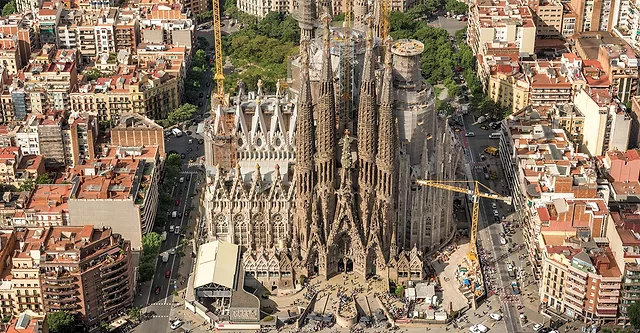
Spain’s Sagrada Familia: Contemporary Construction Methods Speed Iconic Basilica to Completion
February 11, 2026The installation of a cross that is itself the equivalent of a 50-story building, made the church, topping out at 172.5 meters, the tallest in he world.

In 2014, the entity behind construction of one of the world’s most iconic churches—the wildly imaginative Sagrada Familia basilica in Barcelona, Spain—contacted global consultant Arup with a challenge: Could the firm help the project team update designs developed more than a century earlier, to ensure that a critical project component was built to be structurally sound?
Steve McKechnie, then a London-based structural engineering leader for the firm, thought his team could help. Now Arup’s Sagrada Familia project director, McKechnie and the firm’s engineers worked alongside Barcelona-based 2BMFG Architects, which has been on the project since 1986, and architects at Sagrada Familia, to figure out how to design and construct a tower that would be too heavy for the existing foundation.
The team is adapting the designs of Antoni Gaudí, who began work at the church in 1883 and continued until his death at age 73 in 1926. The architect most closely associated with Sagrada Familia, he broke with traditional architectural and construction norms at the time to create playfully unique buildings while also keeping an eye on technical advancements, such as using reinforced concrete before it was a common practice. Gaudí pioneered Catalan modernist architecture, which combined neo-Gothic and Art Nouveau elements with whimsical flourishes that include colorful mosaics and sculptural facades with components that reference the natural world. “No straight lines or sharp corners exist in nature,” he famously said. “Therefore, buildings should have no straight lines or sharp curves.”
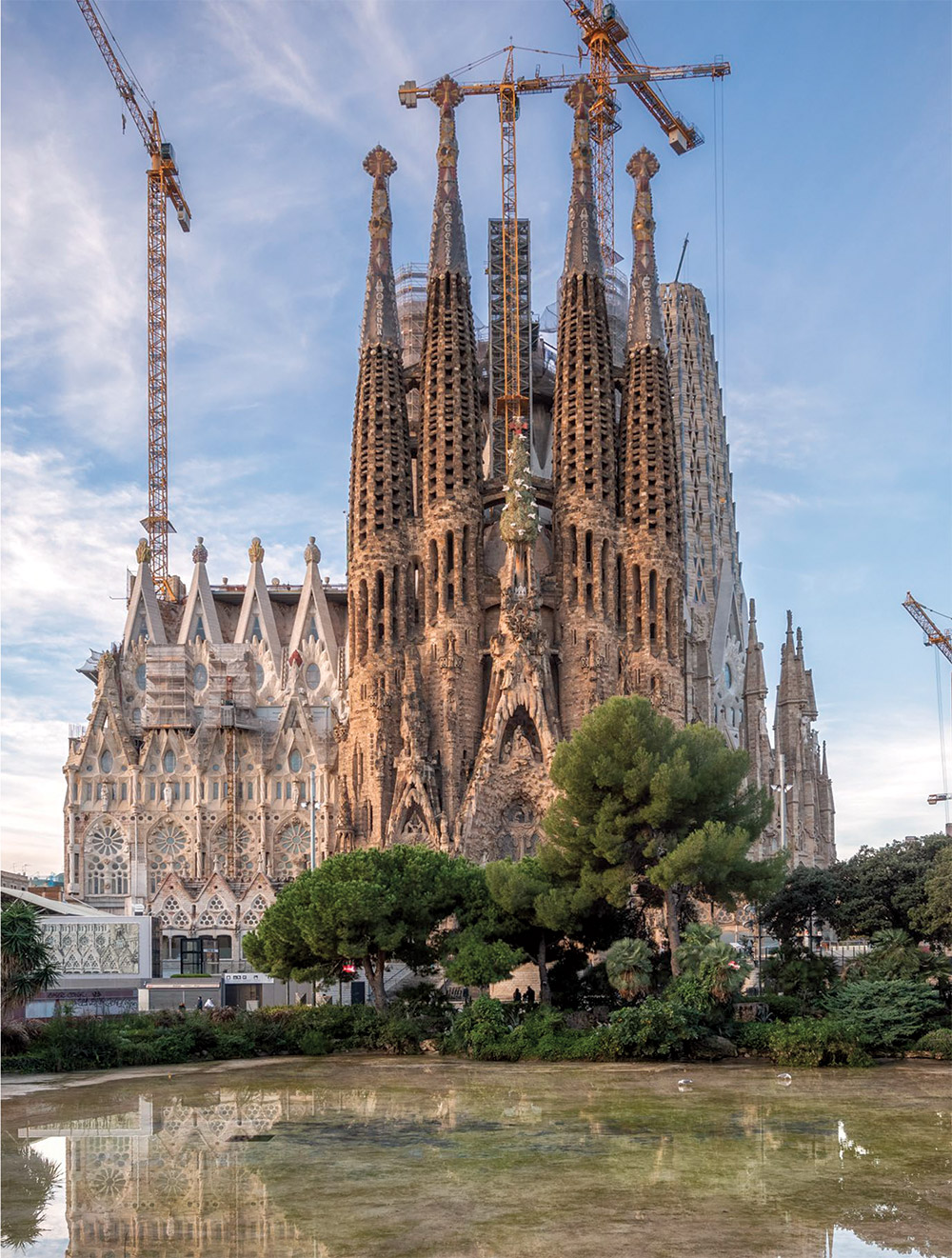
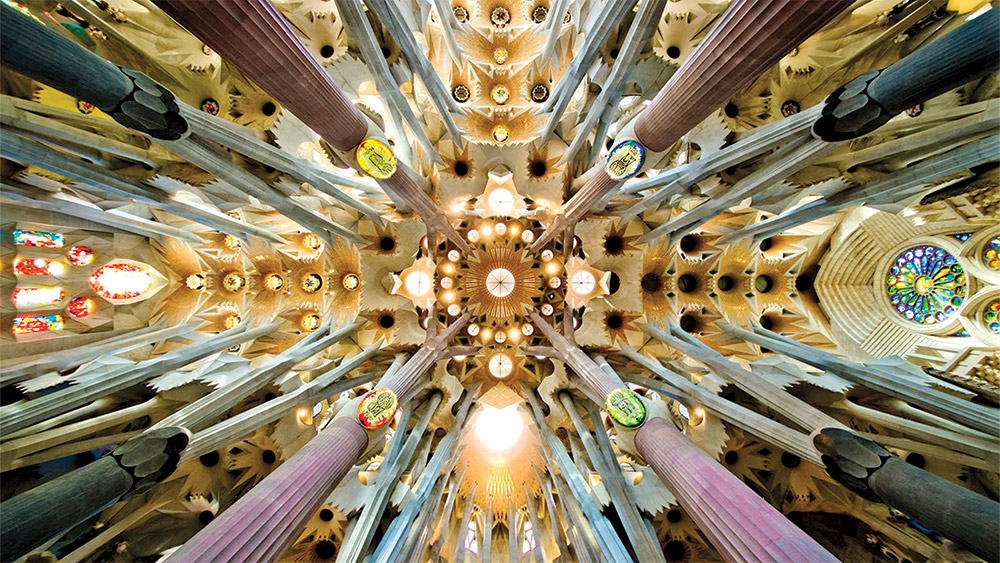
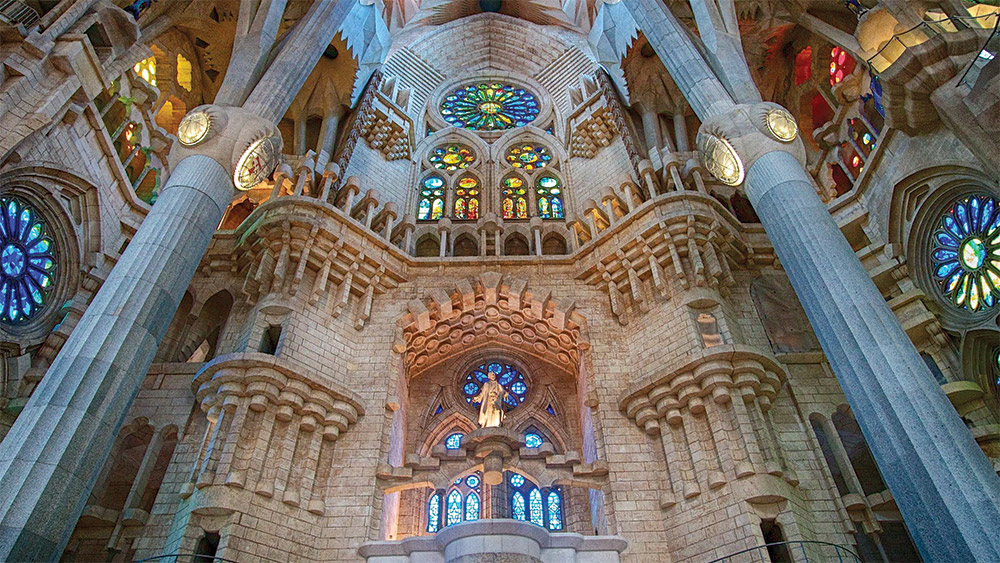
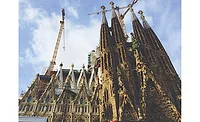
Known worldwide as a leading example of Art Nouveau design, Sagrada Familia’s collection of towers and ornate interior brings to mind a light-filled forest.
All three Photos © Fundació Junta Constructora del Temple Expiatori de la Sagrada Família
It is impossible to talk about the Sagrada Familia without talking about Gaudí’s design. While it’s easy to wax poetic about what is considered to be an architectural masterpiece—a UNESCO World Heritage site since 2005—Gaudí’s lofty vision is also being executed very much as a contemporary construction project, pushing the edges of conventional norms with new technologies and processes to drive design and construction advancements. A collaborative, creative approach to improve upon Gaudí’s concepts, begun even before some of the technologies to build them existed, has been applied consistently, say numerous project participants.
Sagrada Familia became the world’s tallest church last October with partial installation of a cross on its central Tower of Jesus Christ. Another significant milestone comes this spring when the nearly 100-tonne cross is fully installed.
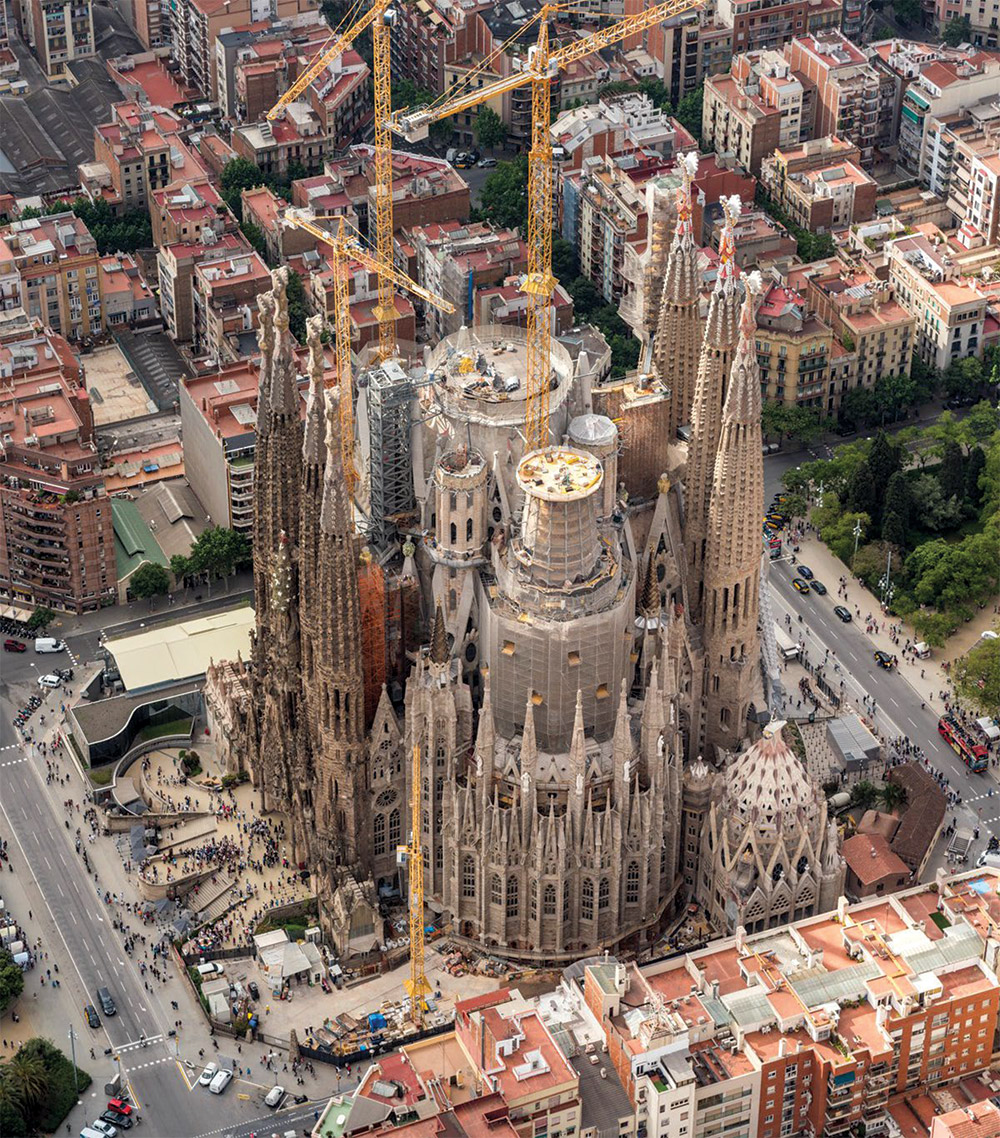
The Sagrada Familia, first a church, elevated to a basilica by Pope Benedict XVI in 2010, has been under construction for more than a century, but the main exterior is approaching completion. Project participants say the construction techniques used have advanced over time.
Photo © Fundació Junta Constructora del Temple Expiatori de la Sagrada Família
Core Collaboration
Since its inception, the Sagrada Familia project has been an inside job. The Sagrada Familia Foundation Procurement oversees design and construction, funded primarily through public donations. The church was conceived and remains an “expiatory” Roman Catholic house of worship to which visitors make offerings as a form of personal atonement.
"No straight lines or sharp corners exist in nature. Therefore, buildings should have
no straight lines or sharp curves."
Antoni Gaudí, Sagrada Familia Architect
The Foundation architects and 2BMFG rely on Arup “to design important parts of the basilica … in a way that is efficient and fast to build,” says Arup’s McKechnie. “At every stage, we have to convince [the architects] at a technical level of the safety and appropriateness of our solutions. It is quite a complex and multilayered relationship. Ultimately, it is the board that decides on the scope split” between 2BMFG and Arup’s roles.
Esteve Umbert, a Sagrada Familia lead architect, says the ownership-construction delivery model works well for the entire project team because it allows members to work collaboratively in problem solving and creating innovative solutions similar to the progressive-design-build method in the U.S.
Looking for quick answers on construction and engineering topics?
Try Ask ENR, our new smart AI search tool.
Ask ENR →

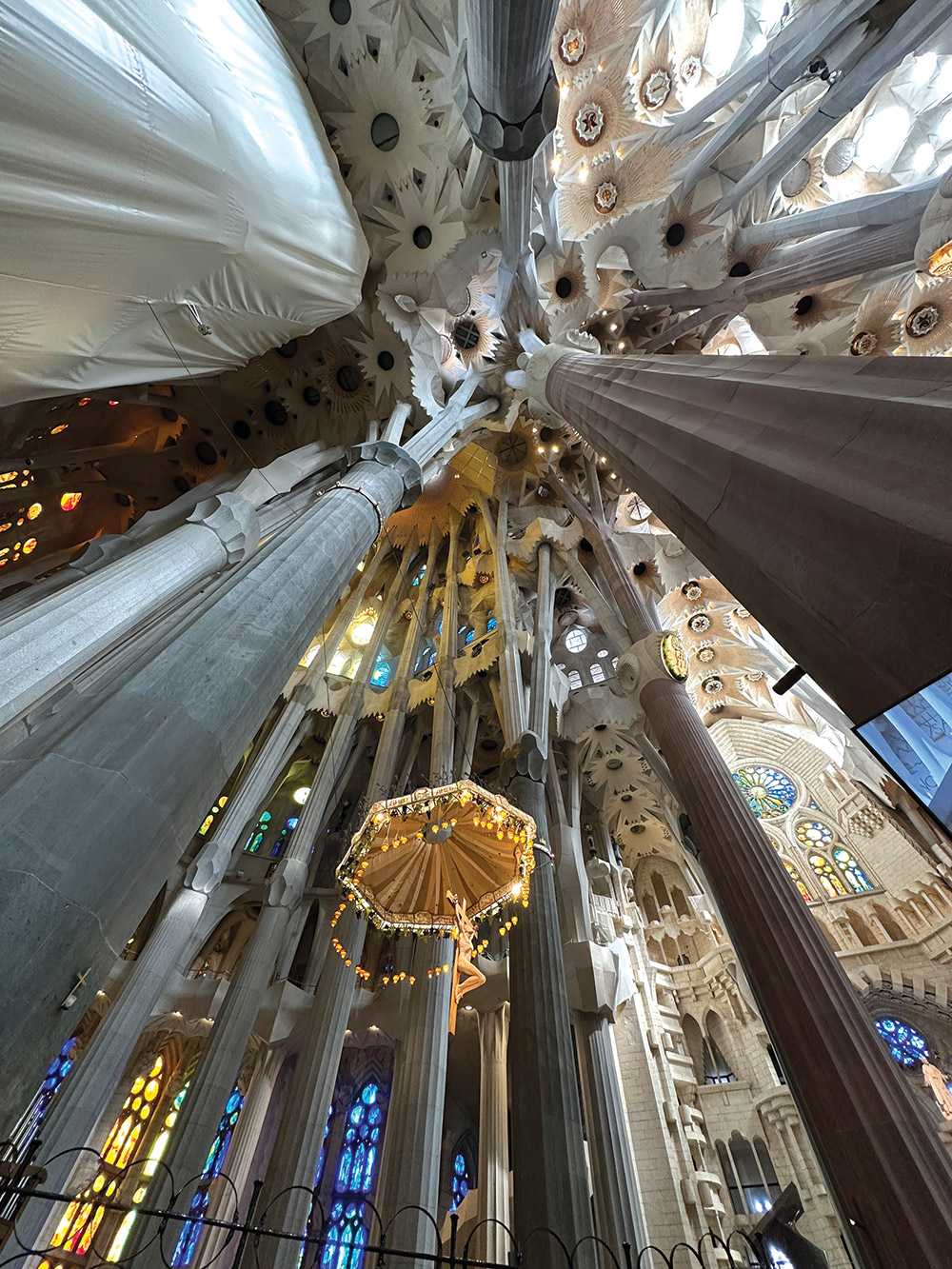
Gaudí used inclined columns, rather than flying buttresses, to distribute and support the weight from the arched vaults above them, but also for aesthetic reasons: to suggest a forest of trees branching out into the sky.
Photo by Scott Blair/ENR
Modernist Aesthetic
There is no building quite like the Sagrada Familia anywhere across the globe. The work planned for its eventual completion make it unique among unfinished global monuments. Even the most jaded cynic would be awed entering the church for the first time. The open and airy interior has stone walls awash with light and color streaming through both clear and ornate stained-glass windows, while 36 tree-like inside columns soar upward and branch outward, finally merging with vaulted arches fitted with openings to allow more light to enter the space.
“The way [Gaudí] uses light— it’s light at the top and multicolored at the bottom, and the columns and the branches, you can’t help but look up and feel uplifted,” says structural engineer Tristram Carfrae, an Arup fellow and principal.
On the exterior, 18 parabolic-shaped towers reach upward, with the 17-m by 13.5-m cross atop the central Tower of Christ topping out at a height of 172.5 m—the equivalent of nearly 50 stories—making the Sagrada the tallest building in Barcelona and the world’s tallest church.
Gaudí designed each of the structure’s three facades to be unique, representing periods in the life of Jesus, according to Sagrada Familia history. The Nativity facade is covered with an ornate collection of religious and nature-inspired sculptures surrounded by decorative ornaments. The total visual effect suggests a massive, melting wall, while the Passion facade on the opposite side is less busy, with stark, angular sculptures and columns arranged to resemble a ribcage. Work continues on the apse, which currently serves as an entrance to the church. Construction on the Glory facade, which will serve as the church’s primary entrance, is expected to continue potentially into the early to mid-2030s, foundation officials say.
Gaudí took over the design in 1883 after predecessor Francisco de Paula del Villar departed over a disagreement with church benefactor Josep Maria Bocabella, a Barcelona publisher. Villar’s concepts called for a more traditional neo-Gothic church with flying buttresses and a relatively small footprint.
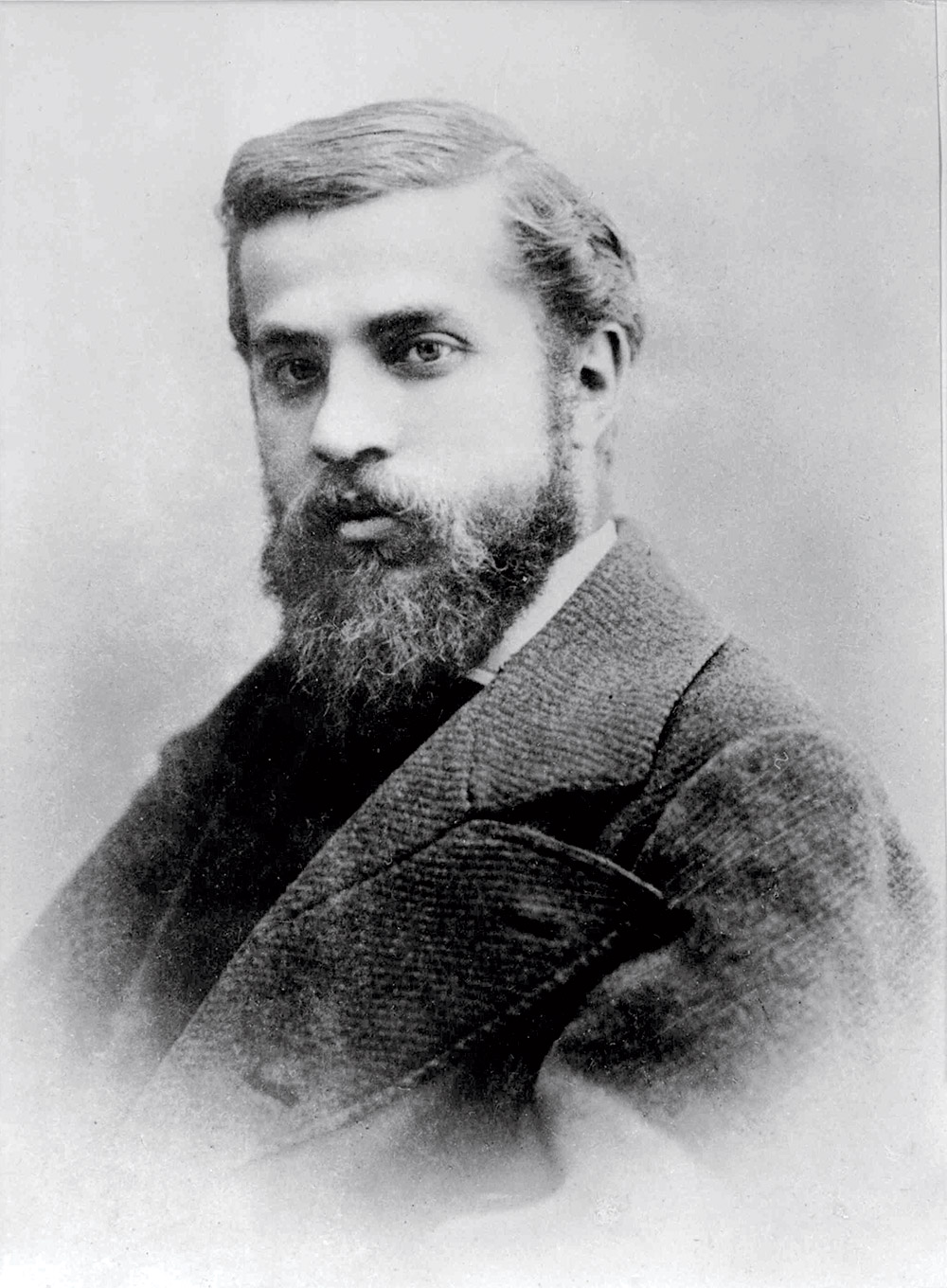
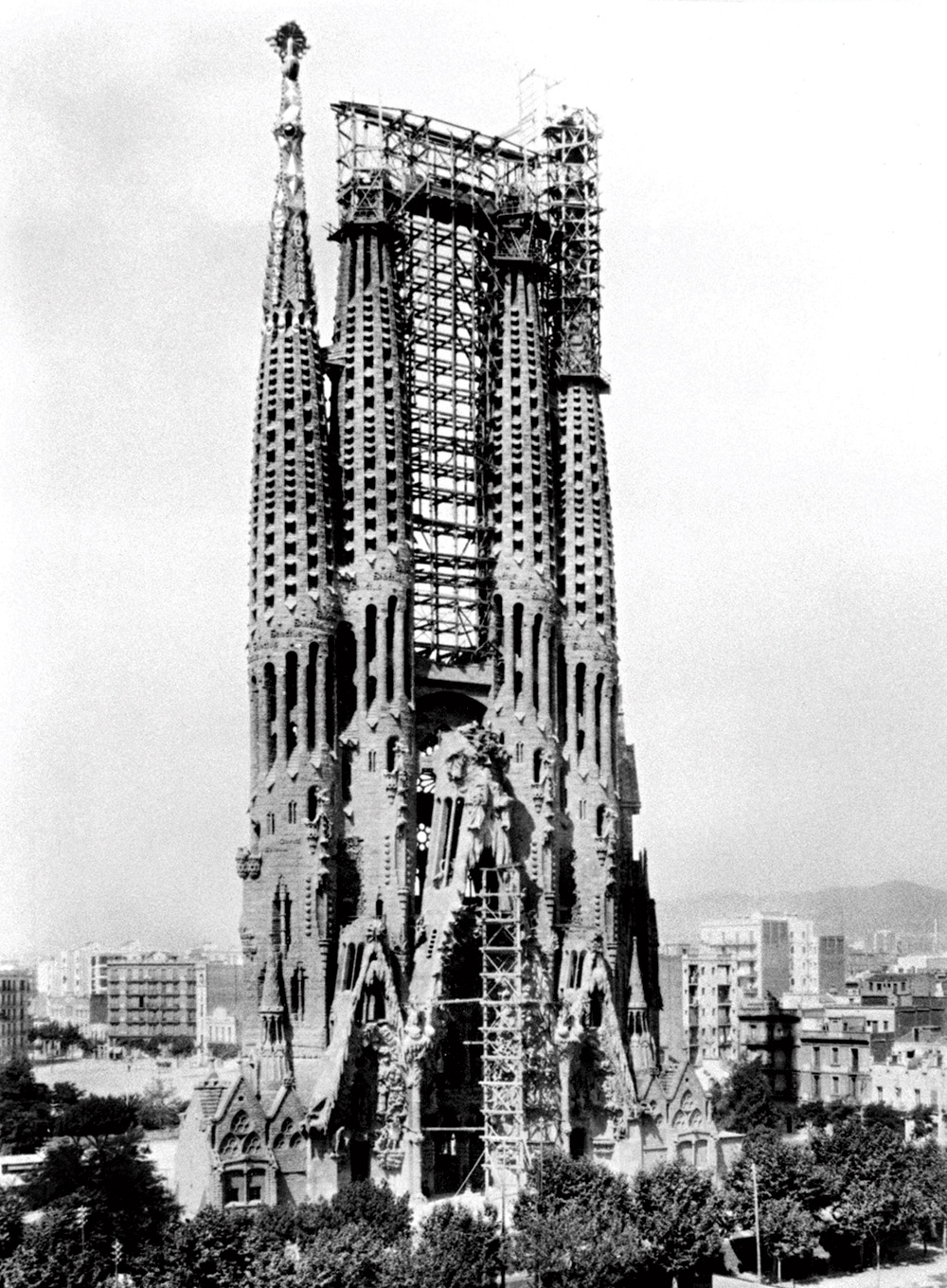
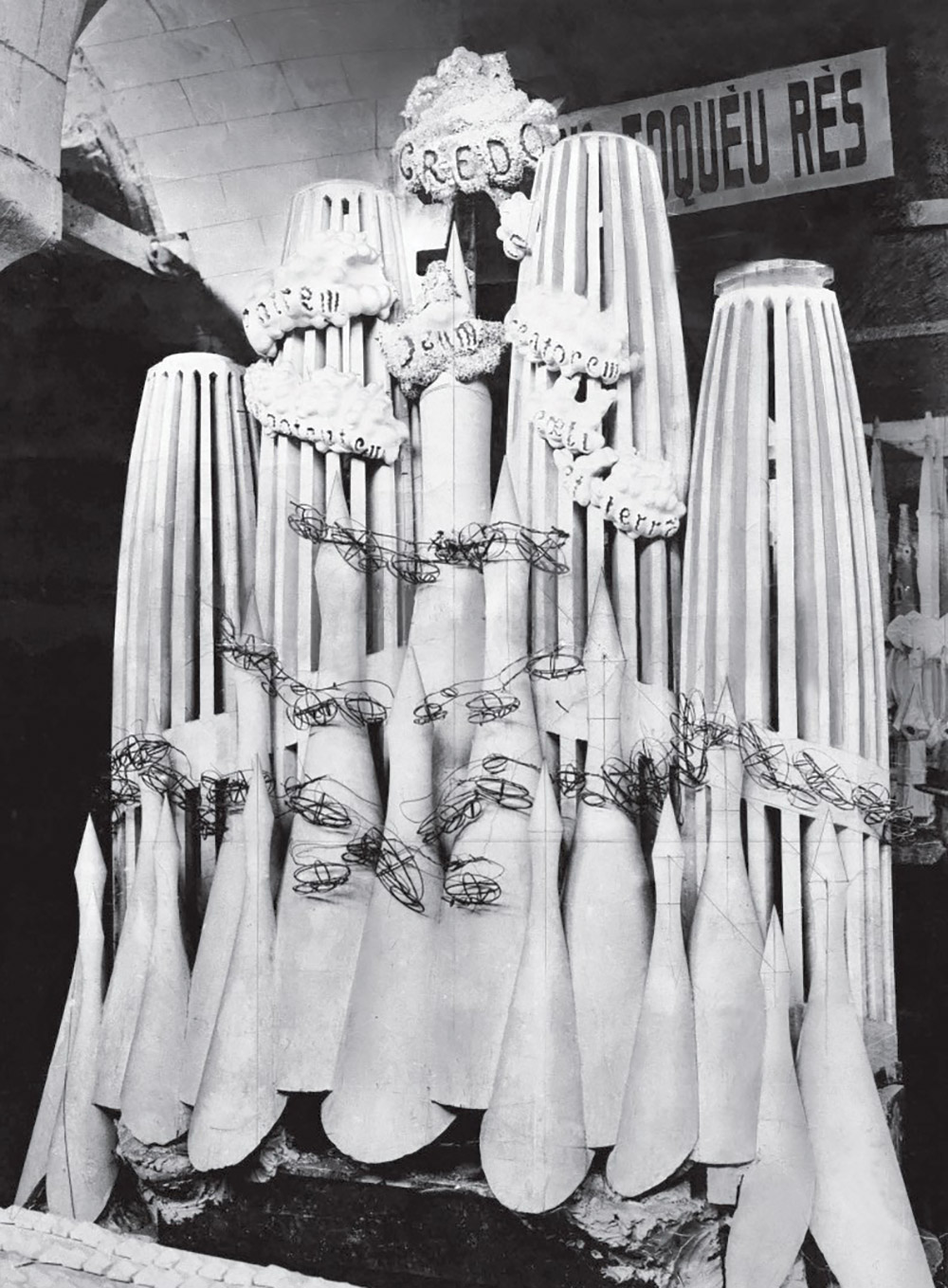
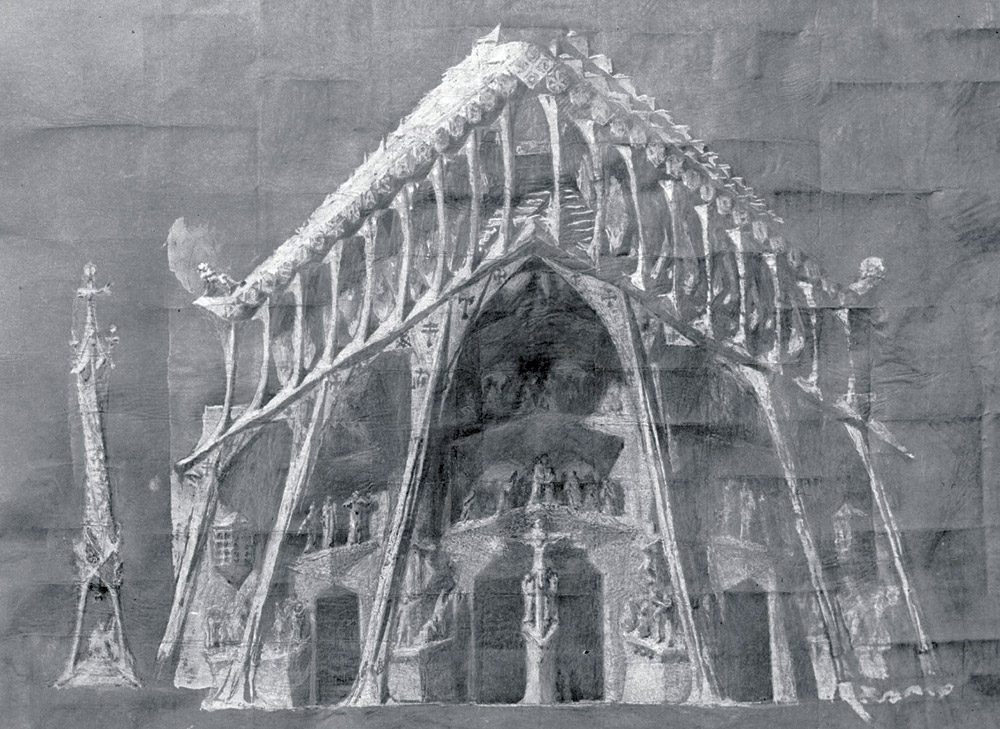
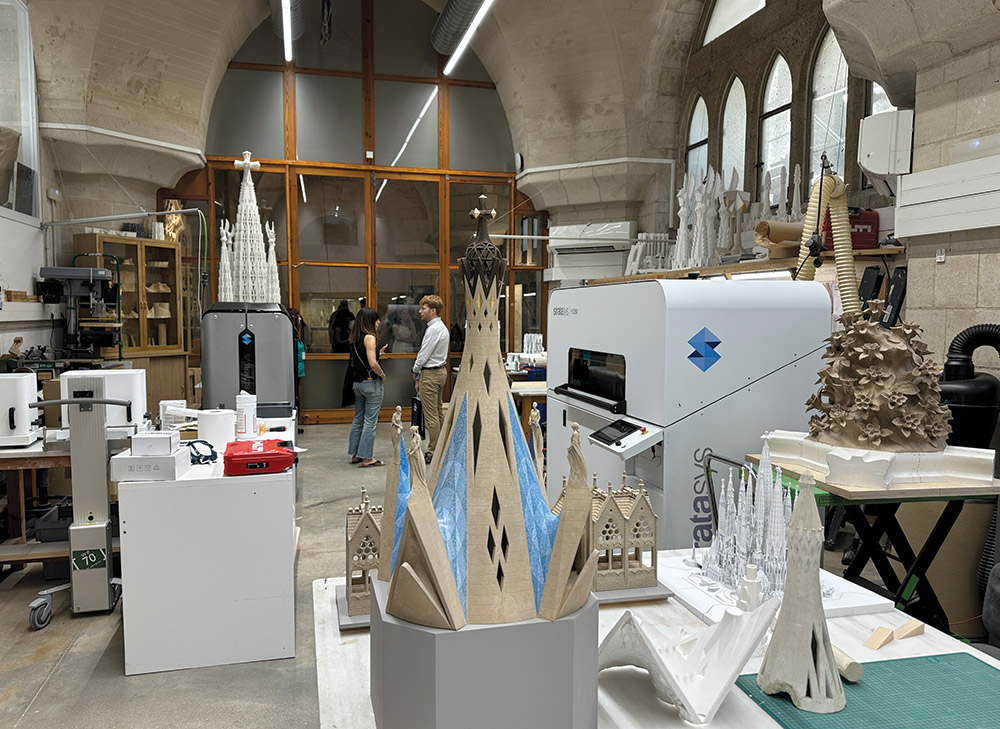
Antoni Gaudí, (top left), lived to see one portion above the Nativity facade (center), but he left behind several hand-made models, including a model for the Glory facade (top right) and drawings, including one for the Passion (bottom left). Now, the project team uses 3D printing (right).
Photo © Fundació Junta Constructora del Temple Expiatori de la Sagrada Família
A Stone Forest
Gaudí had gained notoriety in Barcelona at the time as an up-and-coming architect with ideas very different from what Villar had envisioned. Gaudí sought to avoid flying buttresses to support church towers and spires—instead designing a system of helicoidal, or screwlike, interior columns, with most inclined at specific angles to distribute and support the weight of arched vaults in the central nave.
Gaudí included the columns for both functional and aesthetic reasons, according to Sagrada Familia’s Umbert. Not only are the columns load-bearing, but they also resemble trees, Umbert says, which accomplished Gaudí’s goal to create a “stone forest” inside the church to invite contemplation.
“We designed a system to connect the pieces together on site, so they could go straight into position without having to be adjusted or moved around.“
Steve McKechnie, Sagrada Familia Project Director, Arup
To ensure columns would work as anticipated, Gaudí developed an extensive collection of handmade models—as he did for most of his church designs—using a variety of materials, including plaster, wood and even sandbags held together with string that he inverted to assess compression needs for catenary arches.
Many of Gaudí’s models were destroyed in a fire at the outbreak of the Spanish Civil War in 1936, but a student managed to save a few. Gaudí left behind no blueprints, only the models and drawings. For some aspects of the church, the current team must work only with the latter. Still, says Umbert, team members today take the same approach to constructability of the designs as Gaudí did, only now using software and 3D printing machines instead of handmade models.
“We still use Gaudí’s method in a way,” Umbert says. “We validate that the design is what we expect, and of course, there are always surprises. So it’s a back and forth [where] you modify the design again” and test the results.
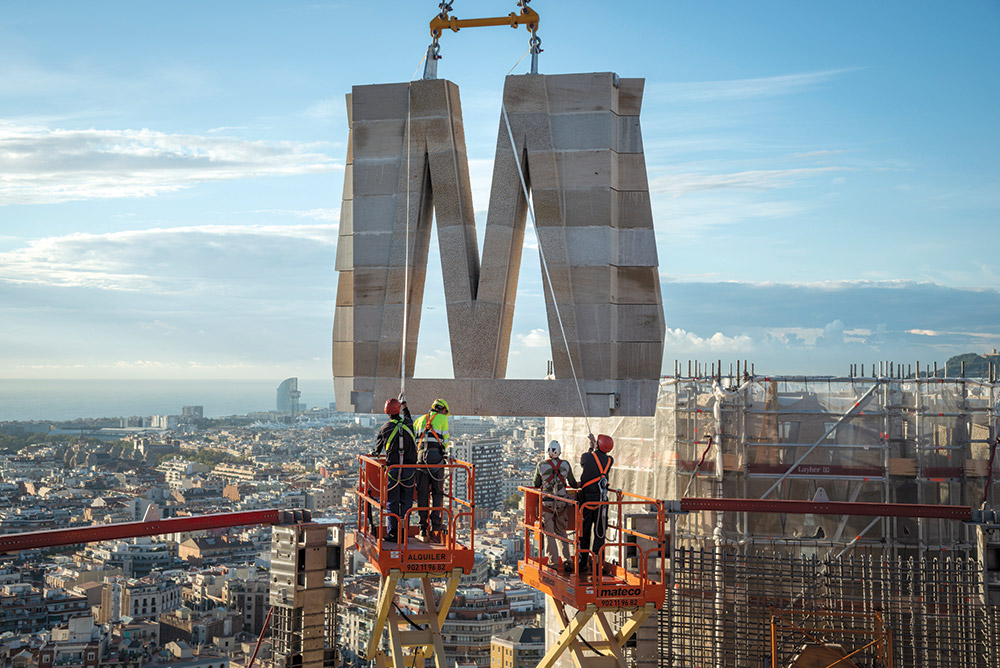
A crane 200 meters up from the ground hoists modules that have been preassembled offsite to the tower and places them, section by section.
Photo © Fundació Junta Constructora del Temple Expiatori de la Sagrada Família
Solving a Problem
Unlike most modern buildings, the church is not being built from the ground up in its entirety, but section by section. Gaudí only lived to see one of four bell towers above the nativity facade built, although the other three were under construction when he died. While the project team has made efforts to adhere to his visions in principle, if not to the letter, “when we use something that Gaudí did not conceive of when we add something, we feel free to use any modern techniques because it comes from a different era,” Carfrae notes.
The project team tests and validates the constuctability of all designs.
“We still use Gaudí’s method in a way.”
Esteve Umbert, Project Architecture Lead, Sagrada Familia
In 2014, the Sagrada team realized that the yet-to-be-built, 138-m-tall Tower of Mary, located above the inner apse on the main level directly above the crypt, would be too heavy to be supported by its columns. The crypt was designed by Gaudí’s predecessor, Villar.
“The load was going to be too much for those columns, so [team members] were looking at ways to make the load lighter” Arup’s McKechnie says. An early option considered was a steel grid with diagonal members—a diagrid—using precast concrete panels clad with stone.
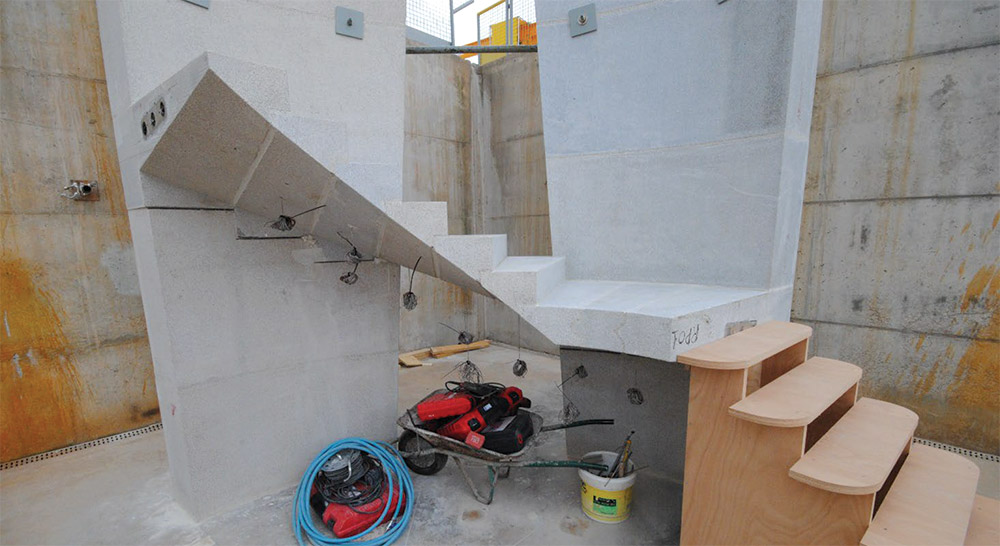
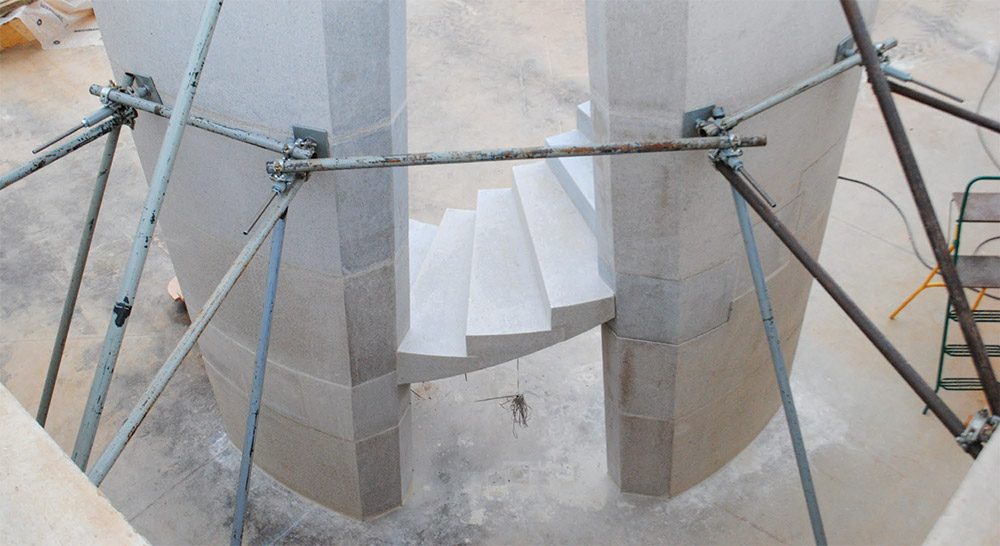
Arup suggested an alternative using prestressed stone itself, leaving out the concrete entirely. Prestressing the stone offsite would offer the benefits of sufficient load-bearing capacity with less stone or any need for concrete.
“Our involvement built from there, because it wasn’t just a question of finding material for the towers, we also wanted to make sure [the components] fit together well, so we designed a system to connect the pieces together onsite, so they could go straight into position without having to be adjusted or moved around,” McKechnie notes.
Stone is culled and provided in cut blocks from a quarry in England chosen for strength properties and color variations, which the project team identified as a good match for the original stone used, says Dave Crawshaw, production manager at U.K.-based Armstrongs Dimensional Stone. The stone and steel are connected at the appropriate tensile strength, then transported to the project site for final assembly.
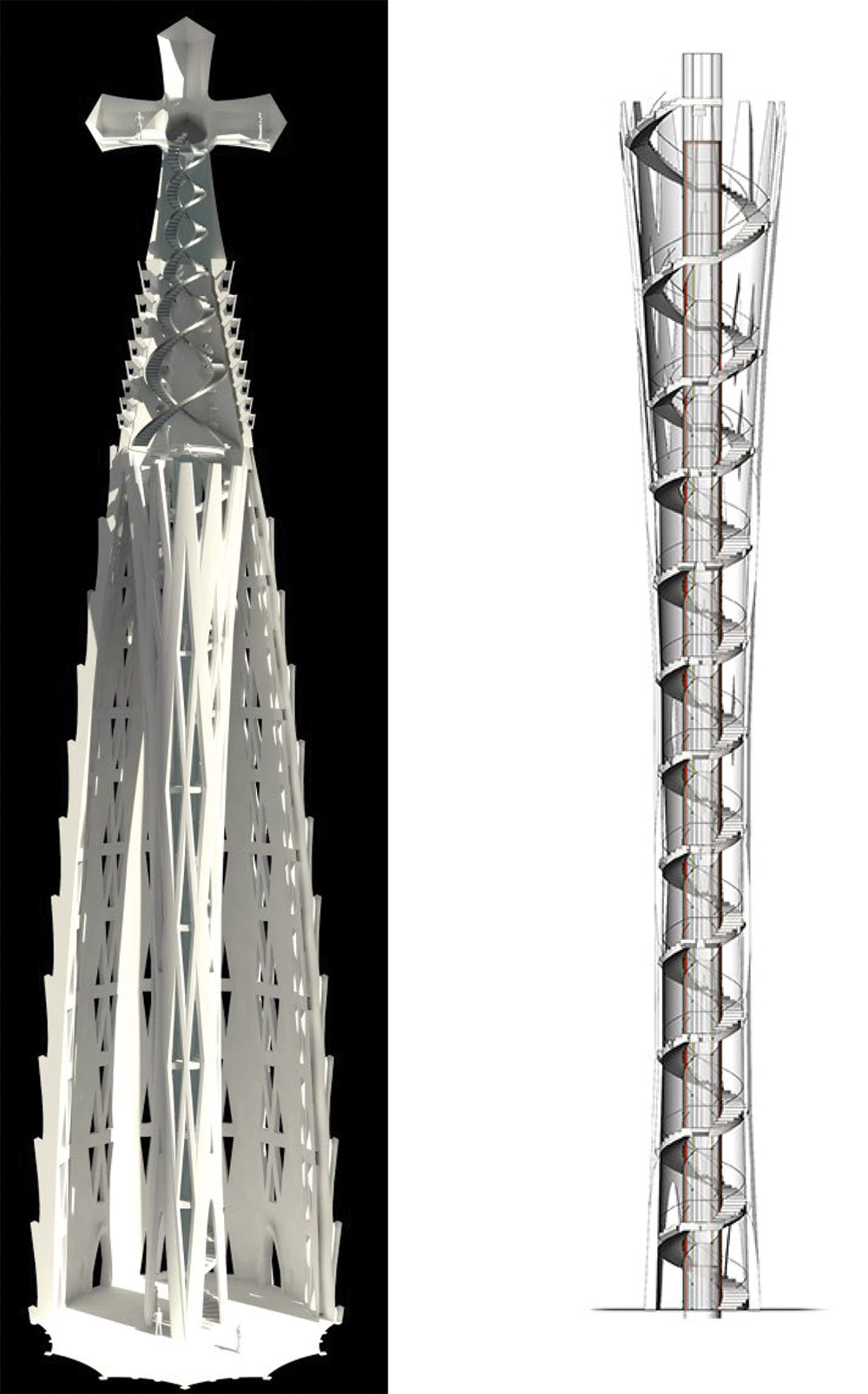
Photo © Fundació Junta Constructora del Temple Expiatori de la Sagrada Família
Photos courtesy of ARUP
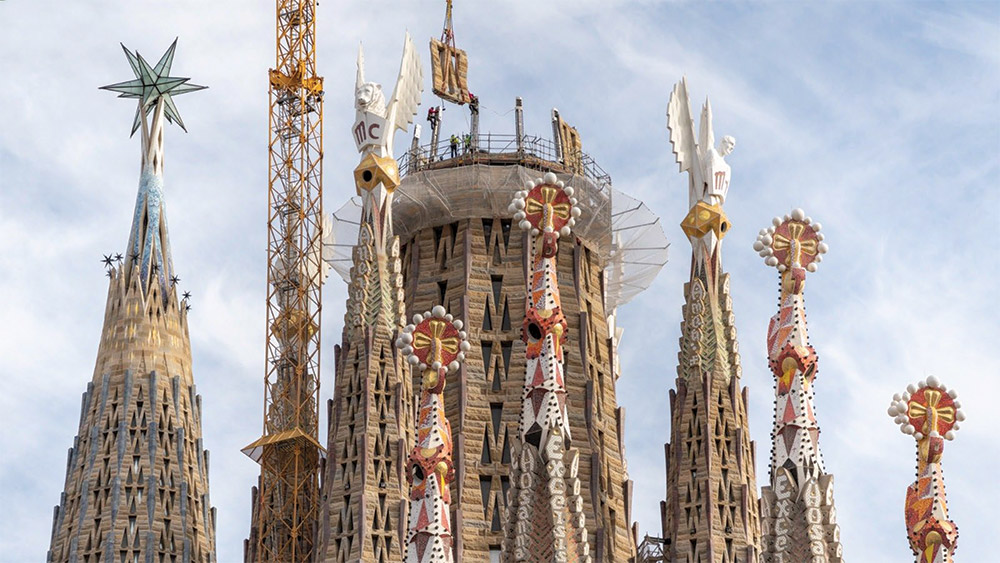
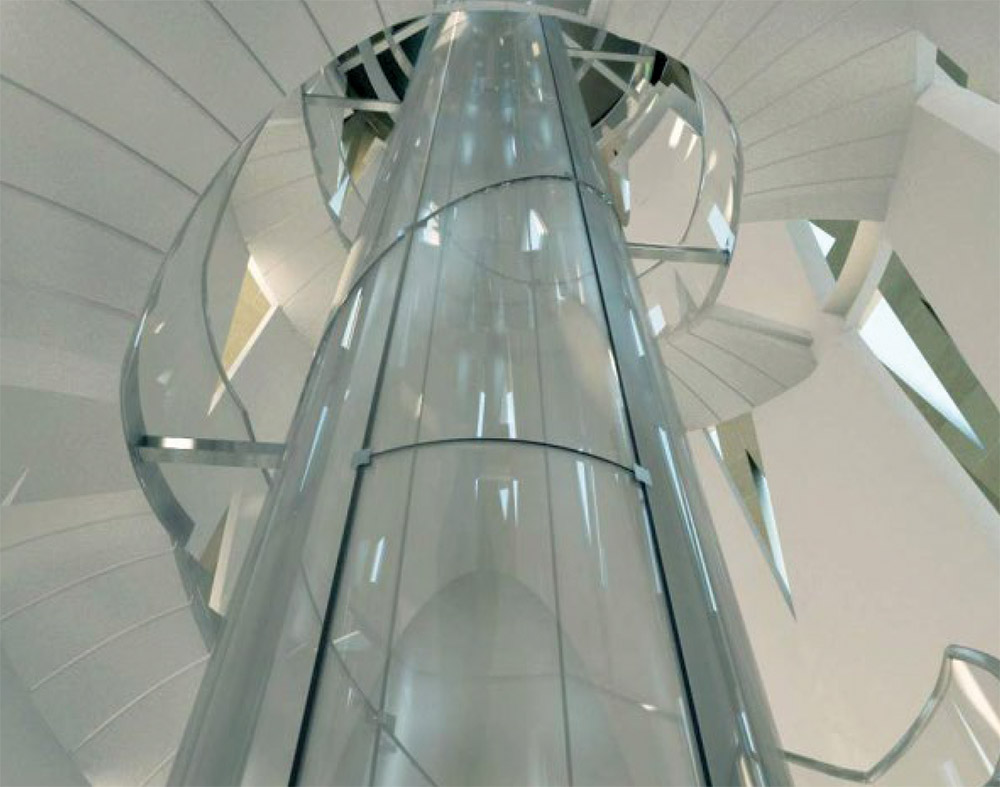
The installation of the Tower of Christ has been a recent project focus. Like other towers at the church, it has a parabolic shape (top) with a spiral staircase rising inside the tower itself (left and right). A hung-glass elevator, yet to be installed, will also allow access (above). At the bottom, the Tower of Christ is adjacent to the Tower of Mary, which is topped with a star and is the second tallest on the church.
Photo © Fundació Junta Constructora del Temple Expiatori de la Sagrada Família
“The most important aspect is the tolerance of both the stone and steel pieces,” says Carles Farràs, Sagrada’s head of supply and approvals management. “For stone, the maximum tolerance is about 3 millimeters, and for steel, it’s one-tenth of a millimeter.”
The project team tests and validates the constuctability of all designs.
“We still use Gaudí’s method in a way.”
Esteve Umbert, project architecture lead, Sagrada Familia
When Arup joined the team in 2014, the project was only 40% complete. But over the past decade, the pace has accelerated. Tourist donations, after a drop during the COVID-19 pandemic, have rebounded and even increased as the church edges toward its final form, preventing delays due to lack of funds. The total cost of the project has not been disclosed but reports estimate it at about $400 million.
Switching to a system with much of the pre-assembly of materials and modules performed offsite has allowed the team to continue to work quickly without being constrained by space limitations, Arup’s Carfrae notes.
Much of the construction focus over the past two years has been on the Tower of Christ, the final tower and tallest part of the church. In 2024, the project team installed the base of a custom-made luffing jib Liebherr tower crane atop the central nave roof, 54 m up from the ground to continue building the tower in pre-assembled units.
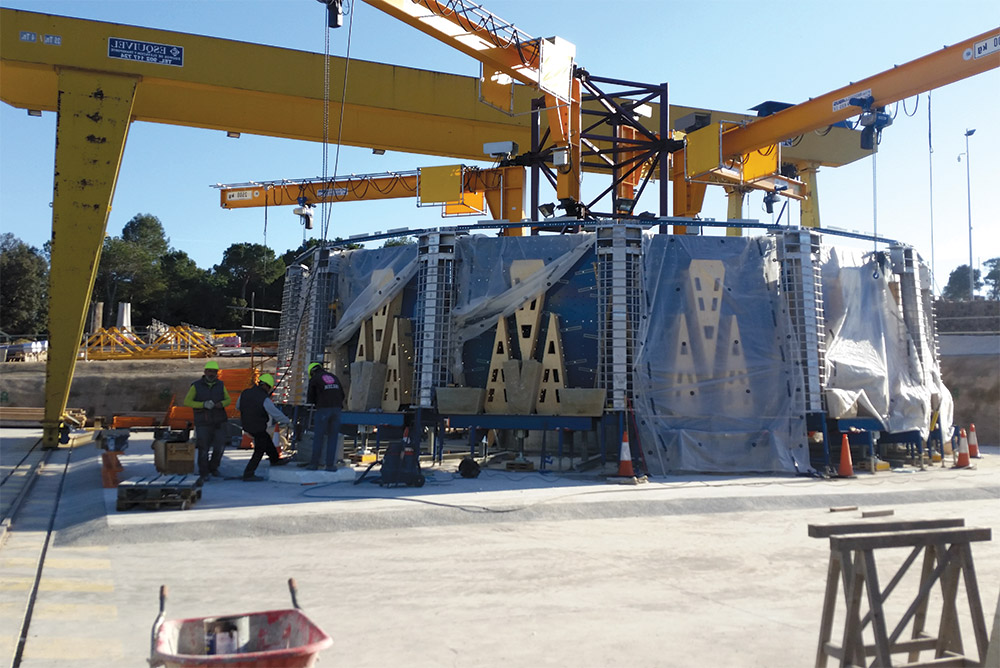
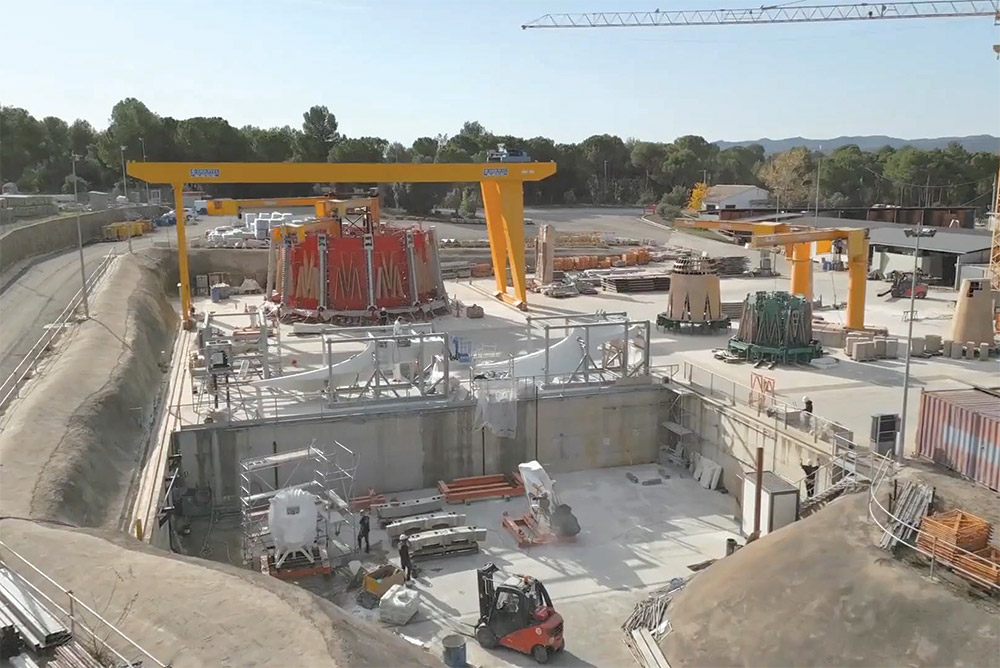
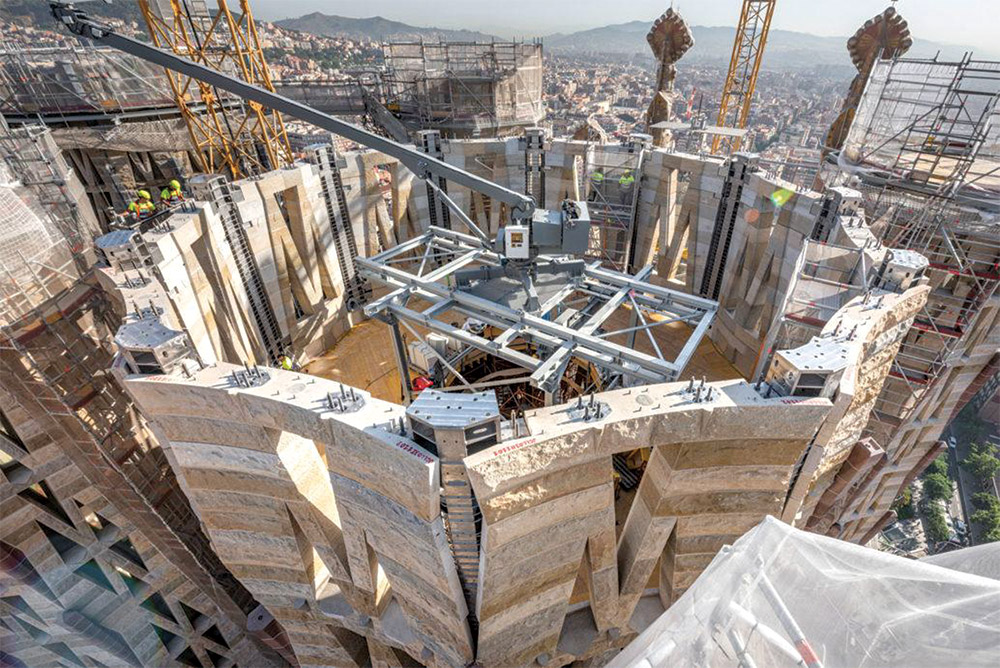
The project team was able to accelerate the pace by developing a system to preassemble project components at an offsite location (top) then deliver to the project site for final installation (below).
Photos © Fundació Junta Constructora del Temple Expiatori de la Sagrada Família
The crane is anchored by a brace outside of a window within the tower at about 154 m to stabilize it, with the top of the crane 200 m from the ground, according to Sagrada construction chief Ramon Espel.
“The most important aspect is the tolerance of the stone and steel pieces. For stone, the maximum tolerance is about 3 millimeters, and for steel, it’s one-tenth of a millimeter.”
Carles Farràs, Sagrada head of supply and approvals management
Since last fall, crews have used the high crane to hoist pre-assembled components of the cross in large modular forms. The cross, manufactured by Garner, a unit of the Permasteelisa Group, is made of stone-clad stainless steel with a white ceramic glaze to reflect sunlight during the day and stay illuminated at night.
By the end of January, Sagrada Familia said it had placed all four horizontal arms of the cross, each weighing about 12.8 tonnes and measuring 4.40 m by 4.40 m by 4.50 m. The last piece to be installed will be the upper arm of the cross, and inside it, a small chamber with a sculpture created by Italian artist Andrea Mastrovito.
Meanwhile, work inside the tower continues, with preparations for a 60-m-tall hung-glass elevator to allow access to the sculpture in the interior of the cross. The interior work will not be complete until sometime in 2027, according to Sagrada Familia officials.
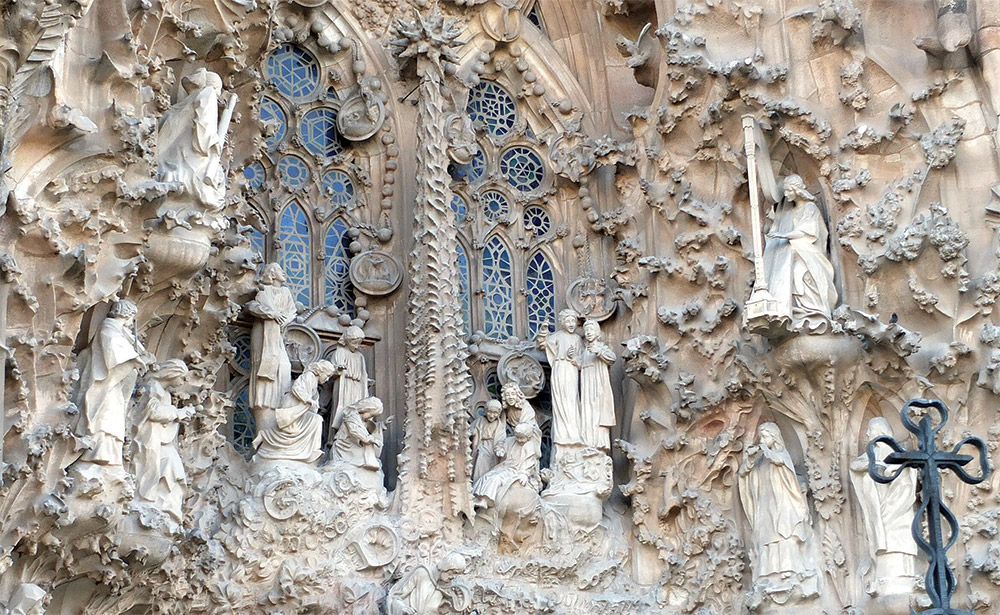
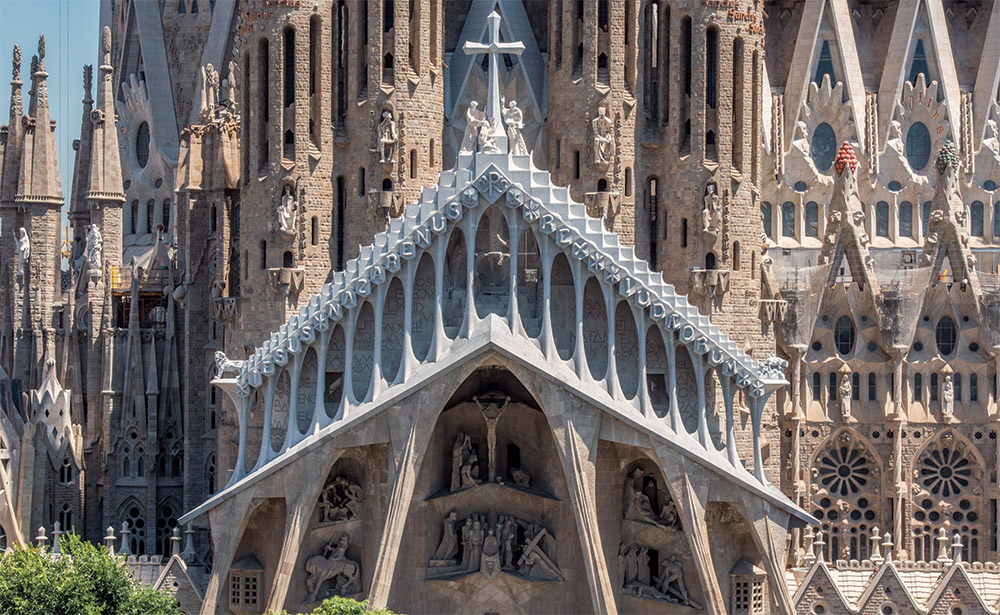
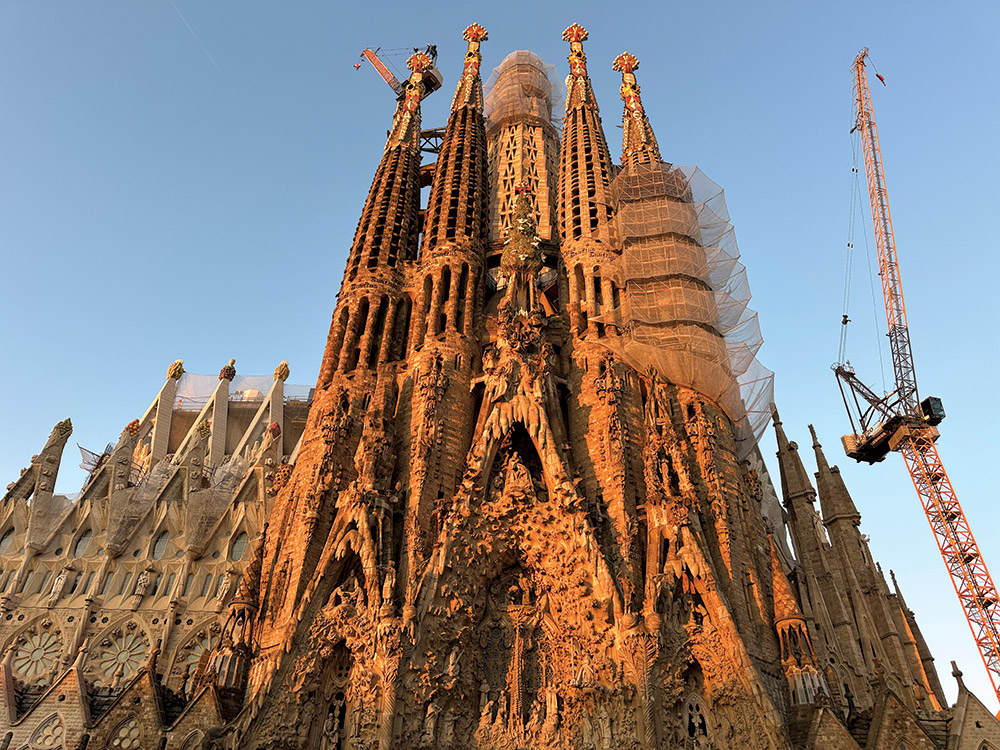
The church, with its fantastical design and sculptures, some seen here on the church’s nativity facade (top left and below) and the passion facade (top right) has not been without its detractors. Writer George Orwell described the church as “hideous.” But artist Salvador Dalí was a fan, calling the church a “stone song.”
Photos (top) © Fundació Junta Constructora del Temple Expiatori de la Sagrada Família; (bottom) by Scott Blair/ENR
Community Pushback
Despite its recognition as an architectural novelty, including elevation to basilica status by Pope Benedict XVI in 2010, the ongoing project has not been without its critics. Even during Gaudí’s lifetime, there were detractors. Writer George Orwell described the building as “hideous” and artist Pablo Picasso famously said that the Sagrada Familia and its designer should be sent “to hell,” although Salvador Dalí was a fan, calling the church a “stone song.”
But today, as the church towers over Barcelona’s Eixample neighborhood, tensions are running high. Some community groups have challenged the Sagrada Familia Foundation effort to obtain a permit to build a pedestrian bridge that would expand the church footprint into a residential area, uprooting some.
Gaudí and his team never obtained a building permit, but the foundation received one in 2019 to continue work on the project within its current footprint through 2026. The approval came with a $41-million penalty for building without a permit before then, which local officials used at least partially to pay for public transportation improvements near the church grounds.
“It’s a magnificent project ... there are so many different ways it makes you feel good to ... contribute to one of the most amazing pieces of architecture in the world.”
Tristram Carfrae, fellow and structural engineer, Arup
While Gaudí had included bridge drawings in his project designs, to build it and expand the building footprint, the foundation would need to obtain another permit, creating uncertainty as to when the project ultimately will complete.
“I do not have a [crystal ball] to predict the future,” foundation chair Esteve Camps told reporters at a press conference last fall in Barcelona asking about the controversy.
But he hinted that the permit gained in 2019 is an indication it would succeed again. “Some neighbors did not agree, and they presented their complaints,” Camps said. “But fortunately, from a legal point of view, these neighbors’ complaints were not accepted.”
The plans will be released and there will be a public comment period, he added.
Construction continues much as it has for 144 years, although also much differently in terms of execution, as the foundation prepares to attract visitors in record numbers over the next year, with rumors that Pope Leo XIV might be among them. Commemorations recognizing Gaudí’s achievements are scheduled throughout much of 2026.
“It’s a magnificent project,” says Arup’s Carfrae. “There are just so many different ways it makes you feel good to be able to contribute to one of the most amazing pieces of architecture in the world.”