ENR 2025 Top 25 Newsmakers
Brian K. Carroll: Advocates and Helps Contractors with Court Briefs and an Important Legal Victory
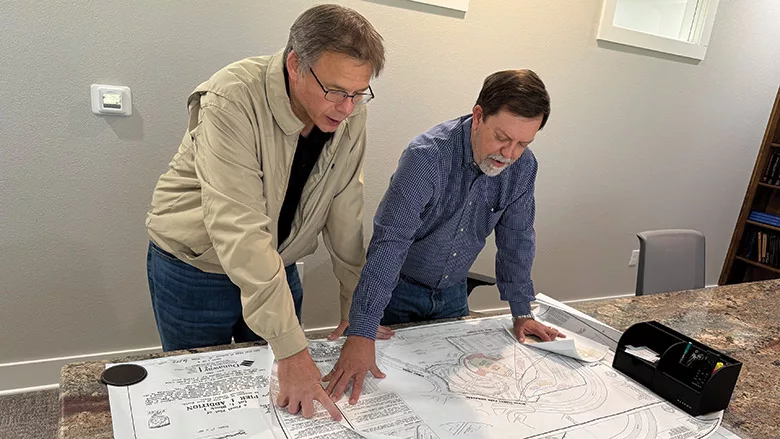
When Carroll (right) reviews project plans, he calls on his work experience as an engineer along with deep knowledge of law.

Related Article:
Texas Case Exposes Cracks in the Government Contractor Immunity Shield
Back to:
25 Top Newsmakers
Brian K. Carroll’s family background—both his grandfather and father worked in construction—and career, first as an engineer and now as a construction attorney—prepared him for his focus on subcontractors and the special risks they are vulnerable to. His emphasis on subs crystallized partly when he became a co-owner and outside general counsel for a Texas paving and concrete contractor. Subcontractors occupied even more of his attention when Carroll first became an officer and then in 2021-2022 that year’s president of the American Subcontractors Association. One of its core functions is advocating for the legal rights of subs, with payment a constant worry.
The reality for subcontractors, says Richard Bright, ASA’s chief executive officer, is that “our people go out and don’t get upfront payments, have retainage held and sometimes wait for years for final payment or never get it.”
Carroll, and his colleagues at the Belton, Texas law firm where he is managing partner, Sanderford & Carroll, provide, at low cost, some of the intellectual and rhetorical firepower needed to win support from judges deciding important construction disputes. Sanderford & Carroll have produced some of the most important friend-of-the-court briefs for ASA and its chapters in recent years. And they do it for several thousand dollars, not tens of thousands of dollars—a discount to the going price for similar, time-consuming legal services.
Friend-of-the-court briefs occupy a special role in American civil justice. Hundreds of industry trade associations file them every year.
This year, the Texas Supreme Court decided another important case for which Carroll and his colleagues wrote a brief. This case pitted a traffic signal subcontractor, Third Coast Services, and general contractor SpawGlass Civil Construction, against the family of Pedro Alfonso Castaneda, who died in a horrific 2019 auto accident adjacent to an overpass being built in Pinehurst, Texas. Despite evidence that Castaneda had made a fateful driving mistake that led to the crash, his family sought to blame the contracting team.
In most states DOT contractors have immunity from lawsuits if they comply with state DOT specifications. In the Third Coast case, the contractors were employed by a county and the Castaneda family claimed that as a result the state DOT immunity didn’t extend to contractors. A trial court and one appeals court upheld the Castaneda family’s argument that there was no immunity for the contracting team. Who the contractor was working for was a point of contention. Sanderford & Carroll’s brief helped convince the Texas Supreme Court panel that state DOT immunity extends to its contractors even when the work is through a county, thus insulating the contractors from enormous damage awards for accidents where they have little or no real liability other than that portrayed by creative personal injury attorneys.
The fees for such briefs collected by Carroll’s firm and others are paid out of the ASA’s Subcontractor Legal Defense Fund. ASA’s national organization kicks in a certain amount to support the fund but it relies on member donations, which can be made through ASA’s website, to pay for all the legal chores needed.
Looking for quick answers on construction and engineering topics?
Try Ask ENR, our new smart AI search tool.
Ask ENR →
Carroll is one of about 100 attorneys on the ASA’s attorneys council, whose members work with association chapters, providing legal advice and speaking on webinars. While the landscape for deciding construction disputes, especially those concerning subcontractor pay and legal protection “are a little better” than they were decades ago, Carroll says, the vulnerability still “requires continued diligence and advocacy.”
The subs, he says, “are the people who build the work and carry the risk.”