Clean Energy
UPDATED: Dominion Sues Feds Over Offshore Wind Project Halt, With Action Possible on Others Shut
Owner points to harms in Virginia construction shutdown due to Trump administration claimed need for more "national security" reviews, with a Jan. 16 court hearing now set to determine if work will restart.
.webp?t=1766484839)
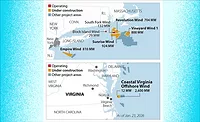
Dominion Energy's estimated $10-billion, 2.6-GW Coastal Virginia Offshore Wind project off Virginia Beach, set to complete construction next year of 176 turbines, is among the five Atlantic Ocean projects claimed by the Trump administration to be a "national security" risk.
UPDATED: Dominion Energy filed a federal lawsuit Dec. 23 in Norfolk, Va. against the U.S. Interior Dept. immediate construction pause order for its 2.6-GW Coastal Virginia Offshore Wind energy project (CVOW) off Virginia Beach, Va., which it developing to begin operation next year. The project is one of five large East Coast offshore wind projects under construction that the federal agency paused, claiming new "national security" risks. Dominion and OSW Project LLC, the entity that includes project co-owner Stonepeak Partners, a private investor, said they seek a temporary restraining order.
A hearing on the Dominion request is now set for Jan. 16, 2026 before U.S. District Court Judge Jamar Walker, with the administration expected to provide classified information for review by Jan. 9. The court did not grant the restraining order request to allow immediate restart of work while the larger case proceeds, instead converting it to a preliminary injunction, as the department sought, with a decision to follow the hearing.
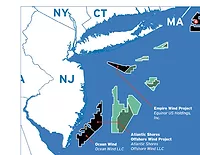
In addition to that project, Interior said on Dec. 22 that the initial 90-day pause that could be extended, applies to the 800-MW Vineyard Wind 1 project off Massachusetts, which already has about half of its 64 turbines operating; the 810-MW Empire Wind and 920-MW Sunrise Wind projects off New York; and the 704-MW Revolution Wind project between Rhode Island and Connecticut that faced a previous Trump shutdown order recently overturned by federal court order.
Interior Secretary Doug Burgum said the pause would allow added "review of emerging national security risks,” including claimed potential radar interference from large offshore wind installations and claimed "evolving adversary technologies."
All five projects have received multi-agency federal approvals, including from defense agencies, and together represent about $28 billion in investment, according to BloombergNEF.
The Virginia project suit said Interior's order "sets forth no rational basis, cannot be reconciled with ... prior issued [federal ocean] lease terms and approvals, is arbitrary and capricious, procedurally deficient, violates [federal law] and infringes upon constitutional principles that limit actions by the Executive Branch." The Dominion suit said the "illegal order is causing serious, irreparable harm to [the owner] and its customers, and must be immediately, and then permanently, vacated and enjoined."
These impacts include $5 million per day in costs related to its idled offshore construction vessel, and related expense for crews and stored equipment, the suit said.
Looking for quick answers on construction and engineering topics?
Try Ask ENR, our new smart AI search tool.
Ask ENR →
“If granted by the court, this will allow the project to resume work,” said a Dominion spokesman. “At the same time, we will work to seek resolution through cooperation with the agencies and the White House, with a focus on achieving a durable solution.” Dominion said it has already spent more than two-thirds of the total $11-billion stated project development cost.
The legal action "highlights the arbitrariness of Interior's halt of CVOW activities divorced from any CVOW-specific findings," Dominion said. The suit does not pertain to the other halted projects, but the energy firm termed the Virginia project pause order "the latest in a series of irrational agency actions attacking offshore wind and then doubling down when those actions are found unlawful."
But calling the order against all five projects “even more lawless and erratic” than the stop-work order for Revolution Wind struck down by a federal court in September, Connecticut Attorney General William Tong (D) said the state is "evaluating all legal options, and this will be stopped just like last time."
In a separate Dec. 23 joint statement, governors of Connecticut, Rhode Island, Massachusetts and New York said the federal lease pause "will also inject further uncertainty into the markets." They did not confirm nor rule out any joint or separate lawsuits, but they also seek to negotiate with the administration—potentially related to gas pipelline investment—according to comments by Connecticut Gov. Ned Lamont (D) to The New York Times.
The governors on Dec. 24 also sent a joint letter to Burgum outlning strong concerns with the project halt rationale and demanding a classified briefing related to claimed national security risks, according to a posting on New York Gov. Kathy Hochul's website.
Neither outgoing Virginia Gov. Glenn Youngkin, a Republican, nor recently elected successor Abigail Spanberger (D), is iisted as part of the governors' group and has not commented on that state's actions to reverse the shutdown—although both have strongly supported the CVOW wind project in past statements.
Meanwhile, Senate Democrats Sheldon Whitehouse (R.I.) and Martin Heinrich (N.M.) said Dec. 22 they would abandon current bipartisan negotiations on federal permitting reform legislation unless the administration reverses the lease pause.
Legal and Regulatory Context
The action follows a Dec. 10 ruling by U.S. District Judge Patti Saris in Boston vacating an earlier directive that paused federal permitting for onshore and offshore wind projects nationwide. That case was brought by 17 states and the District of Columbia, challenging a Jan. 20 presidential directive that halted federal wind approvals pending additional review.
Earlier this year, the Trump administration also moved to halt work on the Empire Wind and Revolution Wind projects, actions later reversed following discussions with New York and New England officials and, in the latter's case, a court-ordered restraining order sought by its developers, Orsted and private investor Blackrock.
In a research note. sector analyst ClearView said the pause "may not be a coincidence" with the Boston court ruling, said a report by wind sector publication Recharge. "Simply put, the administration may view [halt order] as a 'counterpunch' to judicial setbacks."
Denmark-based Orsted, also developer of the halted Sunrise Wind set to complete by the second half of 2027, said it might have to tap into an estimated $9-billion investor funding infusion gained earlier this year if projects have to be taken down. The firm's stock fell 13% on Dec. 22 after the government announcement
The developer said 44 of the project's planned 84 turbine foundations and its offshore substation were installed this year, and that construction of its 106-mile transmission cable from Smith Point, Long Island to the wind-energy lease area is more than 40% complete.
“Ørsted is evaluating all options to resolve the matter expeditiously,” the company said, including evaluating “potential legal proceedings.”
Norway-based Empire Wind developer Equinor said it is "evaluating the order and seeking further information from the federal government.” The firm had been preparing for the 262-ft construction vessel ECO Liberty, to start installing its 54 turbines, each 15MW, next spring. The ship, one of the first manufactured in the U.S., was launched in June from its Louisiana fabrication site.
The administration last May agreed to project completion after talks with Hochul that reports say also enabled renewed action to progress two gas proposed pipelines in New York. The estimated $5-billion Empire Wind project, which is set to provide power to New York City and including upgrade of the South Brooklyn Marine Terminal, had employed more than 4,000 workers before the current halt.
Hochul posted on social media that the administration will "look for any excuse to continue its assault on clean energy—and the thousands of good-paying jobs these projects bring— but there is no credible justification for this stoppage. The real threat to national security is in undermining our energy independence," she said.
Sector development experts also noted lack of detail used to support the administration position.
“All projects subject to the construction pause already underwent a national security review when they were permitted,” Philip Totaro, CEO of offshore wind consultant IntelStor, told ENR. “There are more than 80 GW of offshore wind projects operating globally, and while some did have legitimate radar interference issues, these were dealt with during the permitting process.”
Federal research has long acknowledged that wind turbines can create radar “clutter,” although studies by the U.S. Energy Dept. also say mitigation technologies and operational adjustments can reduce those effects.
Interior said it will work with Defense Dept. leaseholders and state partners to evaluate whether mitigation measures are feasible.
RELATED
UPDATED: Connecticut, RI Governors Fight Trump-Ordered Halt to Nearly Done Wind Project
Collective Push Back
Dominion Energy warned that the CVOW project pause could threaten grid reliability in one of the nation’s major military hubs and fastest-growing power markets.
“The Coastal Virginia Offshore Wind Project is essential for American national security and meeting Virginia’s dramatically growing energy needs,” said Jeremy Slayton, company spokesperson. “Stopping it for any length of time will threaten grid reliability for some of the nation’s most important war-fighting, AI and civilian assets.”
Slayton said the project supports thousands of jobs and was approved by Virginia regulators in 2022 following a detailed review.
Environmental and clean-energy groups criticized the pause of all projects. The Conservation Law Foundation said it revives arguments courts have previously rejected, exposing the government to more legal challenges. Ted Kelly, director and lead counsel for U.S. clean energy at the Environmental Defense Fund, said the administration was “recklessly obstructing the build-out of clean, affordable power for millions of Americans.”
Massachusetts Gov. Maura Healey said Interior had made “unfounded and unspecified claims” about national security risks related to offshore wind. “It is dangerous to halt construction in the middle of a project,” she said, adding that Vineyard Wind has agreements in place with the Defense Dept. and U.S. Air Force to address security concerns. The project is owned by Avengrid and Copenhagen Infrastructure Partners.
Vineyard Wind operating turbines will not have to shut down, Interior officials told the project in communicating the halt order. "Given that this project is partially generating power, you may continue any activities from those wind turbines that are necessary for the current level of power generation,” they said. But there has been no public confirmation or update of the previously stated project completion year end date.
But regional grid operator ISO New England said pausing completion of Vineyard Wind and Revolution Wind could cause power supply shortfalls. "Both projects are included in our near-term and future modeling and analyses to ensure adequate electricity for New England," it said.
RELATED
Boston Federal Court Rejects Trump Blanket Halt of Wind Energy Approvals
Labor leaders also warned of immediate workforce impacts. Kendall Martin, president of the Ironworkers District Council of the Mid-Atlantic States, said pausing work in Virginia would sideline workers who have spent nearly two years building the project. “Halting [its] construction and operations ... is nothing short of devastating for the workers,” he said, adding that they were told the pause would eliminate their jobs for at least 90 days.
Frank Callahan, president of the Massachusetts Building Trades Unions, said the suspension order amounted to “a layoff notice for many union trades workers just three days before Christmas.”
But Green Oceans, a group critical of offshore wind energy development, said the action is a proactive effort to address missile-defense vulnerabilities tied to offshore infrastructure.
Interior did not immediately release project-specific stop-work orders or detail how the lease pause will affect construction schedules, marine operations or supply-chain contracts. Developers and state agencies said they were reviewing the announcement and awaiting formal direction from federal regulators.
IntelStor’s Totaro urged challenges to the pause.
"Developers need to get comfortable with defying these shutdown orders because the consequences of defiance actually pale in comparison to the billions they stand to lose if they pause construction," he said. "Projects could literally run out of budget and never finish construction, and the [U.S.] government knows this. It’s their strategy. "
He added: "The fact that this is a deliberate order issued in bad faith, and that developers have grounds to demonstrate is why they should be allowed to defy the order. They could also seek compensation from the government for intentionally interfering with the project development process.
Totaro pointed to Equinor in particular, noting its "agreement in place" as "evidence of bad faith" by the government, also suggesting that the sovereign wealth fund of Norway, which is the firm's majority owner, has $850 billion invested in the US, "investigate pulling some of that out."