Mergers & Acquisitions
Trump Media–TAE Merger Sets No Obligation to Build Fusion Plant
Federal SEC filings show the combined company states no fixed commitment to future construction of commercial-scale energy
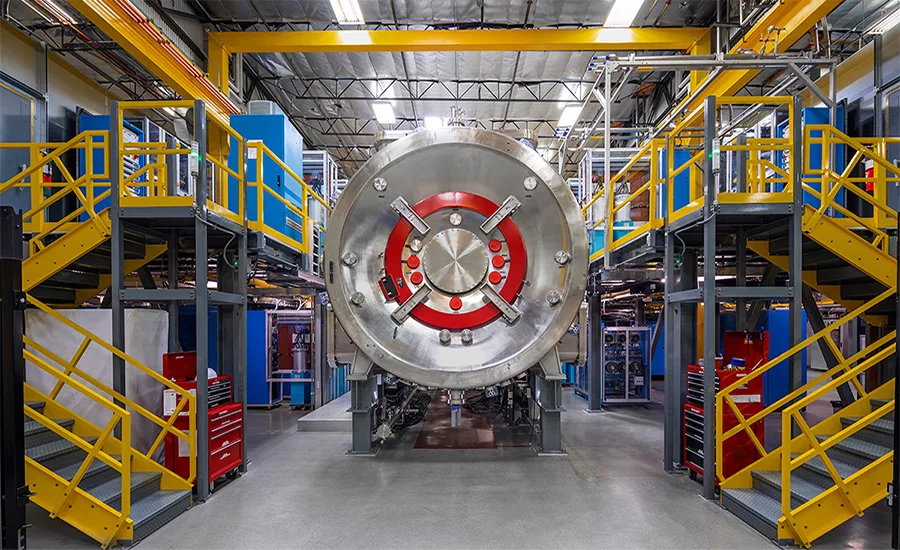
An experimental fusion power device at a TAE Technologies research facility demonstrates the company’s laboratory-scale work. US SEcurities and Echange Commission filings tied to Trump Media & Technology Group’s planned $6B merger with the developer do not commit the combined company to build or permit a commercial-scale fusion energy plant.
President Donald Trump’s publicly traded social media company, Trump Media & Technology Group, announced on Dec. 18 a planned $6-billion merger with nuclear fusion power developer TAE Technologies—placing speculative energy technology at the center of a high-profile corporate transaction.
Federal securities filings show the deal does not obligate the combined company to build, site or permit a fusion power plant. A Form 8-K filing with the U.S. Securities and Exchange Commission outlines what the company has contractually agreed to do—and what it has not.
RELATED
Nuclear Fusion Pushes to Reach Commercial Power Plant Stage
Under the agreement, Trump Media remains the publicly traded parent company and formed a wholly owned unit to execute the transaction, with Foothill Ranch. Calif.-based TAE surviving as a wholly owned subsidiary of that company. While its statements and investor materials reference ambitions to develop a “utility-scale” fusion power plant, the merger agreement itself does not require the combined company to undertake construction activity.
Any discussion of development schedules appears only in forward-looking disclosures. In its filing, Trump Media cautioned that such statements include expectations regarding “development and construction timelines; cost competitiveness of fusion-generated electricity; [and] timing of commercialization of TAE’s fusion technology,” all of which remain subject to significant uncertainty. The filing also warned of risks including regulatory hurdles, financing challenges and “delays in the development and manufacturing of fusion power plants and related technology.”
Read More
SEC Filing | Form 8-K
Trump Media emphasized that the Form 8-K should not be treated as definitive, stating it “is not a substitute for the registration statement, the proxy statement/prospectus and consent solicitation statement,” which it said will contain additional information about the transaction and related risks “if and when they become available.”
TAE Technologies is privately held and has raised more than $1 billion in private capital since its founding in 1998 from investors including Google, Chevron Technology Ventures, Goldman Sachs and Sumitomo Corp. of America.
Looking for quick answers on construction and engineering topics?
Try Ask ENR, our new smart AI search tool.
Ask ENR →
Digging Deeper
SEC Filing | Agreement and Plan of Merger
Trump Media’s ownership structure adds a governance dimension to the transaction.
According to company disclosures, Trump owns roughly 59% of its outstanding stock, about 114.8 million shares, held through the Donald J. Trump Revocable Trust and managed by his son, Donald Trump Jr., as trustee. Based on that holding, the share price jump translated into an approximately $500-million increase in the paper value of the president’s stake.
Ethics specialists said the transaction highlights potential conflicts inherent in a sitting president maintaining a controlling stake in a publicly traded company expanding into a heavily regulated sector. Richard Painter, former chief White House ethics lawyer under President George W. Bush, told The Washington Post the merger presents “a huge conflict of interest” because fusion commercialization would depend on regulatory decisions and could require government support.
For engineering and construction markets, the filings indicate nothing beyond a long-term bet on fusion development rather than a defined project opportunity. Fusion power has not yet been commercialized, and any future facility would require separate site selection, permitting and capital commitments that are not addressed in the transaction documents.
Trump Media said it plans to file a Form S-4 registration statement with the commission, which is expected to provide additional detail on the background of the merger, financial assumptions and risk factors. Until those materials are filed, the disclosed agreements stop short of committing the company to build energy infrastructure.

Bryan Gottlieb is the online editor at Engineering News-Record (ENR).
Gottlieb is a five-time Society of Professional Journalists Excellence in Journalism award winner with more than a decade of experience covering business, construction and community issues, including finance, law and real estate. He has reported for Adweek and the San Diego Daily Transcript and led a community newsroom in Santa Monica, Calif. He served as editor-in-chief of the Detroit Metro Times and as managing editor at Roofing Contractor, where he helped shape national industry coverage. At Engineering News-Record, Gottlieb covers breaking news, large-scale infrastructure and megaprojects, regulatory developments and business trends across the U.S. and global construction sectors.
email: gottliebb@enr.com | office: (248) 786-1591