Commercial Development
Turner Tapped to Build $500M Westcourt Orlando Mixed-Use District
Long-delayed arena-adjacent project combines hotel, residential, office, retail, venue and parking on 8.5-acre downtown site

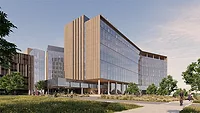
Rendering of the planned Westcourt Orlando mixed-use district adjacent to the Kia Center in downtown Orlando. Turner Construction has been selected as general contractor for the $500-million development, which includes hotel, residential, office, retail and entertainment components.
Turner Construction Co. was selected May 5 as general contractor for Westcourt Orlando, a long-delayed $500-million mixed-use development planned next to the Kia Center in Orlando, Fla., after years of financing hurdles and redevelopment planning.
The 900,000-sq-ft project occupies an 8.5-acre downtown Orlando site directly north of the arena—home of the NBA’s Orlando Magic. Early site activity is now underway, Turner said.
Leasing and development materials reviewed by ENR describe the project as fully entitled and designed, with groundbreaking targeted for the second quarter of 2026 and opening projected for late 2028.
Read More
Westcourt Orlando Development Materials
“JMA Ventures has a clear vision for what Westcourt Orlando can become, and we’re grateful for the opportunity to help bring it to life,” Jeff Justen, Turner vice president and general manager, said in the company’s announcement.
“A project like this demands coordination across dozens of trades working simultaneously on very different building types—that’s the challenge we’re built for,” Justen added.
Construction Sequencing Will Drive Delivery

Westcourt Orlando is positioned within downtown Orlando’s expanding sports, entertainment and residential corridor.
Map courtesy of Westcourt Orlando
Overlapping hospitality, residential, office, entertainment and structured parking components are expected to require tightly phased procurement and trade coordination adjacent to an operating arena and an active downtown event district.
Early enabling work includes utility mapping, surveying and test piles for the deep foundation program. The contractor said work packages will be organized to promote broad participation across multiple components, creating opportunities for local subcontractors and trade partners.
Looking for quick answers on construction and engineering topics?
Try Ask ENR, our new smart AI search tool.
Ask ENR →
The developer team is led by JMA Ventures, with Machete Group Inc., a sports and entertainment venue advisory firm, and the DeVos family, owners of the Orlando Magic. Baker Barrios is the project’s architecture, planning and urban design firm.
Plans call for an 11-story, 265-key Kimpton-branded hotel, 269 high-rise residential units, a 3,500-capacity Live Nation-operated venue, 125,000 sq ft of entertainment and dining-focused retail space, up to 310,000 sq ft of Class A office space, 1.5 acres of landscaped open space and a seven-story, 1,140-stall parking structure.
Project materials describe 45,000 sq ft of meeting and conference space distributed across the development, including 16,000 sq ft within the Kimpton-branded hotel and a 6,000-sq-ft glass-enclosed sports court and event space atop the office building.
Additional event capacity would come from a planned 3,500-capacity Live Nation-operated venue. A separate International Council of Shopping Centers case study describes a 65,000-sq-ft event venue and festival plaza tied to the broader entertainment district.
The office tower includes a 17,000-sq-ft rooftop amenity level with a fitness facility, tenant lounge, conference room, coworking space, outdoor terrace and other features, according to leasing materials.
RELATED
San Antonio Voters Approve Plans for $1.5B Downtown Spurs Arena
Public Funding Helped Move Project Forward
Public-sector participation has been central to the project’s advancement. Orlando’s Community Redevelopment Agency, under an updated developers’ agreement reviewed by ENR, increased its funding from $1.7 million to $2.5 million to support building the meeting space and address rising construction costs.
In exchange, the joint venture must commence construction of the event space within three years of the agreement’s effective date. The city will be able to host as many as 10 government- or civic-related events annually without paying a facility rental fee—seven at the hotel space and three at the 65,000-sq-ft venue—according to the case study.
The tax-increment structure allows the city to reimburse SED Partners for property taxes collected on the development site. For the first four years, 100% of the tax-increment revenue generated by the project would be recaptured, then transition to 80% recapture until Jan. 1, 2042, with a total cap of $40 million. The cap would fall to $35 million if the office component is not built, and payments would begin after the first project component is completed, the case study outlines.
RELATED
Mortenson Picked to Build $1.3B Tampa Bay Baseball Stadium
Housing and Retail Add Civic Commitments

The mixed-use district will include attainable housing units and retail opportunities.
Rendering courtesy of Turner Construction
A cost-benefit analysis projects the development will generate more than $860 million in economic output and support about 800 workers on site at peak—roughly 1,600 direct construction jobs over full buildout—before adding 3,000 permanent jobs annually upon delivery.
The development includes 10 attainable housing units for at least 10 years for households earning 80% or less of area median income, set at $69,500 for a three-person household in Orange County under HUD's 2024 income limits.

Bryan Gottlieb is the online editor at Engineering News-Record (ENR).
Gottlieb is a five-time Society of Professional Journalists Excellence in Journalism award winner with more than a decade of experience covering business, construction and community issues, including finance, law and real estate. He has reported for Adweek and the San Diego Daily Transcript and led a community newsroom in Santa Monica, Calif. He served as editor-in-chief of the Detroit Metro Times and as managing editor at Roofing Contractor, where he helped shape national industry coverage. At Engineering News-Record, Gottlieb covers breaking news, large-scale infrastructure and megaprojects, regulatory developments and business trends across the U.S. and global construction sectors.
email: gottliebb@enr.com | office: (248) 786-1591