Analysis
Infrastructure Gains in New ASCE Report Card—but Progress Hinges on Post-2026 Funds
American Society of Civil Engineers 2025 analysis shows broad gains, but also aging assets, climate risk and a 2026 funding cliff that threaten project delivery

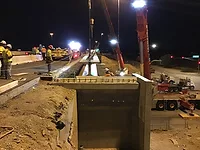
A wastewater treatment plant demonstrates the size and high cost of U.S. infrastructure systems that the American Society of Civil Engineers says are improving overall but remain vulnerable without continued investment after 2026.
America’s infrastructure is showing its clearest signs of improvement in decades, but the momentum remains dependent on sustained funding and delivery capacity as federal investment approaches a critical inflection point, according to the American Society of Civil Engineers’ 2025 Infrastructure Report Card.
ASCE raised the nation’s overall infrastructure grade to a C from a C- four years ago, with nearly half of the 18 evaluated categories improving and no sector receiving a D- for the first time since the report card was introduced in 1998. The gains reflect the early impact of the 2021 Infrastructure Investment and Jobs Act and related federal programs that began distributing more funding in 2022.
Still, ASCE cautions that the improvements are driven largely by short-term funding increases rather than long-term certainty, leaving aging and climate-exposed systems vulnerable to upgrade project delivery if investment slows once the law's authorizations expire in 2026.
Even if current funding levels continue, ASCE estimates a $3.7-trillion investment gap over the next decade to bring infrastructure systems into a state of good repair.
“Considering the extensive time it takes to study, design and complete projects, sustained investment at current or higher funding levels will be necessary for infrastructure to continue to improve,” the group said in the report.
Infrastructure Improves, but Timing Now Matters

The American Society of Civil Engineers’ 2025 Infrastructure Report Card finds that U.S. infrastructure conditions are improving overall but gains remain vulnerable without sustained post-2026 investment. Read the full report.
Image courtesy of ASCE
The 2025 report shows gains across several historically underperforming sectors, but progress remains uneven across interconnected systems. Ports received the highest grade, a B, while rail also improved. At the lower end, stormwater and transit investment remained at a D grade, and roads, levees, schools and wastewater facilities posted only marginal gains.
Energy was downgraded despite record federal spending—with ASCE citing growing capacity constraints, rising demand from electrification and data centers, and lagging transmission and grid modernization relative to system complexity. The downgrade underscores a broader challenge facing multiple sectors: investment alone does not guarantee improved performance when coordination and execution capacity lag.
Looking for quick answers on construction and engineering topics?
Try Ask ENR, our new smart AI search tool.
Ask ENR →
The divergence highlights a growing coordination risk. When improvements advance at different speeds across interdependent systems, weaknesses in one network can undermine gains elsewhere.
Capital Rises Faster Than Delivery Capacity
ASCE estimates that achieving and maintaining a state of good repair across all 18 infrastructure categories would require $9.1 trillion in investment from 2024 to 2033. Public and private funding is projected to reach about $5.4 trillion over that period if recent federal investment levels hold, leaving a $3.7-trillion shortfall.
For infrastructure owners, that gap is already shaping how projects are sequenced, scoped and bid. Agencies prioritize preservation of “fair-condition” assets and defer discretionary expansion to avoid triggering more costly rehabilitation later. That preservation bias is increasingly reflected in bid packages favoring rehabilitation, phased construction and programmatic delivery over single, all-at-once megaprojects.
RELATED
US Infrastructure Grade Improves to a C on ASCE Report Card, Bolstered by Federal Funding
ASCE also stresses that outcomes depend not only on federal funding but also on state, local and utility execution capacity. Jurisdictions with mature capital programs and bonding authority are better positioned to absorb infrastructure act dollars, while others face delays tied to staffing shortages, rate constraints or limited delivery experience.
But funding is only part of the equation. Across nearly every infrastructure category, ASCE identifies climate-driven stress as a defining performance factor. Extreme weather events caused more than $180 billion in damage in 2024, reinforcing ASCE’s conclusion that resilience investments—while increasing upfront costs—reduce long-term financial and operational risk.
That shift is expanding scopes, schedules and bid pricing across multiple sectors. Life-cycle cost analysis is increasingly embedded in funding criteria and procurement decisions—particularly for water, transportation and energy assets exposed to flooding, heat and wildfire risk.
Compounding the challenge is a persistent workforce shortage across engineering, construction and inspection roles. Even as funding has increased, many owners lack sufficient in-house staff or contractor capacity to deliver projects at scale, widening the gap between their complexity and available labor and technical resources, ASCE notes.
Less visible, but equally consequential, are persistent data gaps. ASCE found that unreliable or incomplete asset data remains common in sectors including stormwater, levees, schools, broadband and public parks. In practice, those gaps shift risk back onto owners and contractors, steering agencies toward conservative delivery strategies that limit financial exposure but slow systemwide improvement.
RELATED
$900B Final Defense Bill Passes House With Sweeping Procurement, Infrastructure Changes
The 2026 Test: What Grades Don’t Show
The report’s central warning is operational, not academic: timing now matters as much as funding.
Authorizations under the Infrastructure act expire in 2026, but projects often require years of planning before construction begins. ASCE warns that uncertainty over when projects are bid, how they are packaged and whether they proceed could delay delivery, fragment scopes and raise long-term costs.
What the grades do not show is how owners are already responding to that uncertainty.
Across sectors, agencies are advancing environmental reviews and preliminary design work ahead of construction, breaking large programs into phased or programmatic contracts and prioritizing rehabilitation of “fair-condition” assets over expansion projects carrying higher long-term risk.
For contractors, that shift is reshaping backlog composition—favoring steady program work over single, all-at-once awards. While the approach limits risk in an uncertain funding environment, it also stretches delivery timelines and slows needed systemwide improvement.
For owners, engineers and contractors, the next two years will determine whether today’s planning pipeline converts into durable construction—or whether deferred maintenance once again becomes the dominant strategy for U.S. infrastructure systems.

Bryan Gottlieb is the online editor at Engineering News-Record (ENR).
Gottlieb is a five-time Society of Professional Journalists Excellence in Journalism award winner with more than a decade of experience covering business, construction and community issues, including finance, law and real estate. He has reported for Adweek and the San Diego Daily Transcript and led a community newsroom in Santa Monica, Calif. He served as editor-in-chief of the Detroit Metro Times and as managing editor at Roofing Contractor, where he helped shape national industry coverage. At Engineering News-Record, Gottlieb covers breaking news, large-scale infrastructure and megaprojects, regulatory developments and business trends across the U.S. and global construction sectors.
email: gottliebb@enr.com | office: (248) 786-1591