Government
Project Permit Reform Measure Advances in Congress
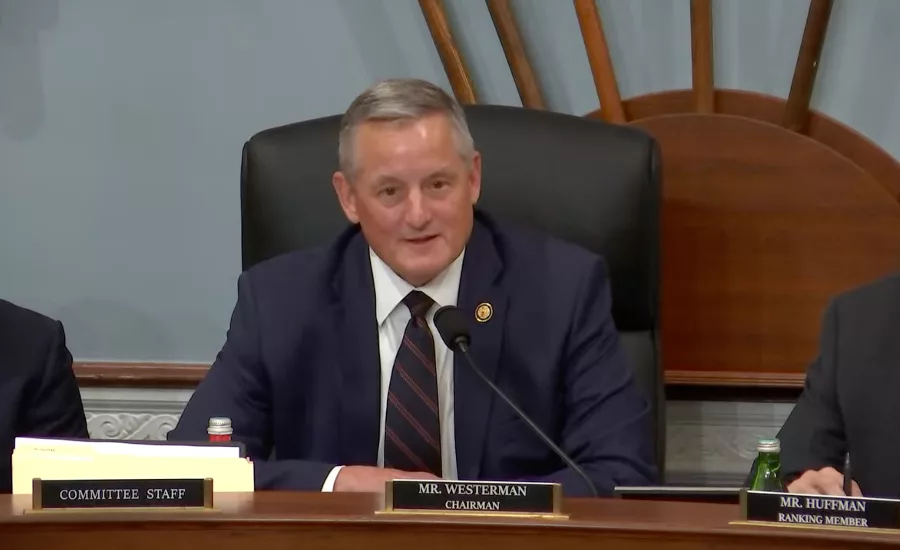
GOP Rep. Bruce Westerman of Arkansas introduced the bill, which passed the committee Nov.20 and next moves to the full House.
Legislation aimed to hasten federal permitting for projects is advancing through Congress as the House Natural Resources Committee voted Nov. 20 to forward an amended version of the Standardizing Permitting and Expediting Economic Development, or SPEED Act, for a full vote. But even with some bipartisan support for permit reform, opponents say the measure goes too far to weaken the National Environmental Policy Act by reducing transparency and limiting the ability of those impacted by a project to provide input or challenge it.
The bill brought by committee Chair Bruce Westerman (R-Ark.), approved 25-18, emphasizes that NEPA is “procedural” and does not mandate a particular result when agencies consider project environmental impacts. During the committee markup hearing, he said the legislation is “project-neutral” and “would tackle a number of problems at the heart of NEPA dysfunction that is present today.”
The SPEED Act would codify the U.S. Supreme Court ruling last year in the Seven County Infrastructure Coalition case, in which justices unanimously ruled against environmental advocates who argued the proposed $1.4-billion Uinta Basin Railway in Utah would have detrimental impacts on communities in Louisiana near where oil transported on the railroad would be refined. The legislation states that agencies performing NEPA reviews may only consider “those effects that share a reasonably close causal relationship to, and are proximately caused by, the immediate project or action under consideration.”
The bill would place additional limits on what agencies can consider in their environmental reviews, directing them to rely more on past assessments for similar projects. It would also remove a requirement that a project receiving federal funding—including a grant, loan, loan guarantee or other assistance—would mandate an environmental review.
Rep. Jared Huffman (D-Calif.), ranking committee member, questioned how many projects might be waived from requiring environmental review as a result, pointing to U.S. Dept. of Transportation-funded highway projects as an example. The bill would have “wide-ranging and detrimental ripple effects,” he said.
The SPEED Act would also set deadlines for agencies performing NEPA reviews to complete various pieces of the process, direct any cooperating ones to carry out assessments concurrently and prevent them from rescinding previously issued permits.
The bill would also limit challenges to permits and projects following reviews. Opponents would have just 150 days after a permitting approval to file a legal challenge. A courts hearing a case would also have limits, required to “afford substantial deference to the agency” and prevented from “subsitit[ing] its judgment for that of the agency regarding the environmental effects.”
Looking for quick answers on construction and engineering topics?
Try Ask ENR, our new smart AI search tool.
Ask ENR →
Bipartisan Interest, But Questions Emerge
Republicans have sought to promote the SPEED Act as bipartisan, and committee Democrats expressed a desire to implement permit reform. Seven have signed on to co-sponsor the SPEED Act but only two voted to advance the bill in its current form, with others criticizing its far-ranging potential impacts.
“In our meetings, we heard a real hunger for bipartisan permitting reform. This bill is not it,” Huffman said. “This bill is so extreme that there’s simply nothing left, in a meaningful way, of NEPA if this were to become law.”
The bill has generally received a favorable response from the construction industry. In a letter to lawmakers in September, Alex Etchen of the Associated General Contractors of America highlighted the industry’s need to clarify and streamline various aspects of NEPA.
“Project delays caused by prolonged NEPA reviews, permitting, and litigation increase costs and harm the construction workforce by delaying job creation, disrupting hiring and reducing economic activity,” he wrote. “The delays increase labor and material costs, forcing contractors to reprice projects and potentially leading to cost overruns.”
Bill opponents raised concerns that Trump administration actions have slowed project approvals. The White House has moved to claw back billions of dollars in project funding since Donald Trump took office in January, and to fire thousands of federal workers—potentially leaving permitting agencies under-resourced to conduct efficient and thorough reviews.
“Adequate staffing and resources delivered improvements in permitting timelines last year, and yet this bill does nothing to stop the indiscriminate firings of career civil servants or disregard for congressional direction on funding,” Matthew Davis, vice president of federal policy at the League of Conservation Voters, said in a statement.
Ray Long, president and CEO of the American Council on Renewable Energy, said in a statement that the group applauds lawmakers for advancing the SPEED Act, calling for project-neutral permitting and removal of roadblocks to fully permitted projects. But fully funding and staffing permitting agencies is also key to progress approvals, especially as increased energy demand presses for more projects to provide needed infrastructure.
“Durable, bipartisan permitting reforms that provide project certainty and speed up energy infrastructure build-out will help keep the lights on and reduce electricity costs,” he said. “With less than four years to add the equivalent of 15 New York Citys worth of electricity to the grid, it is critical that energy infrastructure projects can move forward quickly.”