Economics
ABC Says Nonresidential Spending Slips Again as Manufacturing Weakens
August Census data show third decline in four months
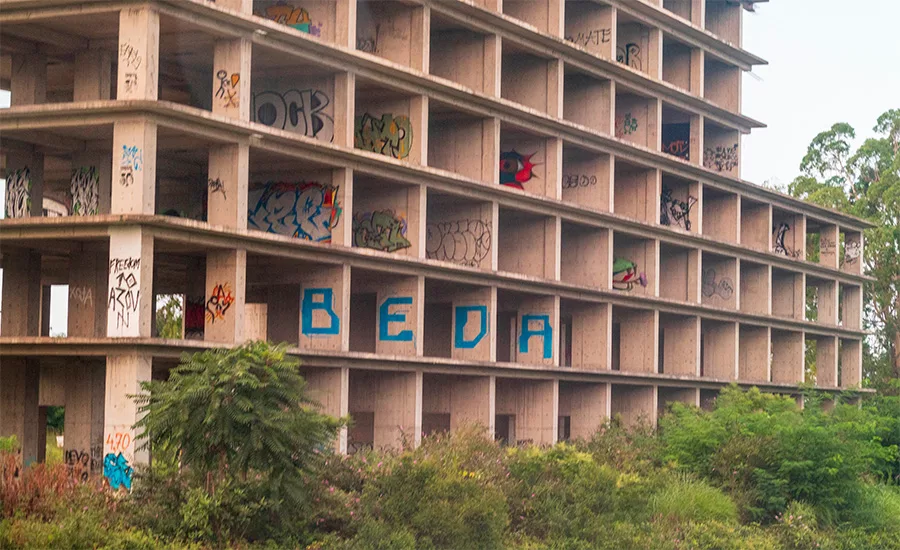
An unfinished commercial shell shows signs of prolonged vacancy and vandalism. Census data analyzed by ABC show commercial construction spending fell 0.1% in August and is down 7.5% from a year earlier, part of a broader softening across private nonresidential markets.
National nonresidential construction spending fell 0.2% in August to a seasonally adjusted annual rate of $1.24 trillion, according to Associated Builders and Contractors’ analysis of newly released U.S. Census Bureau data.
The decline is the third in four months and continues a gradual cooling from early 2024 highs, when a wave of semiconductor, battery and clean-energy megaprojects pushed nonresidential outlays to record levels before they plateaued.
Private nonresidential spending decreased 0.3% in August and is down 4.0% year-over-year, while public nonresidential work slipped 0.1% for the month but remains up 2.4% annually. Total construction spending held nearly flat at $2.17 trillion.

Census data analyzed by Associated Builders and Contractors show that nonresidential construction spending slipped 0.2% in August to $1.24 trillion, with manufacturing down 0.9% for the month and 8.2% year over year, as the sector continues to cool from its recent surge in megaprojects.
Sector Analysis
Sector-level results were mixed: Manufacturing posted the sharpest decline, down 0.9% in August and 8.2% from a year earlier—the steepest annual drop in any nonresidential category—as the megaproject cycle that fueled 2022–24 growth continues to unwind.
Commercial construction decreased 0.1% for the month and is down 7.5% year-over-year, while office construction declined 0.4% in August. Lodging declined 0.4% for the month and 1.7% year-over-year. Sewage and waste disposal fell 0.7% in August.
RELATED
Construction Faces Higher Costs, Weaker Jobs Amid PPI Downturn
Several public-facing categories improved. Highway and street spending increased 0.2% for the month, reflecting continued federal formula funding under the Infrastructure Investment and Jobs Act.
Looking for quick answers on construction and engineering topics?
Try Ask ENR, our new smart AI search tool.
Ask ENR →
Water supply construction increased 0.4% in August and 2.3% year-over-year. Educational spending climbed 0.7% for the month.
Public safety, conservation and development and water-related segments all posted annual gains. The religious category rose 20.8% year over year, though from a comparatively small base.

ENR’s latest 3Q Cost Report examines current economic pressures on construction, including slowing nonresidential spending and shifting materials trends.
“Nonresidential construction spending contracted for the third time in the past four months in August and is now down 1.5% year over year,” said ABC Chief Economist Anirban Basu, noting that weakness remains concentrated in manufacturing and commercial work.
By contrast, data centers continue to outperform. Basu said approximately one in seven ABC members are currently under contract to build data centers and are reporting higher backlog levels than those without such work.
Basu added that the August figures precede impacts from the prolonged federal government shutdown that began in September, as well as cost-raising tariffs that took effect Aug. 1.
“With private nonresidential activity buckling under the weight of high borrowing costs, extraordinarily elevated uncertainty and rising materials costs, a slowdown in public-sector work could lead to a particularly difficult few quarters for the industry,” he said.
Despite recent easing, Census long-term spending data show that nonresidential construction remains substantially above pre-2022 levels, underscoring how dramatically megaproject and data-center activity expanded the market over the past three years.
As agencies work through shutdown-related delays and contractors assess the impacts of tariffs and interest-rate conditions, spending performance in the final quarter of 2025 will indicate whether the current slowdown stabilizes or deepens.

Bryan Gottlieb is the online editor at Engineering News-Record (ENR).
Gottlieb is a five-time Society of Professional Journalists Excellence in Journalism award winner with more than a decade of experience covering business, construction and community issues, including finance, law and real estate. He has reported for Adweek and the San Diego Daily Transcript and led a community newsroom in Santa Monica, Calif. He served as editor-in-chief of the Detroit Metro Times and as managing editor at Roofing Contractor, where he helped shape national industry coverage. At Engineering News-Record, Gottlieb covers breaking news, large-scale infrastructure and megaprojects, regulatory developments and business trends across the U.S. and global construction sectors.
email: gottliebb@enr.com | office: (248) 786-1591