Green Transition Goes Local: States and Cities Tackle Climate Change as US Protections Relax
September 24, 2025
Green Transition Goes Local: States and Cities Tackle Climate Change as US Protections Relax
September 24, 2025Collage illustration by Scott Hilling/ENR, earth by NASA/NOAA/GSFC/Suomi npp/viirs/Norman Kuring, cityscape by Getty Images/urfinguss, Capitol by Getty Images/code6d, statue of justice by Getty Images/arsenisspyros, solar panel by Getty Images/jarnbeer19, lever by Getty Images/3drenderings, lightning bolt by Getty Images/designer29, smoke stack by Getty Images/ asm_Zealot, smoke plume by Getty Images/Antagain, brown background by Getty Images/Mubera Boskov, green leaves in the public domain via Rare Book Division, The New York Public Library. “Strelitzia Reginae” The New York Public Library digital collections. 1805 - 1816., Lawsuit graphic courtesy of ag.hawaii.gov

The ongoing string of executive orders, federal agency actions, Congressional lawmaking and court cases relating to climate change and the clean energy transition has become one of the hard swerves in federal policy defining the second Trump administration.
Among enacted or proposed rescissions and “clawbacks” are cancellation of billions of dollars in grants for renewable energy and climate change-related infrastructure work, removal of restrictions on coal and gas-fired plant emissions as well as 29 other clean water, air and climate regulations; and a move to end the basis for much of the U.S. Environmental Protection Agency’s regulatory muscle—the greenhouse gas Endangerment Finding. Monetary losses from canceled grants and projects have had knock-on effects, leading to a loss of $22 billion from clean energy project cancellations in the first half of 2025, according to the nonpartisan climate advocacy group E2.
Many lawsuits challenging these funding cancellations are still winding through the courts. But that is not the only avenue for action on the transition to a net-zero or lower-carbon emissions future. The current administration has slowed momentum on renewable energy and climate-related work, but state and local efforts aim to take up the slack, and private investors are showing interest in filling funding gaps.
States and municipalities continue to pass laws and introduce green energy and climate-related initiatives, often indirectly through building performance standards and electrification mandates. Lawsuits have been filed to force fossil fuel companies to fund green infrastructure and continue investments in renewable energy—and that pressure can drive national policy. “States are the testing grounds for policies and regulations that may ultimately be adopted at the federal level or by other states, thus having a wider impact on energy savings and greenhouse gas (GHG) emissions,” notes a 2025 report by the American Council for an Energy-Efficient Economy. Federal actions this year have put up undeniable hurdles and slowed progress, but they have not ended the inevitable transition.

More cities and states are adding benchmarking policies for various buildings categories, from public to commercial to mutlifamily. [Map via IMT]
Graphic Courtesy the Institute for Market Transformation
Building Decarbonization

Successful building performance standard adoption requires thoughtful planning and providing resources that help filers navigate the process. [Infographic via IMT]
Graphic Courtesy the institute for Market Transformation (IMT)
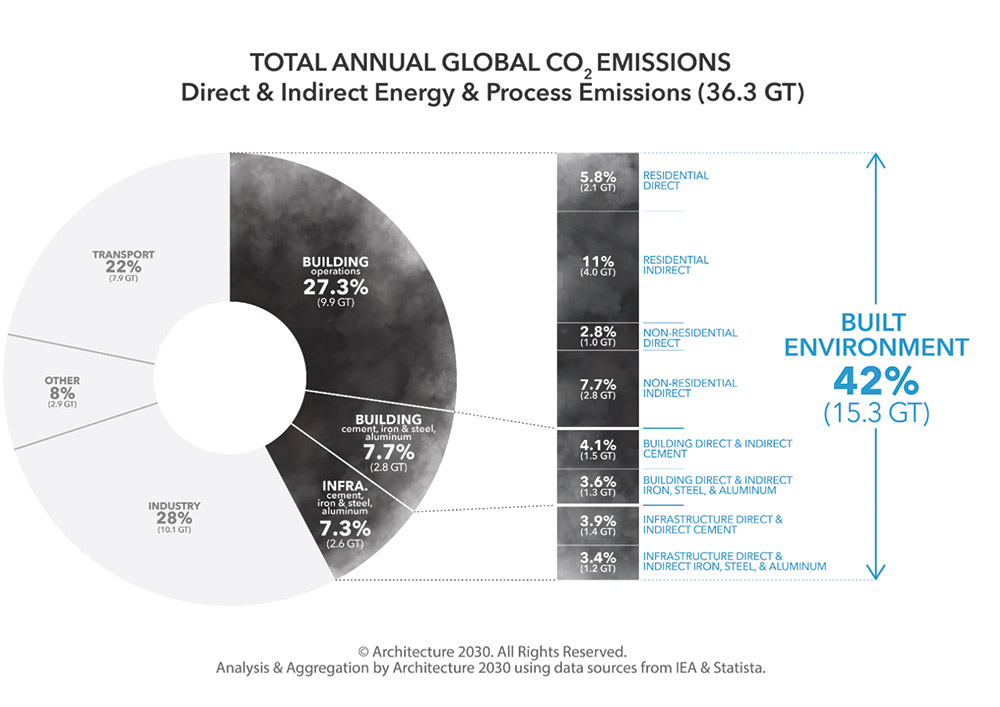
Comprising roughly 40% of total energy consumption in the U.S. and one-third of overall U.S. emissions, buildings offer a major lever for control through regulations at the state and municipal level. This is particularly true for decarbonization efforts in large cities such as New York City where buildings account for roughly 70% of emissions.
Adoption of benchmarking, energy efficiency building codes, building performance standards and electrification laws have ramped up in recent years. Building performance standards has been adopted in 15 cities and states since Washington, D.C., did so first in 2018. These policies are “the most important and powerful tool for reducing emissions from existing buildings,” says Alex Dews, CEO of the Institute for Market Transformation, a nonprofit that promotes building efficiency efforts.
Benchmarking policies now exist in various forms in seven states and 49 cities, setting requirements for public, commercial and multifamily buildings. In August, New Orleans became the latest city to pass a benchmarking ordinance, with unanimous support from the city council. While benchmarking requires merely measuring and reporting emissions, it is a crucial first step to targeted energy use reduction measures. If done consistently, benchmarking policies lead to an annual average energy savings of 2.4%, according to a 2021 U.S. Environmental Protection Agency report.
Cost-benefit analysis can make it an easier sell, including to building owners reluctant to take on the cost and engage with decarbonization as a social good. “Regardless of anybody’s thoughts about sustainability and climate change ... everybody wants to save on operating costs,” says Tristan Schwartzman, principal and director of energy services at engineering consulting firm Goldman Copeland, whose services include compliance with New York City’s Local Law 97.
This past May marked the start of the initial reporting period for the law, one of the nation’s first building performance standards mandates, passed in 2019. Results will be closely watched, along with those in St. Louis and Denver, which also began reporting this year.
On the climate and sustainability policy side, “New York City has been a leader for a long time and, because of the density of [its] built environment, [there is] a huge amount of impact,” says Dews. “There are so many buildings that are covered by Local Law 97, and so many of the largest real estate actors in the world that either have assets or are based in New York City, so it is the subject of intense scrutiny and focus. In some ways, it is a model for how building performance standards have been developed.” But there are necessary variations in standards to account for geographic and environmental differences, he notes.
The city’s law covers buildings over 25,000 sq ft, which make up 38% of its greenhouse gas emissions. Owners must report on and meet certain carbon emissions limits during a series of compliance intervals with increasingly stricter limits in future years, eventually reaching net zero emissions by 2050. Limits for the first filing period, with compliance based on 2024 reporting, vary depending on building type, but 92% of all affected buildings were already in compliance in 2023, according to the Urban Green Council.
Much of what was necessary to meet requirements for this reporting period could be achieved with calibrating and optimizing existing systems, particularly steam heating, allowing owners to focus on more ambitious future changes, says Schwartzman, something that certain building owners already are considering. “The big Class A commercial office buildings have been looped into energy efficiency for a long time. It’s important to their shareholders ... and to their expensive leasing contracts that they’re able to get there,” he adds. “Over the last few years … they have been trying to figure out what it would cost to meet 2030 and 2035 [emissions targets].”
Schwartzman says other building classes are also considering future requirements. “It’s my opinion that at least 80% of building stock in New York City can meet 2030 [requirements] without any major electrification projects. If they get themselves tuned up and running tightly, they’ll be fine.”
This is by design, notes Dews. It allows participants to get on board by encouraging energy efficiency efforts in a more manageable, incremental manner. While there are noncompliance penalties under Local Law 97, the focus is on participation rather than punishment.
Beyond 2030, existing buildings will have to make more ambitious changes to meet goals with electrification retrofits, including replacing fossil-fuel-based heating systems, as well as cooling and water systems, with heat pumps.
Updated Local Codes Shown to Help Offset Major Energy Consumption
Graphic Courtesy Architecture 2030
The U.S. building sector has seen its overall energy consumption decline by 8.2% since 2005, despite adding 70 billion sq ft, reports Architecture 2030, a climate action nonprofit that promotes sustainable and zero-carbon design. It also said that power use by buildings dropped nearly 11% over the same period.
The scale of such an achievement compares to “designing and constructing 44 new cities the size of Chicago, while simultaneously reducing overall building sector energy and electricity consumption,” says Edward Mazria, founder of Architecture 2030, in a recent article in the magazine Architect. He explains that this is due partially to “efficiency gains” from planning and building design, as well as to retrofits and adoption of the latest building energy codes and standards.
Looking for quick answers on construction and engineering topics?
Try Ask ENR, our new smart AI search tool.
Ask ENR →

In Maine, which has a 2045 carbon neutrality target, the volunteer board that oversees the state Uniform Building Energy Code voted last December to adopt the 2021 International Energy Conservation Code, sometimes called the “stretch code,” since insulation levels and other specs stretch beyond previous 2015 requirements.
Since Boston’s first-in-the-nation net-zero carbon zoning rule went into effect July 1, local Associated General Contractors CEO John Ferrante says the contracting community has responded with more technical training and by hiring more sustainability experts. “Through AGC’s Sustainability Advisory Committee, we support progress in green building by offering professional development opportunities in partnership with organizations like Built Environment Plus and Passive House Massachusetts,” he says, although cautioning that disparate requirements of various codes and standards can “add unnecessary complexity to project development and increase costs.”
Cities and states “learn from best practice networks about how to make sure they’re efficient in their practice, how to target the most consuming buildings and how to make sure these programs are equitable and economically viable,” says Architecture 2030 CEO Vincent Martinez. “That’s exciting.”
By Johanna Knapschaefer
Municipalities Form New Standards
Successful implementation hinges on well-thought-out laws, collaboration and support networks. A building performance hub hosted by the U.S. Green Building Council California began in 2024 with participants from just a few cities in the state. The California Building Performance Peer Collaborative now has representatives from more than 50 municipalities attending monthly meetings, says Ben Stapleton, the council's state executive director. That same year marked the merging of six state-based green building councils into one chapter, a timely pooling of resources. “We’re trying to create alignment around building performance policy,” to avoid the danger of it “becoming a real patchwork of different policy across the state, which becomes very difficult to implement,” says Stapleton. “We could not have done that without being a statewide entity.”
Stapleton says it is challenging for a single city to go it alone to implement a building performance standard or policy, given how time, labor and resource intensive it can be. Successful ones have had large federal grants or external support from foundations, he notes. The California council effectively created its own support system, including launching a building resource hub that will feature guides on retrofitting and building performance standard policy implementation. “Something we’re trying to tackle head-on with [building performance standards] is that building retrofits can help be an economic driver,” says Stapleton. “We can retrofit these buildings, reduce their costs and employ people in the process.”
“Everybody wants to save on operating costs,” regardless of climate opinion
—Tristan Schwartzman, Director of Energy Services, Goldman Copeland
There’s still a lot of interest in moving these policies forward, “despite the loss of support mechanisms in place from the federal government,” says Dews, adding, “All building performance standards that already exist, none to date have relied on federal funds to be able to develop and implement these policies.” After his group took over a coalition created during the Biden administration, “We’ve continued to actually see it grow.”
Resource hubs have formed in New York City, Chicago, Washington, D.C., Philadelphia, Boston, St. Louis and Kansas City. The Institute for Market Transformation has partnered with Building Energy Exchange to support and encourage the growth of additional hubs under the Building Performance Partnership.
The site specificity allows for exchanging expertise and planning among all parties involved in the local development and implementation of a standard. It is an example, Dews says, of “peer networks that are getting a lot out of folks connecting with each other, but in a way that is facilitated with a lot of specific technical expertise.” He adds that “we’ve all had to figure out how to do this in an environment with less interest and support from the federal government, where [previously] there had traditionally been a lot of expertise and ability to provide support.”
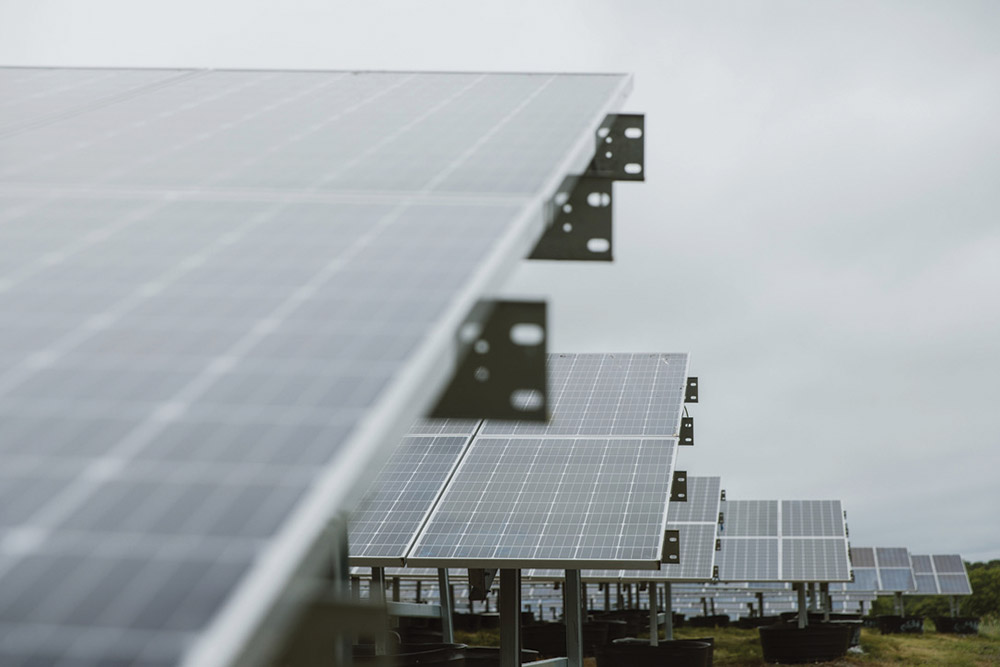
NuGen Capital Management solar investment projects include the 6.9-MW Bristol Landfill Solar project, completed in 2024 on a capped landfill in Rhode Island.
Photo Courtesy NuGen Capital Management
Electrification laws, meanwhile, serve as a kind of complement to emissions control on the new construction side.
New York City withstood a legal challenge in March to Local Law 154, allowing the city to require new construction or major renovations to limit onsite fossil fuel combustion to no more than 25 kg of carbon dioxide per MBtu, effectively preventing installation of gas- and oil-powered fuel systems and appliances.
In July, the state followed up with the All-Electric Buildings Law, applying similar requirements to the entire state, the first in the U.S. to do so. Both phase in requirements by building height and type, providing exceptions for certain buildings.
An earlier case relating to a Berkeley, Calif., law that expressly banned gas hook-ups in new construction was struck down by a federal appeals court. “Local governments aiming to lower their emissions from buildings—who might have been reluctant to take on the subject matter due to [the Berkeley case's] outcome—may look to Local Law 154 as a legally defensible approach to building decarbonization,” wrote Vincent M. Nolette, a fellow at Columbia University’s Sabin Center for Climate Change Law, in a post.
Legal Challenges
Several states are currently exploring legal options to claim funding for green and sustainable infrastructure from fossil fuel companies.
In May 2024, Vermont became the first state to pass a “climate superfund” law that allows the state to seek damages from fossil fuel companies for contributions to climate change impacts, with the money to be used for climate adaptation projects. New York followed suit last December with a similar law, and others were proposed in 10 state legislatures in 2025.
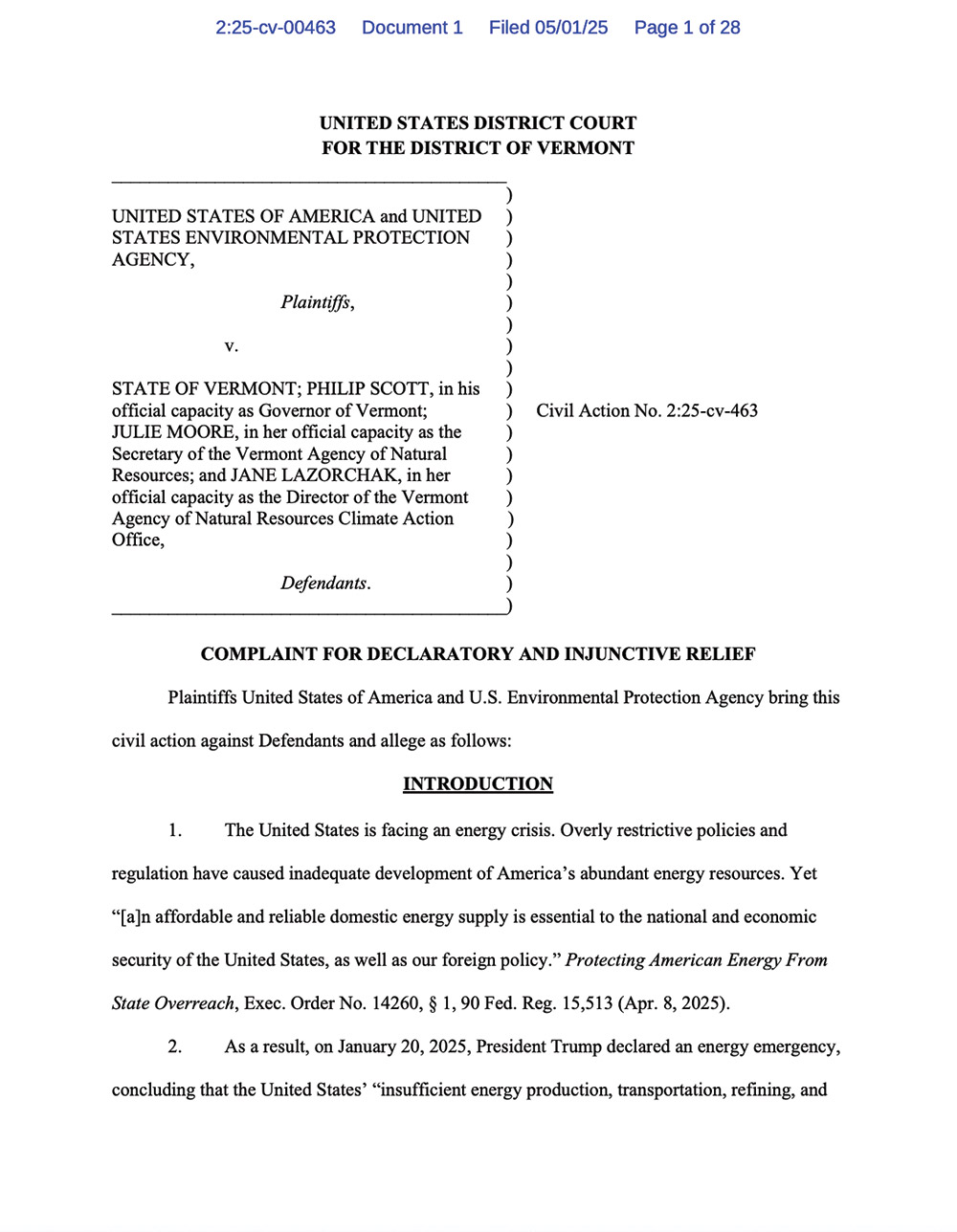
The laws currently face legal challenges on multiple fronts—with the U.S. Dept. of Justice asserting that they are pre-empted by the federal Clean Air Act and impact national security.
If courts uphold the laws, they would generate billions of dollars to fund climate change infrastructure—up to $75 billion over 25 years for New York state alone.
Another novel approach involves suing fossil fuel companies over claims of climate deception, arguing that companies knowingly hid that their activities negatively impacted the environment.
A lawsuit by Hawaii against multiple fossil fuel companies and the American Petroleum Institute drew a challenge from the Trump administration, which sued in April to halt the lawsuit. Both cases are still pending.
“Climate litigation is playing an increasingly important role in shaping how governments, companies, and financial institutions respond to climate change,” wrote L. Delta Merner, lead scientist for the Union of Concerned Scientists’ Science Hub for Climate Litigation, in a post. More than 40 such lawsuits have been filed by states and cities.
Outside of the success of individual lawsuits, there is their cumulative effect on the “court of public opinion,” says Jillian Blanchard, vice president of climate change and environmental justice at nonprofit Lawyers for Good Government, which in July launched its Pro Bono Litigation Corps program to offer support and resources to attorneys seeking to bring challenges on constitutional issues related to federal actions.
“There are many stories on the ground to be told about the increased costs resulting from all of these terminations, about the pain and suffering and harm to industry as well as communities” from cancellation of grant funding, adds Blanchard. “All of that, collectively, is having an impact,” and may place public pressure on the government to restore grant funding even if it wins a case. The organization estimates $113 billion in cancelled or frozen climate infrastructure and energy funding.
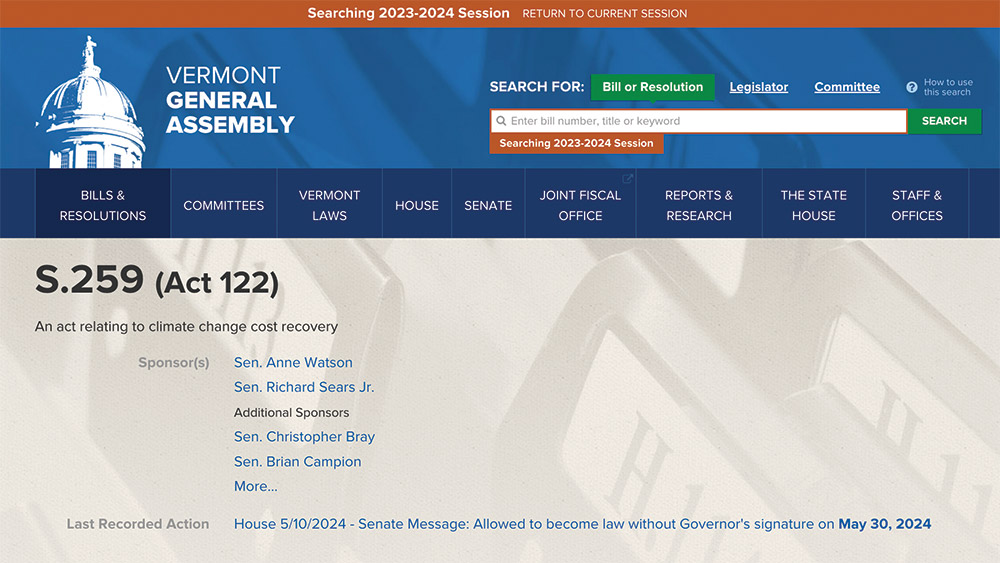
The fate of ”polluters pay” legislation, like Vermont’s first-in-the-nation Climate Superfund Act, is being decided in the courts. There were 164 legal cases related to climate change in the U.S. in 2024, according to the London School of Economics.
Screenshot courtesy Vermont General Assembly Government Website
Document courtesy Sabin Center Climate Litigation database
Still Invested
To make a significant impact, building electrification efforts will need to be paired with cleaner sources of power generation.
Across the last half of 2024 and first half of 2025, $276 billion was invested in clean energy deployment and manufacturing, vehicles, building electrification and carbon management technology, with $68 billion in the second quarter of 2025 alone, according to research firm Rhodium Group and the MIT Center for Energy and Environmental Policy Research.
Trump administration actions, including removal of tax credits and import tariff policies, have added costs and hurdles and created an air of uncertainty that has depressed investment and project development this past quarter. But many construction sector experts are still optimistic about renewable energy, pointing to alternate opportunities as well as the inevitability of the green energy transition.
“In response to reduced federal funding, alternative financing is gaining traction,” says Ian Minnes, practice leader for net zero programs at Arcadis. “State and local governments are launching their own climate policies and tools like green bonds, while private capital continues to flow into sustainability-focused projects. Private organizations are creating funding schemes to invest in renewables and net zero efforts to reduce their own emissions.”
Last November, Californians voted to enact Proposition 4, a $10-billion bond to pay for projects addressing climate change, including clean energy, wildfire prevention and clean water, with nearly 60% of voters supporting the measure. The first distributions of that money made it into the state’s legislative budget passed this month.
“Despite new policy challenges for clean energy, we find continued demand for clean technologies across the economy,” wrote Rhodium Group report authors on Sept. 10, noting that since 2023, wind, solar and battery storage comprised 87% of grid capacity additions. But despite these gains, the level of clean power buildout is below earlier projections.
For the first half of 2025, solar and storage represented 82% of new generating capacity, according to a Sept. 8 report from the Solar Energy Industries Association and research firm Wood Mackenzie, although overall solar capacity generation in the second quarter fell 24% year-over-year and 28% from the previous quarter. A bright spot was commercial solar, up 27% year-over-year, with “massive growth” attributed to California’s net energy metering program, which encourages solar installation by paying owners for excess generation that is sent to utilities. The report expects growth to continue through 2030, based on projects capitalizing on expiring tax breaks rushing to meet that deadline.
Clean energy and infrastructure investment firm NuGen Capital Management also announced $100 million added to its current $250 million investment portfolio of solar and storage projects, both those in development and ones it owns and operates, often as a distressed asset it has taken over. NuGen already has experience nursing troubled solar farms back to financial health, and is now planning for a future without renewable tax credits.
“We kind of knew this was coming,” says Laura Frazier, NuGen managing director, business development and strategy. “We enter investments assuming tax credits were not going to be around forever, so we were already kind of positioning ourselves, knowing eventually that we’re going to go away. We kept ourselves lean in order to [anticipate] an opportune and helpful time for our industry to step in and start investing.”
Growing power demands of data centers and pressure to improve grid reliability are driving “an urgent need for fast, scalable and resilient energy sources,” says Sarah Varghese, Arcadis net zero specialist. “While the current administration is actively streamlining permitting for fossil fuel infrastructure, those timelines are still expected to increase in complexity over the long term. Despite that, renewables—especially solar—remain highly competitive. Their speed-to-grid, modularity and co-benefits like dual land use and pairing with storage, make them a compelling part of the energy mix.”
A recent Rocky Mountain Institute report analyzed more than 860 clean energy project applications made to EPA’s climate pollution reduction grant program, rescinded by Congress earlier this year, reframing the collection of potential projects as possible opportunities for private investment.
The applications offer “investors a rare window into a curated pipeline of initiatives that are not only visionary but also commercially viable,” the institute wrote. “These projects—many of which feature defined revenue streams, public-private partnerships and committed off-takers—represent a new frontier for scalable, impact-driven investment.”
The report’s authors note that “the groundwork laid through rigorous planning, stakeholder engagement and government sponsorship has significantly de-risked many [projects] in the pipeline,” adding that “for investors seeking both climate impact and financial return, this inventory is more than a list—it’s a launchpad for building resilient, diversified portfolios that can accelerate the energy transition while delivering long-term value.”
“We continue to see great innovation,” says USGBC California’s Stapleton, noting continued interest in energy storage and materials, bolstered by embodied carbon reporting requirements in the state. This summer the organization announced the latest cohort for its Net Zero Accelerator, focused specifically on firms innovating in the built environment space, including HempCement, offering structural industrial hemp, and cooling system water conservation firm Capture H₂O. The organization says it has helped firms launch over 60 pilot deployments.
“That’s really an important area, especially with what’s happening at the federal level,” says Stapleton, who says California needs “to continue to push and show that these things can have positive ROI. It’s all about the return, and I work in green buildings because I think they make economic sense. We’re reducing costs, we’re improving health, we’re reducing environmental impacts in communities—and those things all reduce power.”