Clean Energy
UPDATED: Connecticut, RI Governors Fight Trump-Ordered Halt to Nearly Done Wind Project
States sue administration in federal court as feds also now aim to cut $679M in awarded US wind port grants and revoke approved permits for a 2.2GW wind project in Maryland and Delaware.
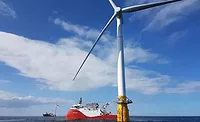
Governors of Rhode Island and Connecticut said they would fight a Trump administration order—including a potential lawsuit—to halt shutdown of giant Revolution Wind project that is 80% complete
Governors of Rhode Island and Connecticut said they would fight a Trump administration order—including a potential lawsuit—to halt construction on the shared 704-MW Revolution Wind energy project 15 miles off their coasts that is about 80% complete and could operate late next year.
On Aug. 22, the federal Bureau of Ocean Energy Management—the U.S. Interior Dept. agency that regulates offshore wind in federal waters—notified project developer Orsted to “halt all ongoing activities,” claiming need to "address concerns related to the protection of national security interests in the United States.” These are not detailed but work is halted until a project "review" is completed, with no time frame noted.
Noting the extent of work completed, the developer and state officials have expressed intent to discuss shutdown alternatives directly with President Donald Trump, as outlined in a Sept. 3 letter from Gov. McKee to Interior Secretary Douglas Burgum.
But Orsted also filed a federal lawsuit Sept. 4 against the administration to halt the stop-work order it said "was issued without statutory authority, lacks any evidentiary basis and is unlawful," with a request for a preliminary injunction to follow. "Litigation is a necessary step," said the firm, noting "substantial harm from continuation of the stop-work order." Soon after, the states' attorneys' general announced a planned suit in Rhode Island federal court to overturn the order. “With zero justification, Trump wants to mothball the project, send workers home and saddle ... families with millions of dollars in higher energy costs,” said Connecticut Attorney General William Tong. “This is an utterly unlawful and baseless—and frankly senseless and stupid. This kind of erratic and reckless governing is blatantly illegal, and we’re suing to stop it.”
Revolution Wind has already spent or committed about $5 billion on the project and faces more than $1 billion in new costs if the project is canceled, officials said.
Interior did not comment but a White House spokesperson said offshore wind projects were given “unfair, preferential treatment” under President Joe Biden while the fossil fuel sector was “hindered by burdensome regulations.”
Previously, Markus Krebber, CEO of German energy developer RWE that paid the U.S. government a record $1.1 billion in 2022 tor a 510-sq-mile ocean lease area near New York City for up to 3.3 GW of planned offshore wind development told European media it also foresaw legal action against the administration if construction remains blocked.
Looking for quick answers on construction and engineering topics?
Try Ask ENR, our new smart AI search tool.
Ask ENR →
"It cannot be that the federal government says, ‘I will allow you to build offshore in my waters, but in return I want payments from you’, and then once the payments have been made, it says, ‘It's no longer possible.’” Krebber said, according to Reuters. The firm owns nearly 75% of the potential wind project, with UK-based utility National Grid owning the rest.
___________________________________________________________________________________
UPDATES:
The U.S. Transportation Dept., on Aug. 29 just before the Labor Day weekend, said it would withdraw or terminate $679 million in grants for port and freight infrastructure to support new manufacturing, including for offshore wind energy development after a "review." The funding, both obligated and unobligated to projects, "will be recompeted, where possible," DOT said.
About 12 projects are affected, with a major port expansion in Humboldt County, Calif., now facing loss of $427 million in grants for a new offshore wind terminal, the first on the west coast, and unrelated marine projects, officials said. "We have every intention of continuing the project," said a harbor district spokesperson. "We are incredibly proud of the work we have done to date." The action is "an example of the Trump administration assaulting clean energy and infrastructure projects– hurting business and killing jobs in rural areas, and ceding our economic future to China," said a spokesperson for Calif. Gov. Gavin Newsom.
Port expansions in Salem, Mass., Baltimore, New York City and Norfolk are among those also facing grant losses. Massachusetts Gov. Maura Healey said the Salem project could lose 800 construction jobs, with the funding cuts.
Meanwhile, in late Aug. 25 federal court filings in Maryland and in Delaware, the administration said it intends to revoke by Sept. 12 key federal construction and other approvals by the Biden government in late 2024 for a proposed 2.2-GW, 114-turbine offshore wind project in the two states being developed by US Wind. The federal action, first reported by regional TV station WBOC, was filed in tandem with an existing lawsuit brought last year by officials in Ocean City, Md., against the Interior Dept. for approving the project, which the coastal city opposes.
“We remain confident that the federal permits we secured after a multi-year and rigorous public review process are legally sound,” said Nancy Sopko, vice president of external affairs for US Wind, in a media statement. Gov. Wes Moore (D) in an Aug. 25 statement. said “canceling a project set to bring in $1 billion in investment, create thousands of good-paying jobs in manufacturing, and generate more Maryland-made electrical supply is utterly shortsighted."
The U.S Environmental Protection Agency also on Aug. 25 joined Ocean City in its petition to Maryland officials to create an appeals process at the federal level to contest the project's state-granted air emissions permit. State environmental regulators and U.S. Wind oppose that action as unnecessary.
___________________________________________________________________________________
The estimated $6.2-billion Revolution Wind, the first state-shared offshore wind energy project in the U.S., is set to provide power to more than 350,000 homes in the two states, with Rhode Island signing a 20-year power purchase agreement for 400 MW and Connecticut agreeing to buy 304 MW. All foundations for the project's 65 Siemens Gamesa-built turbines, each 11 MW, are installed, with 45 turbines constructed. Revolution Wind is a 50-50 partnership of Denmark-based Orsted and the Skyborn Renewables unit of private infrastructure investment firm Global Infrastructure Partners, itself now owned by investment giant BlackRock.
On Aug. 22, the federal Bureau of Ocean Energy Management—the U.S. Interior Dept. agency that regulates offshore wind in federal waters—notified Orsted to “halt all ongoing activities.” It claimed the need to "address concerns related to the protection of national security interests in the United States.” These are not detailed, with the U.S. Defense Dept already approving the project, but work is halted until a new "review" is completed, No time frame for that was disclosed.
Interior spokespersons did not initially return media queries for added information, but one, Aubrie Spady, claimed in later statements to The New York Times and The Hill that "Americans deserve energy that is affordable, reliable and built to last — not experimental and expensive wind projects that are proven failures."
In an Aug. 28 interview with CNN, Interior Secretary Douglas Burgum contended that, despite Defense Dept. project approval two years ago, there are alleged "concerns about radar relative to undersea." He claimed that people with "bad ulterior motives to the United States would launch a swarm drone attack through a wind farm." He also repeated allegations that the project received preferential treatment in its permit review by the Biden administration.
Media reported no Orsted response to Burgum's statements, but the firm said in an earlier statement that it was “considering a range of scenarios, including legal proceedings,” even though it also said it “is complying with the order and taking appropriate steps to stop offshore activities, ensuring the safety of workers and the environment.”
The company also developed the 123-MW South Fork offshore wind project off New York state, which was built in 2023 and is the first such energy project to operate at commercial scale in the U.S. It has operated at 53% of its capacity through the first half of 2025, “on par with the state’s baseload power sources,” Orsted said. The firm is still building a third project, the 924-MW Sunrise Wind, also to sell power to New York when completed in about 2027. Orsted said its U.S. offshore wind projects have totaled about 4 million union labor hours to date, with 2 million for Revolution Wind.
'Delay and Disruption'
Officials responded swiftly. “At a time when we should be moving forward with solutions for energy, jobs and affordability, the Trump Administration is choosing delay and disruption,” said Rhode Island Gov. Dan McKee (D) on social media. “I will pursue every avenue to reverse the decision to halt work on Revolution Wind,” he added, emphasizing that the project was fully permitted.
Connecticut Gov. Ned Lamont (D) added: "This political move by the Trump administration will drive up the cost of electricity bills and contradicts everything [officials have] told us." Sen. Richard Blumenthal (D-Conn.) stated that he expects legal decisions in the states’ favor, finding the order unlawful, since it was based on "secret information."
New England grid operator ISO New England said Revolution Wind is factored into its power supply projections, so not building it will "undermine the power grid’s reliability and the region’s economy now and in the future.” State officials also cited risk of rolling blackouts.
Others also faulted the administration action. “President Donald Trump just fired 1,000 of our members who had already labored to complete 80% of this major energy project,” said North America’s Building Trades Unions President Sean McGarvey in a statement. Trump “keeps talking a big game about energy dominance, but actions like this prove it’s another empty promise. Energy dominance doesn’t mean taking away jobs.“
Potential lost jobs also include those to fishing industry members, who assist on projects, despite that sector's opposition to offshore wind.
Revolution Wind “sparked investments in Louisiana and New England shipyards, purchased export cables from a South Carolina factory and spurred a steel supply chain that crossed New York and created hundreds of union jobs in Providence, Rhode Island,” said Liz Burdick, CEO of industry advocacy group Oceantic Network.
In a social media post, offshore wind sector analyst Philip Totaro, CEO of IntelStor, noted the array of global suppliers and contractors working on Revolution Wind, including Australia-based Worley and European firms that have set up U.S.-based operations. “I am curious as to which of the supply chain companies involved with the project supposedly represent a national security risk to the U.S," he said. "Is it companies based in the U.S.? The U.K.? E.U.-member countries like Denmark, Spain, France or the Netherlands? The industry must demand accountability!”
But the order adds new financial strains for Orsted, which is 50% owned by the Danish government, with company shares down 17% on Aug. 25, financial media reported. U.S. market challenges in recent years and particularly this year from Donald Trump orders—also affecting other sector developers—have included rising costs and interest rates, supply chain disruptions and squeezed tax credits that have delayed and cancelled projects. Just announced is a U.S. Commerce Dept. investigation of turbine and other component imports that could generate more tariffs, analysts speculate.
On an Aug. 11 earnings call, Orsted executives noted corporate funding needs caused by “unexpected developments outside our control” in the U.S. market, created in recent months by the consecutive anti-wind sector administration policies. The company is meeting with investors on Aug. 26 related to its need for about $9.4 billion in new investment to proceed with the Revolution Wind and Sunrise Wind projects.
In April, the administration ordered developer Equinor to halt work on the $5-billion Empire Wind project off New York, but quickly reversed it after intervention by state and other officials, and a meeting between Gov. Kathy Hochul (D) and Trump. There is speculation the reversal occurred after she informally agreed to consider resumed construction of two natural gas pipelines in the state, although Hochul has denied it.
Equinor said the month-long shutdown cost the company about $50 million per week, with market analysts speculating a similar expense for Orsted based on estimated costs of idled installation vessels, equipment, and workforce, as well as port fees, legal costs and other items.
Related to Revolution Wind, analysts also speculate the Trump order is linked to Denmark signing hours before a climate cooperation deal with California Gov. Gavin Newsom, according to Bloomberg. "It remains to be seen what price [Trump] might seek to extract from Connecticut and Rhode Island, Orsted or even Denmark for lifting the [Revolution Wind] stop work order," said wind sector publication Recharge.
"As electricity demand continues to increase with the intensive build-out of data centers ... they cannot be reliably powered by a single gas turbine or nuclear power plant," says Eric Hines, who directs the offshore wind graduate engineering program at Tufts University in Massachusetts. "In recent years, wind and solar have become the least expensive, most available forms of power generation in the U.S., bringing enormous benefits for U.S. jobs and supply chains across the country."
He adds that "actions like this undermine our country’s ability to capitalize on investments we have made over decades to ensure that we have abundant, affordable and reliable power for generations to come. Stopping work on a highly-reliable 700-MW power station that is 80% complete during an energy crisis feels like building a beautiful house and then abandoning it instead of moving in."
In a Sept. 1 joint statement, Govs. Lamont and McKee as well as Hochul, Healey and Phil Murphy of New Jersey, urged the Administration to "uphold all offshore wind permits already granted and allow these projects to be constructed," adding that "efforts to walk back these commitments ... waste years of progress and cede leadership to foreign competitors. Workers, businesses and communities need certainty, not reversals. The project halts "send the worrisome message to investors that the work can be stopped on a whim."
But they also stress that while offshore wind and other renewables "are central" to a boosted and more affordable U.S. power network, they "must be complemented" by nuclear power, natural gas, hydropower and other technologies, "that together keep our system strong and our energy sources secure."


.webp?height=200&t=1766484839&width=200 "Wind-Farm-Pause-(2)")