Technology
In Surveying, Small Wins Bring Big Gains
August 6, 2025
Technology
In Surveying, Small Wins Bring Big Gains
August 6, 2025Leica Geosystems’ Nova MS60 Scanning Robotic MultiStation delivers scans with 1-2 mm of precision 12 to 15 times per day on Norway’s Rogfast Tunnel.

Survey data is the real-world basis for any construction project, from the smallest building to a 16-mile-long tunnel snaking beneath the Norwegian Sea.
It is the straightforward effort to determine the positions of points on or near the Earth’s surface and the distances and angles between them. The best surveyors say the process is more art than science. Entire projects can–and often are–built on a crumbling data foundation. It is easy for control points to be entered as the wrong locations for myriad reasons, including improperly snapped chalk lines, failures in converting units of measurement, satellite lines of sight blocked by obstructions or even some crews simply being better at layout tasks than others.
When control is inconsistent, even the most robust, well-coordinated 3D models can fall apart in the field.
Construction technologists have sought to address the problem of inaccurate survey data with solutions that include robotic layout and placement that eliminates human error, more precise scanning technology that allows surveyors to make better decisions and even tighter connections to global navigation satellite systems and their most-used output, global positioning systems (GPS). But recent advances in sensor technology, and the addition of cloud computing and robotics, now offer surveyors and contractors a level of certainty previously seen as unrealistic or prohibitively expensive.
Better, more accurate scan data is delivering results on some of the smallest and largest jobsites—including a fast-tracked hospital project in Memphis, Tenn., a series of hospital expansions in Illinois and Ohio—and on the world’s deepest underwater tunnel, now being dug nearly 1,300 ft beneath the fjords of Norway.
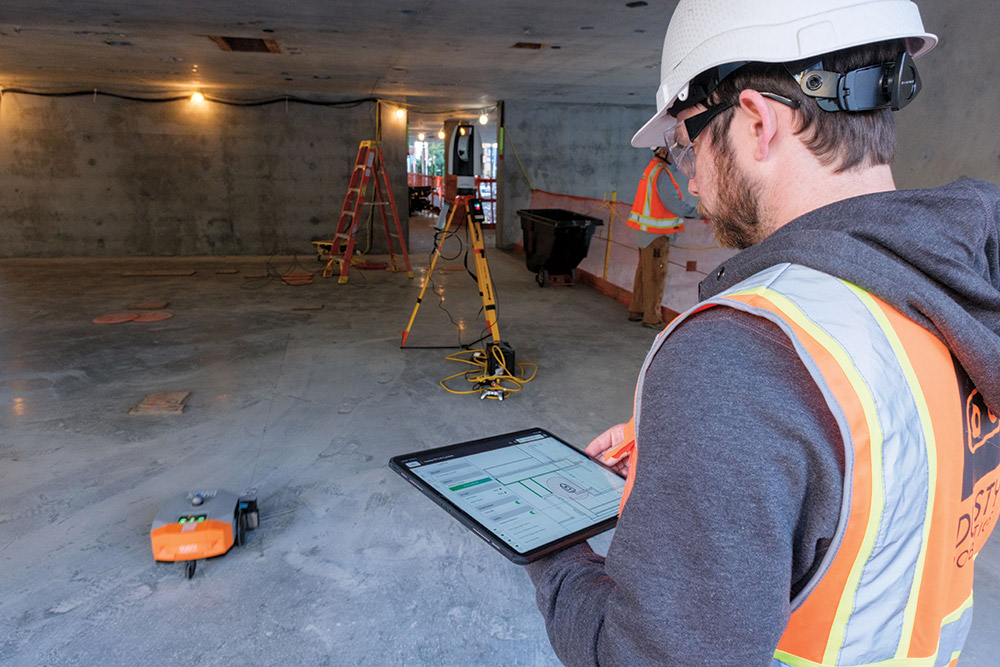
Dusty Robotics’ Field Printer 2 can print accurate layout from CAD drawings or a BIM model and synchronize its position and layout with a nearby laser tracker. It also has dead reckoning to avoid stub ups and other penetrations.
Image courtesy of Dusty Robotics
Raising the Bar on Curtainwall
At St. Jude Medical Center, a 15-story, twin-tower medical facility in Memphis now undergoing a $2.3-billion expansion and renovation, glazing contractor JR Butler identified early that inaccurate information was leading to rework in the project’s curtainwall system.
“When doing layout by hand on the first two floors we saw $100,000 to $130,000 worth of rework due to defects,” says Pierce Torrance, senior project manager for the firm, which is responsible for the hospital tower glazing. “After that expensive lesson, the decision was made to bring Raise Robotics onto the job as a countermeasure to prevent those same layout issues on the remaining floors,” he notes.
_ENRready.jpg "heat map to show accuracy")
Dusty Robotics mobile field printer's layout data comes from CAD drawings, with a heat map to show floor elevation.
Image courtesy of Dusty Robotics
Using AI and machine learning models that adapt to different end effects on such a project, the Raise Robotics platform uses several interchangeable tools on its robotic arm for multiple applications including layout, scanning, drilling, and installation.
Looking for quick answers on construction and engineering topics?
Try Ask ENR, our new smart AI search tool.
Ask ENR →

Originally designed to place brackets for curtainwall, the platform has evolved to include attachments such as a hammer drill for making penetrations and sensors for layout tasks. Set on a mobile base, the system requires only standard 2D floor plans and reduces safety risk by working on edges requiring tie-offs by workers to approach. Measurements are based on preset plans and onboard sensors, not on human estimates or those made under stress.
“When we crunched the numbers, the robot beat our budget,” says Morgan Patnode, project superintendent at JR Butler. “The price was less expensive than we could do it, and the accuracy eliminated the rework plaguing our manual approach,” he adds.
Raise Robotics co-founders Gary Chen and Conley Oster launched their platform in 2021 with a focus on tackling some of the most repetitive, hazardous tasks in construction.
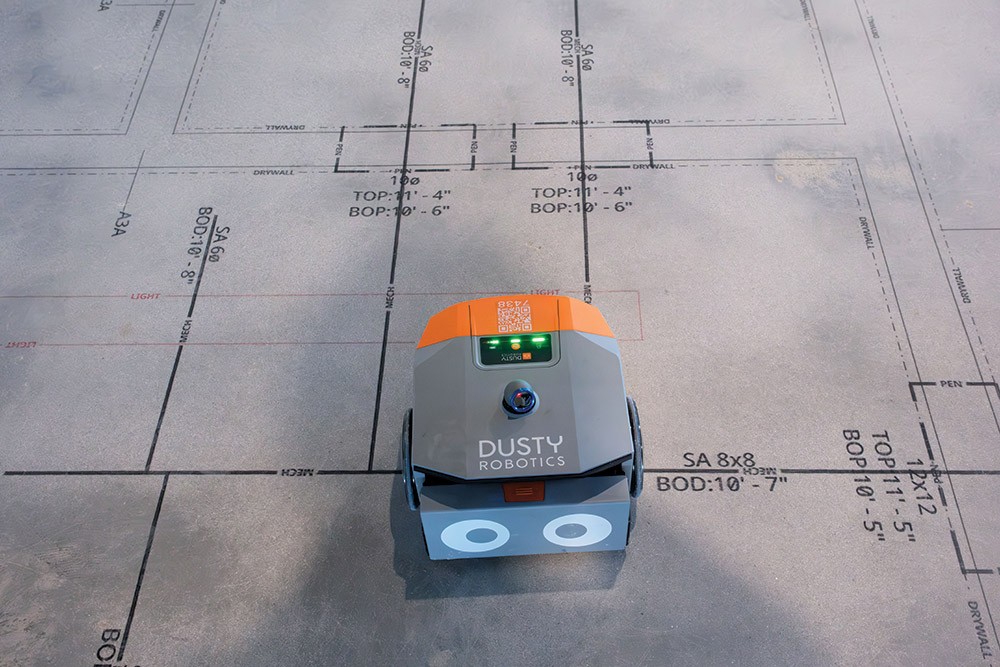
Putting every trade’s layout into one set of drawings printed by the Dusty Field Printer 2 has eliminated clashes and disagreements found between RG Construction its general contractors’ 3D models.
Image courtesy of Dusty Robotics
“We built the company to change [dangerous and inefficient processes]–delivering a versatile platform that takes on the most challenging, riskiest tasks while increasing ROI across multiple trade partners,” says Chen, the robotics firm’s CEO. “Projects like St. Jude prove that our mission of keeping workers safe can also deliver productivity gains the industry is looking for.”
Oster adds that Raise was being used on another JR Butler hospital project in Nashville when the firm got the call about the rework on St. Jude.
“When we crunched the numbers, the robot beat our budget.”
Morgan Patnode, Superintendent, JR Butler Construction
“They did the layout, started installing panels, and realized that layout was not where it was supposed to be, nor were panels, brackets etc., not where they were supposed to be,” Oster says, forcing layout redo for those floors. "That’s when we received the call from Pierce. The question was ‘how quick can you get out here?’”
Raise Robotics is not the only technology provider leveraging robotics for better sensor technology to meet the needs of contractors striving to get accurate scans, layouts and information about existing conditions to sites. Dusty Robotics has worked with drywall contractor RG Construction to optimize layouts it has used on hospital projects from Illinois to Ohio.
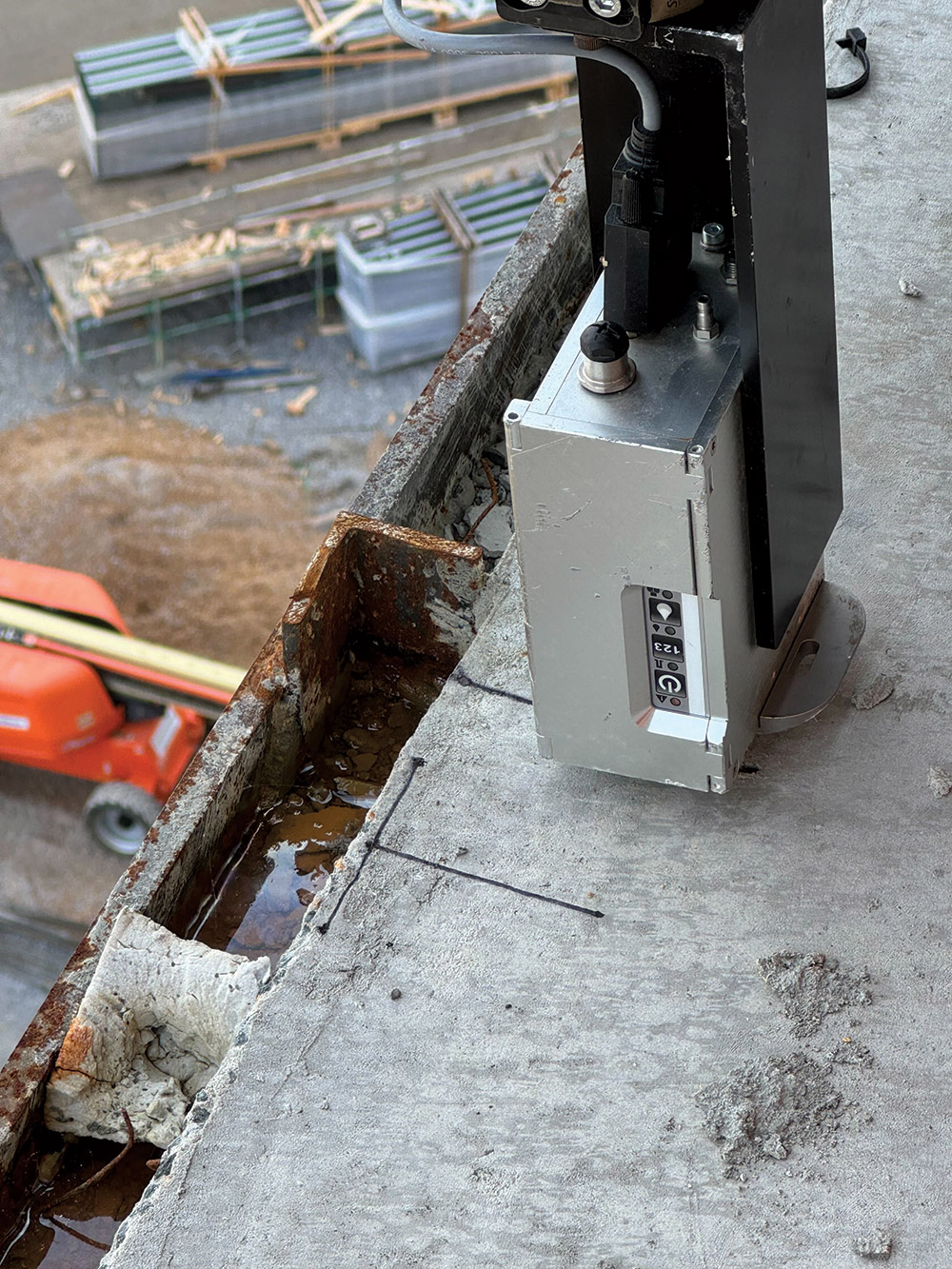
Raise Robotics' robotic platform was initially focused on high-risk tasks such as installing penetrations and brackets on slab edges at height, but can now handle a range of tasks, including ensuring accurate layout.
Photo courtesy of Raise Robotics/JR Butler Inc.
“We were looking for technology to automate the process of layout,” says Luther Lampkin, director of construction technology and innovation at the Elmhurst, Ill.-based contractor. “We were trying to evaluate the best option, and Dusty gave the best customer support. We know, in an endeavor like this, things are going to fail. What does it look like when they do? ... At the same time, we own the process of layout [with the Dusty layout robot].”
But owning the process means more than just doing layout for all of the drywall, explains Lampkin. Expansion of Advocate Illinois Masonic Medical Center in Chicago’s Lakeview neighborhood in 2023 was the first project on which RG Construction used the robot for layouts. General contractor Turner Construction says it so much liked the accuracy provided that it sought layouts for all trades on the project. RG Construction also was tapped to do the same work on another project, the University of Chicago Cancer Center, a freestanding, 575,000-sq-ft facility on the hospital campus in the city’s Hyde Park neighborhood.
“That’s when I actually got layout put in as a part of the qualifying bid,” Lampkin says. “They had never let a drywall contractor run the show. We trained everybody on the Dusty robot ... and created all files for the trades, combining everything into one model. As we went up the building, you could see everything with an issue-recording aspect of design and construction.”
RG Construction has taken its all-trades layout model to other hospital projects since. The Cleveland Clinic Global Center for Pathogen Research and Human Health is a $500-million, two-building expansion with 296,000 sq ft of space. General contractor Gilbane Building Co. brought in RG Construction in late 2023, with Lampkin and his team training all trades in its use..
“Most people think innovation is [doing] something big, and sometimes innovation is taking some of the things you least expect, that you pay the least amount of time and money to, but always have the same problems, and fix them,” Lampkin says. “Start small. Since all we thought about was getting small wins, we were able to not only finish the layout within our own scope of work with more accuracy, but bring that to the other trades as well.”

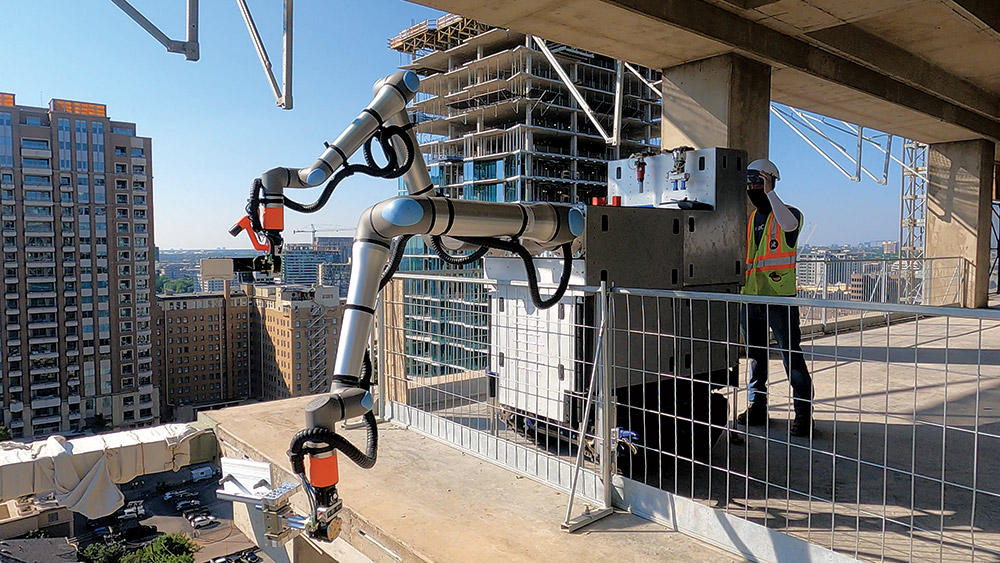
JR Butler found that using the layout from accurate CAD drawings and Raise Robotics’ onboard sensors resulted in more accurate floor layouts and less rework. Human layout, no matter how meticulous, is prone to quarter-inch errors due to fatigue and distractions.
Photo courtesy of Raise Robotics/JR Butler,Inc.
Exacting Accuracy on Megaproject Scale
Contractors Skanska, Implenia and Stangeland Maskin now are building in Norway—under the Norwegian Sea, an island and several fjords—what is set to be the longest and deepest road tunnel in the world. The Rogfast project is planned to be almost 17 miles long and is being built nearly 1,300 ft below sea level.
The tunnel, now under construction being in three separate sections, is part of the Norwegian Public Roads Administration effort to connect a highway along the country’s west coast. Taking the E39 highway today requires multiple ferry crossings with three separate ferry trips. The Norwegian government says when Rogfast is completed in 2033, it will cut the multi-hour journey between the cities of Stavanger and Bergen to about 40 minutes via the tunnel.
“It’s quite a bit more grouting than we expected,” says Anne Brit Moen, project manager for Skanska Norway, which is building the Boknafjord tunnel segment between the municipalities of Randaberg and Bokn in Rogaland County. “We are close to 300 meters underneath sea level now.”
Using drill-and-blast methods throughout, the overall project will require Skanska to move more than 280 million cu ft of rock. The twin tunnels, spaced nearly 50 ft apart, will each carry two lanes of traffic. Ventilation shafts are planned to extend more than 665 ft above the tunnels.

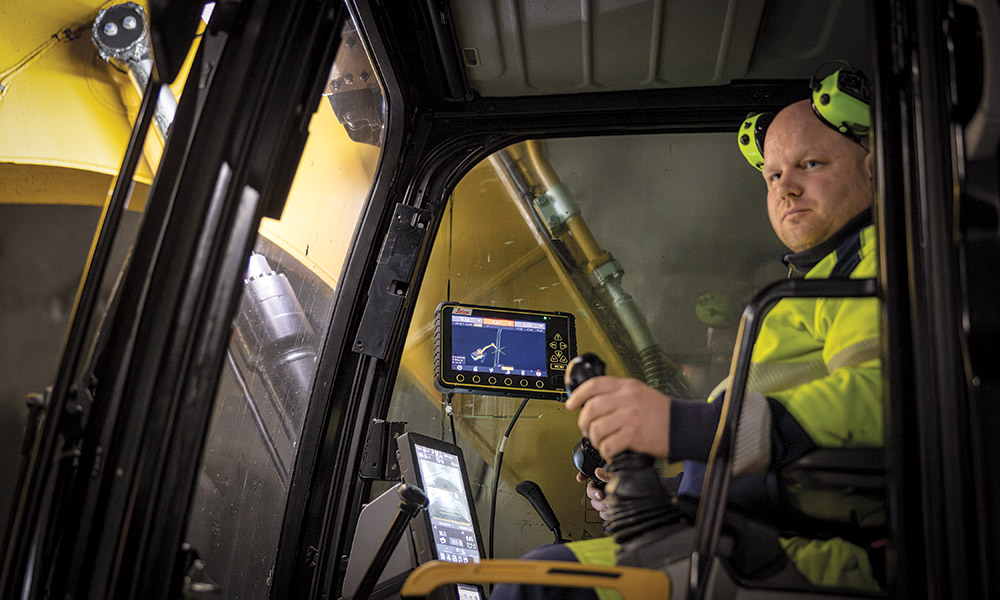
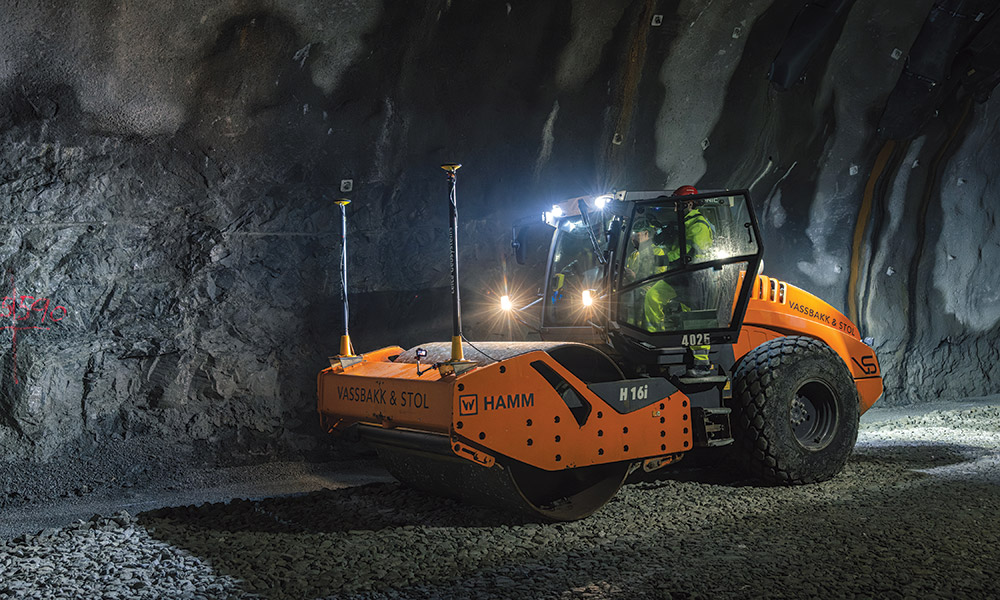
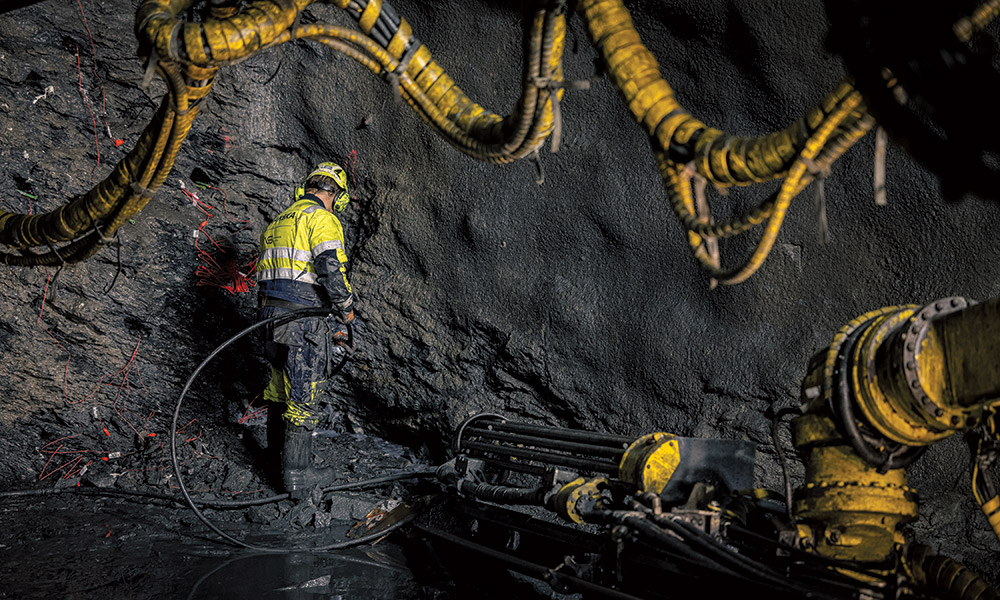
In addition to accurately boring and blasting the twin Rogfast Tunnels, Skanska has installed 8,000 pieces to date of complex precast concrete using Leica iCON total stations for measurement to date.
Photo courtesy Skanska and Leica Geosystems/Hexagon Inc.
A key part of the project is installation of 8,000 complex precast concrete tunnel sections. A sub-4-in. accuracy is needed to properly align the twin tunnels. Sections now being built by Skanska will eventually meet with those being built by the Implenia/Stangeland Maskin joint venture for for the E02 Kvitsøy section. These will meet near the island of Kvitsøy.
“It’s impossible to do tunneling like this without the proper technology,” Moen says. “You are blind if you don’t have the right tools to help you, and we are really depending on the accuracy to keep the project in line, and everything in shape. We needed the right tools and easily accessible tools as well. That’s what we’re completely depending on.”
Skanska is relying on an array of technologies from technology partner Leica Geosystems, including six to eight scans a day using gear such as the Leica Nova MS60 scanning robotic total station, the Leica TS16 and TS18 robotic total stations and global navigation satellite systems rovers in the bay zones. The total stations are used to help with positioning machine control systems of equipment such as hydraulic drill rigs and excavators doing the digging once they have created positions for initial blasting.
“There are excavators, graders, compactors, when [these are] necessary for the road works. We can also provide the positioning with the total stations,” explains Andreas Torsvik, managing director of Leica Geosystems AS in Norway.
Less than 2 in. of deviation to meet project parameters means if any deviation is recorded, excavators must be taken off the tunnel to perform rework. Moen says that has not happened, with Leica technology providing accuracy up to 5⁄64 of an inch.
“The daily work, if it’s off 10 centimeters one way we drill and blast, that will make us pull out one or two trucks for every section that we have to redo, that’s completely unnecessary,” Moen says. “But with the technology we have today we are able to meet within 5 centimeters.”

Set to be the longest and deepest road tunnel in the world, the Rogfast will be nearly 17 miles long and sit in bedrock nearly 1,300 ft below the Norwegian Sea.
Map courtesy Skanska Norway
Moen says sensors can keep hydraulic face-drilling rigs and other equipment on track during operations. “Normally, in Norway, we have three boomers [hydraulic rock drilling machines used to dig tunnels] in each rig, and then you have lots of sensors to keep [them] on that position,” she says, adding that the Leica total stations have kept drilling moving forward within the tight parameters, despite how difficult deviations can be to detect.
“If you get even a little bit out of position it’s not easy to detect because it looks okay, so you need to have the scanning and accuracy,” notes Moen. Leica imports the position information directly to the drill rigs, excavators and other equipment so operators can be alerted about deviation in alignment. Having that certainty has allowed them to keep up the pace, she says. “The cooperation with the companies delivers good technology,” Moen notes.
When Skanska’s twin tunnels eventually meet those of the Impleia/Standland Maskin team at Kvitsøy Island, there are plans to construct two roundabouts to also allow local residents access to the tunnels.
“It’s accessible from an island out in the fjord.” Moen says. “The other contractor, Implenia, that we are going to meet in a couple of years, uses the same [Novorender] viewing model as we do. The Norway-based company is providing us with a very good viewing model."
Skanska has been collecting project data on its section of Rogfast since starting work in 2023—sharing drilling and excavation data and other project information with the projet team and client, the Public Roads Administration. Moen says the project will soon confront its toughest engineering challenge, going under the bottom of the fjord itself. “We have to get through with that, but we’ll manage,” she says.
If work proceeds as planned, the unfinished tunnel will secure, in coming weeks, the record of the world’s longest and deepest subsea road tunnel.