Government
Feds Announce Plan to Scuttle Climate Emissions Control Efforts
EPA Chief Lee Zeldin proposes revoking 2009 federal endangerment finding that greenhouse gases are a public health threat
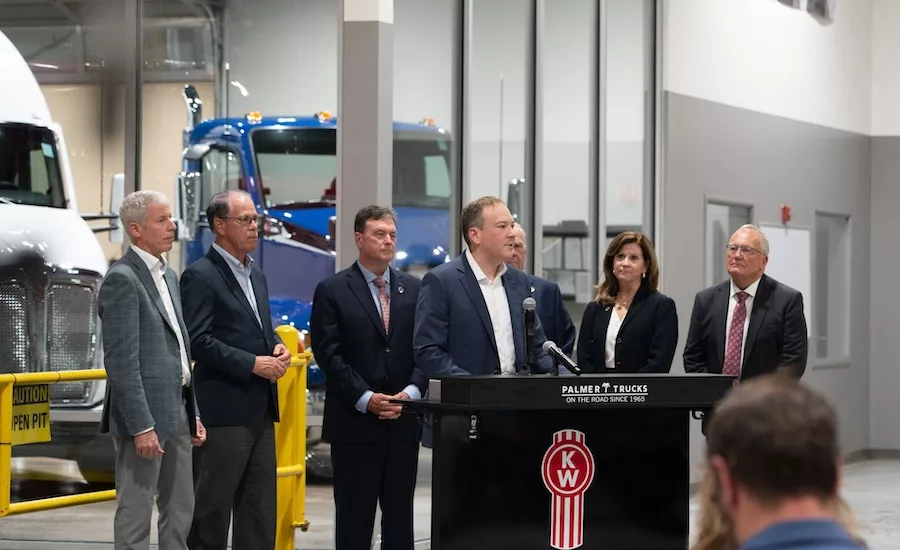
US Energy Secretary Chris Wright, far left, and US Environmental Protection Agency Administrator Lee Zeldin, at podium, announced new regulatory proposals to ease greenhouse gas emission controls at a car dealership in Indiana July 29.
Photo courtesy of EPA
The U.S. Environmental Protection Agency has released the plan to rescind its 2009 “endangerment” finding, the underpinning of numerous regulations to reduce greenhouse gas emissions in the transportation and the energy sectors since the rule was adopted in 2009.
The Trump administration has also released a proposal to remove greenhouse gas standards for cars and trucks and released a report stating that while climate change is "real and deserves attention, [it] is not the greatest threat facing humanity."
EPA Administrator Lee Zeldin, joined by U.S. Energy Secretary Chris Wright, Indiana Gov. Mike Braun (R) and other officials, made the announcements July 29 at an Indiana car dealership. “With this proposal, the Trump EPA is proposing to end sixteen years of uncertainty for automakers and American consumers," Zeldin said.
The action was not unexpected. Zeldin announced on March 12, which he dubbed “the greatest day of deregulation,” that he would take steps to revoke 31 environmental regulations—including the endangerment finding—in coming months. The proposal has been under review at the Office of Management and Budget for weeks. The regulatory process requires a public comment period before the change can be finalized.
Oil and gas groups, along with the automotive industry, praised the proposals, but environmental and clean transportation advocates said reversing the policies would prove disastrous for effectively addressing climate change in the U.S.
2007 Supreme Court Ruling
The Obama administration enacted the finding that greenhouse gases are harmful to public health in 2009 as a result of the U.S. Supreme Court’s 2007 decision in Massachusetts v. EPA that greenhouse gases can be regulated as pollutants under the federal Clean Air Act. The ruling also has been used as the legal basis for regulations to reduce emissions from power plants, cars and trucks, and in the oil and gas sector.
EPA says that without the endangerment finding, it does not have legal authority under the act to develop standards to reduce climate emissions.
Looking for quick answers on construction and engineering topics?
Try Ask ENR, our new smart AI search tool.
Ask ENR →
The Energy Dept. report authored by its 2025 Climate Working Group, what it describes as "a group of five independent scientists," was released the same day as the EPA proposals. It concluded that carbon-induced warming is less damaging economically than “commonly believed” and that U.S. policy actions are expected to have “undetectably small direct impacts on the global climate, and any efforts will emerge with long delays.”
In a statement, DOE Secretary Wright said "aggressive mitigation strategies may be misdirected."
Environmental and clean power and transportation groups say the government’s actions will have devastating impacts on efforts to address climate change.
John Boesel, president and CEO of Pasadena, Calif.-based clean transportation advocacy group CALSTART, said rolling back tailpipe emissions standards would be detrimental to the decades-long growth of clean transportation projects. “This proposal undermines the regulatory certainty that businesses need to plan and invest with confidence, destabilizes the market and will kill tens of thousands of jobs in the electric vehicle sector,” he said in a statement, adding that if finalized, it could also undermine new electric vehicle and battery plant manufacturing investments in Kansas, Indiana, Georgia, Tennessee and the Carolinas.
“By rolling back these standards, EPA is handing the advantage to the oil industry and foreign competitors, further weakening U.S. leadership in the global clean transportation race.” Boesel said.
Rolling Back the Clock on Climate
Some sources said rollback of both the endangerment finding and the tailpipe rule could potentially resurrect more interest in coal projects in the power sector, despite the decades-long trend of closing plants due to costs and market shifts.
“With growing demand for electricity especially for data centers and AI, one could at least envision existing natural gas and maybe coal plants repowering or staying online longer," Shannon Heyck-Williams, head of the National Wildlife Federation’s climate and energy program, said in an email. "With weakened tax credits for solar and wind, reversals of offshore wind leasing, promises to block wind and solar leasing on public lands, and difficulty obtaining permits for new transmission lines, the administration is doing its best to prop up fossil fuels and block clean energy growth and access to the grid.”
While Zeldin said the removal of climate-related regulations would save taxpayers $54 billion annually, the U.S. National Oceanic and Atmospheric Administration has documented that the number of billion-dollar disasters caused by extreme weather events such as wildfires and hurricane has grown exponentially in recent years.
William A. Wallace, a climate change consultant, author, university lecturer and former CH2M Hill engineering executive, said in an email that the largest number of billion-dollar damage events have occurred over the last decade. “That doesn’t seem less damaging to me, it seems like it’s getting worse,” he noted. “Secretary Wright’s statement goes against decades of damage assessments attributed to a changing climate.”
Wallace stressed that “the notion that the administration aims for ‘innovation’ to address energy and climate issues is a red herring, intended to allow the fossil fuel industry to continue profiting while future generations bear the brunt of the disasters.”