Coronavirus and Construction
Update: Trump Signs Bill to Add $310B to 'Paycheck Protection' Loan Program
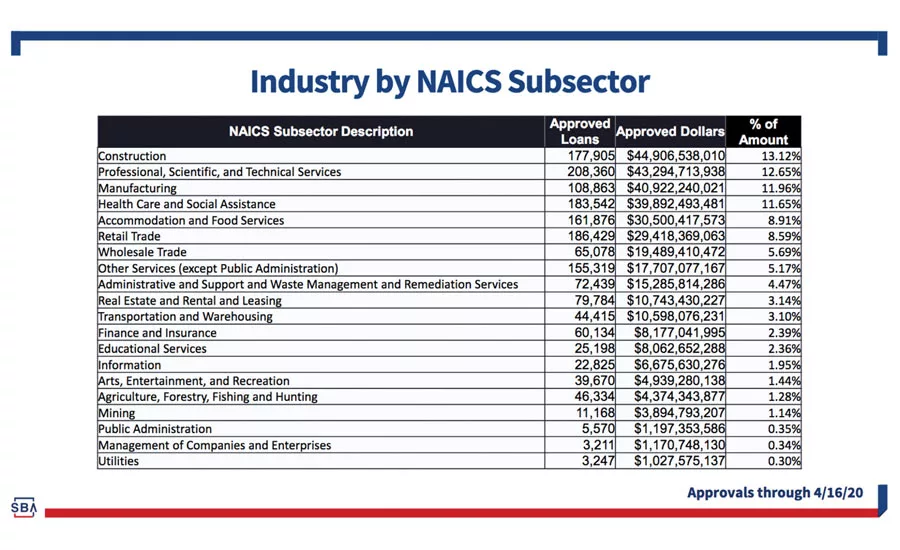
Breakdown of loans by industry sector during the first round of funding show construction firms got the largest share. Chart courtesy SBA
President Trump has signed a compromise measure that provides $310 billion to revive the federal Paycheck Protection Program (PPP)—which aims to assist financially strapped small businesses, including those in construction, engineering and building materials—with forgivable loans to help them cope with economic blows struck by the coronavirus pandemic.
The new legislative package, the Paycheck Protection and Health Care Enhancement Act, was signed into law on April 24, less than 24 hours after the House passed it by an overwhelming 388-5 vote.
[For ENR’s latest coverage of the impacts of the COVID-19 pandemic, click here]
The House vote followed the Senate’s unanimous approval of the measure two days earlier.
The Congressional Budget Office estimates the measure's total cost at $483.4 billion.
The PPP infusion will reopen a program whose initial funds had all been committed by April 16.
Just hours after Trump signed the bill, Treasury Secretary Steven Mnuchin and the head of the U.S. Small Business Administration, Jovita Carranza, announced that SBA will resume taking PPP loan applications on April 27, at 10:30 Eastern time "from approved lenders on behalf of any eligible borrower."
Looking for quick answers on construction and engineering topics?
Try Ask ENR, our new smart AI search tool.
Ask ENR →
The package also includes $75 billion to help hospitals and health-care workers, plus $25 billion for expanded virus testing and research and development at the federal Centers for Disease Control and Prevention and the National Institutes of Health.
In addition, the measure includes $50 billion for SBA disaster relief loans and $10 billion in SBA disaster grants.
PPP, which the agency administers, was created in the Coronavirus Aid, Relief and Economic Security (CARES) Act, which President Trump signed into law on March 27.
The program was formally launched on April 3, and quickly became flooded with requests from companies and nonprofit organizations. It exhausted its $349-billion initial funding in less than two weeks.
PPP's construction and engineering impact
Construction industry firms received the largest share of the initial batch of PPP loan dollars, with $44.9 billion, according to SBA.
In addition, 8% of the AGC firms were awaiting replies to their applications and 7% had applied but were told no more funds were available.
The program also has been popular among engineering firms, which fall under a different SBA category. About 72% of American Council of Engineering Companies member firms responding to a recent survey had applied for a PPP loan and 14% planned to apply.
“This underscores the program’s critical importance during the coronavirus crisis,” ACEC spokesman Jeff Urbanchuk told ENR via email.
More construction and engineering firms almost certainly had applied for loans and were waiting for them to be processed when the lending window closed on April 16. The new bill should provide help for at least some of those.
Brian P. McGuire, CEO of the Association of Equipment Dealers, said that PPP has helped dealerships keep workers employed and added that “the new funding will allow more equipment distributors to benefit.”
It’s unclear how long the new PPP money will last, however. The American Institute of Architects said it is encouraging firms to move quickly to apply for loans.
Hoped-for Next Package
As they pursue the PPP dollars, construction contractors, engineering and architectural firms and equipment companies will be focusing on another followup economic stimulus measure.
What industry companies and firms most want to see in a new package is a substantial amount of new federal infrastructure funding.
Stephen E. Sandherr, AGC's CEO, said in a statement "The president and Congress need to start putting in place measures to revive our economy by rebuilding our infrastructure and restoring private-sector demand for construction."
At a White House briefing on April 21, Mnuchin noted that Trump had said the administration was looking forward to a "phase four" bill, adding that "it would be infrastructure."
Mnuchin added, "The President has been talking about infrastructure since the campaign: roads, bridges, broadband. Especially, broadband now to rural America is very important."
Senate Minority Leader Chuck Schumer (D-N.Y.) said on the same day, “There will be a a big, broad, bold ‘COVID-4’ [bill].” He added, “For anyone who thinks this is the last train out of the station, that is not even close to the case.”
