Uncertainties Abound
...USI’s markets. "Our advantage is that we are backed by a big, financially sound company," he says. "Given the problems of the roll-ups, I’d much rather be me than them."
Comfort Systems also is poised for a market rebound. "Like everyone else, we’ve contended with tough industry conditions, but since the end of 2003 we’ve showed favorable gains," says CFO Gordie Beittenmiller. "After a couple of years in the wilderness, things are looking up. We are debt-free and generating and there is a renewed sense of optimism inside our company."
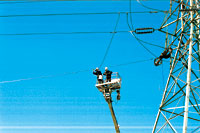 |
| (Photo courtesy of Xcel Energy) |
Silver Lining?
While some roll-ups did poorly or failed, there was a silver lining for a few companies. Tri-City Electrical Contractors, acquired by Encompass Service Corp., bought itself back through its managers when Encompass imploded. "We kept going about our business throughout the buyout and buy-back," says CEO Jack A. Olmstead. Encompass’s Chapter 11 filing caused some problems, "but we came out of it intact with a healthy backlog," he says.
| Click below to view... |

If there is a lesson to be learned from the Encompass experience, "it is the value of your name and reputation," Olmstead says. Being part of a large, publicly held company can hurt local decision-making. "Being private now, we can make decisions here and act on them quickly," he points out. Tri-City now is enjoying an upsurge in hospitality and entertainment construction markets. Work put on the back burner after 9/11 has now reached full boil, says Olmstead. The recent spate of Florida hurricanes could affect the resort condo market, Olmstead admits, "but just as 9/11’s impact on the hospitality market was temporary, I think the hurricane impact, if any, will also be temporary."
However, firms see a dimming market in electrical subcontracting. "Our people are still waiting for a pickup," says John Grau, executive vice president of the National Electrical Contractors Association, Bethesda, Md. "The electrical manufacturers are buoyant, but our contractors are not seeing a turnaround."
Many electrical contractors are watching the transmission and distribution sector. Some line contractors are positioning themselves for the future. Pike Electric, Mount Airy, N.C., acquired Red Simpson Inc. on July 1. "The transition is going smoothly," says Ronald Schenk, Red Simpson marketing director. The combined companies have 6,800 line workers.
The flurry of hurricanes kept Pike and Red Simpson hopping to fulfill line restoration agreements they have with many affected utilities. "We had 2,500 people in Florida, Alabama and Georgia. Some of them were working 16 hours a day," Schenk notes. He says the level of hurricane damage shows the result of long-term underinvestment in transmission lines.
Subcontractors also will have to meet tougher health and safety rules. "We are working with the Edison Electric Institute and [the U.S. Occupational Safety & Health Administration] on new safety standards in transmission and distribution work," says NECA’s Grau. The association also is developing a national agreement with the International Brotherhood of Electrical Workers to set safeguards and procedures for mandatory drug testing of union workers. IBEW has signed off on the measure. It now heads for final endorsement at NECA’s national convention this week in Los Angeles.
 |
| (Photo courtesy of Ivey Mechanical Company LLC/Julie Bennett |
Among mechanical contractors, Limbach Facility Services continues to reestablish itself after its brief ownership by Enron Corp. In April, Limbach hired Charlie Bacon, former president of New York City-based general contractor Bovis Lend Lease, as new CEO.
"I know what general contractors and construction management firms are looking for," says Bacon, who is pushing for more design-build work in his GC and CM alliances. "We have engineers on staff so we can provide full design-build services on mechanical systems. Elsewhere, Limbach is being cautious. "We’ve already left the industrial market after some bad experiences," Bacon says.
Skyrocketing material prices are causing many specialty contractors to pause. "Everyone knows about steel prices," says John McMahon, chairman of Miller & Long. "Now cement prices are rising in the South and lumber has nearly doubled."
 |
| (Photo by Guy Lawrence for ENR) |
While McMahon believes prices may be settling, demand from abroad has changed market dynamics. "Dealing with material prices used to be a local or regional issue." he says. "Now the battle for basic materials is a global one." McMahon is concerned that neither the construction industry nor the nation as a whole are prepared for the battle. "Remember the first oil crisis in the 1970s, where we all vowed never to be dependent on foreign oil again?" he points out.
McMahon says there is a move toward concrete construction. "You’re seeing more concrete buildings, less from a cost reason than for the mass of concrete acting as a damp for vibrations for delicate instruments and processes," he says. "Because concrete acts as a heat sink, it’s bringing more interest from the green-building movement."
Perhaps no group has been hit harder by escalating materials prices than steel firms. "Steel sheet and plate prices have doubled and allocations are still in place," says Frank Williams III, managing partner of Williams Group. "Wide flanges have...
