Uncertainties Abound
...not been as affected by availability and there are no allocations in place I’ve heard about." This price spike has hurt many major fabricators and erectors. "There doesn’t seem to be enough work out there for some of the big guys." Williams says he wouldn’t be surprised if some major firms are out of business before the steel crisis is over.
 |
| (Photo by Tudor Hampton for ENR) |
Big Iron
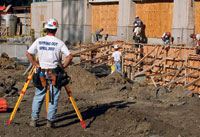
Among excavators and other heavy equipment users materials costs are having an impact on equipment costs and availability. "Delivery times are getting longer than usual, depending on what you’re ordering," says Jim Whitmer, vice president of Stark Excavating. "Delivery can get pushed to the first quarter of 2005. That can hurt you if you need the equipment for a job right away."
Stark isn’t alone in finding equipment shortages. "We’re seeing 12- to 18-week delays in shipments" in everything from excavators to attachments to buckets, says Leonard Cherry, president of Cherry Demolition. "We’re seeing no negotiations on price and have seen two major increases in the past year."
This has given a boost to equipment reconditioners. "There are guys out there that specialize in equipment rehabilitation," notes Mark Robison, chairman of RCI Construction Group. "You send them a 20-year-old [Caterpillar] D10 and four to six weeks later, you get it back looking like new."
Residential development still is going strong for excavators. "We do a lot of residential subdivision work," says Whitmer of Stark Excavating. To aid in this market, the firm acquired Colclasure Inc., a Bloomington, Ill., utility contractor, this past summer. "We’ve opted to get bigger by stretching our capabilities and our geographic reach," he says.
| Click below to view... |

Hawaii is one of RCI’s major markets that has turned the corner with the boom in hospitality. "They’re seeing some of the highest occupancy rates and dollar rates ever," Robison says, pointing to several resorts that are planned or under way there. "In the past, most tourists and investment in Hawaii came from Asia," he says. "Since 9/11, investors and tourists from North America and Europe are looking at Hawaii as a safe vacation haven."
 |
| (Photo by Tom Sawyer for ENR) |
Among the roll-ups, at least one company is doing well. Tecta America is an amalgamation of several major U.S. roofing contractors. "We’re proud to say that, of all the roofing consolidations, we’re the last one standing and we’re standing tall," says Mark Santacrose, president and CEO. "We had no outside money and we didn’t go public." Many roll-ups failed because outsiders brought money to the industry, but no real understanding of the business. "They were financially driven. We are operationally driven," he says. Tecta has grown from 17 offices in 2001 to 32 locations today.
Santacrose says about 65% of Tecta’s business is in putting in replacement roofs. "A lot of major firms that do their business in new construction are hurting," he says. The general building slump has driven many of these firms into competition with Tecta in the reroofing market. "But this is a local business and having strong local management is a must," says Santacrose.
For sheet metal contractors, the market decline seems to have leveled off. "In 2001, we had a record year in man-hours among members," says John Sroka, executive vice president of the Sheet Metal and Air-Conditioning Contractors of America. Hours fell off in 2002, but "this year, it looks like we are about even with 2003," he says. California is booming, "but the East Coast is hurting, with numbers down about 20%," Sroka says.
SMACNA, Chantilly, Va., now has an initiative with the Sheet Metal Workers of America to target markets where union sheet metal work is rare, such as residential. "We’re looking at a model being used in Ontario, Canada, where union sheet metal residential work is being done on a piece-work basis," Sroka says.
 |
| (Photo courtesy of Michael Dickter/Magnusson Klemencic Associates) |
Glazed Over
The softness of the commercial building market has taken its toll on the glazing and curtainwall business. "We aren’t planning on or anticipating any improvements in our business this year or next year," says Chuck Mowrey, president of Harmon Inc.
The firm is now targeting renovation and service sectors. Blast-resistant curtainwall, particularly in airports and government facilities, is one area of opportunity. "Clients and architects are looking for more laminated glass as a matter of protecting a building’s occupants," Mowrey says.
Harmon is well-positioned in the Washington, D.C., area to take advantage of the government market. "We had a pretty steady year last year, not because the...
