Colombia is currently working to develop more than a dozen major infrastructure projects worth more than $5.5 billion. In addition, the Transportation Ministry is moving forward with efforts to construct and revitalize existing highways, seaports, airports, railroads and waterways. Transportation Minister Andres Uriel is President Alvaro Uribe�s point man in this ambitious undertaking. Andres Uriel (Photo courtesy of Colombian Ministry of Transportation) Uriel became Colombia�s Minister of Transportation in 2002 when he was named to the post by Uribe, the country�s newly elected. A longtime friend of the president, Uriel served as the Secretary of Public Works in the state
Bogota, Colombia–After years of economic turmoil and social upheaval Colombia is poised to spend big to bolster its languishing infrastructure. But it isn’t going to be easy for this developing country known for its drug kingpins and jungle-based insurgents. The government of President Alvaro Uribe has made infrastructure development a priority while hoping for a free-trade agreement with the U.S. His government is pushing dozens of major projects worth several billions of dollars. In addition, private companies, particularly those in the energy sector, are pushing multi-million dollar upgrade projects. All that’s missing is the money for the public works and
After years of neglect infrastructure development is a priority in Peru. Highways have top priority. Nestor Palacios, Perus deputy minister of transportation, is overseeing approximately $2 billion in ongoing and planned road projects. Nestor Palacios (Photo by C.J. Schexnayder) The upgrades are critical in the wake of a free trade agreement between Peru and the United States reached in December. The concord now faces approval by the legislatures of both countries. Peru is betting the pact will continue to spur business and attract investments but that wont be possible without extensive upgrades in infrastructure. Mountainous Peru boasts more than 80,000
Investigations are continuing as to why one segment of a tunnel being built in Sydney, Australia, collapsed on Nov. 2. Residents above the Lane Cove tunnel were evacuated after a section being excavated by roadheaders collapsed near an exit ramp. No injuries were reported. Rescue teams from the New South Wales Fire Brigade immediately evacuated 60 people. They reported that a growing hole 10 meters wide and 7 m deep was undermining and damaging low-rise apartment houses. The rest of the 3.6—km twin tunnel, 95% excavated, was unaffected, according to the contractor. The joint venture of locally based Thiess Pty,
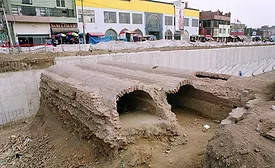
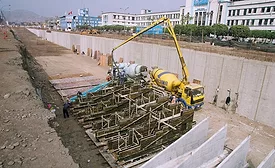
While the glory days of the Spanish conquest have ebbed into the Peru's uneasy past, its capital remains a major modern metropolitan center with all the headaches that entails. Mass transit ranks high among the problems it is struggling to bring under control. Currently, the city has undertaken an ambitious public works program that is designed to transform the chaotic road system into an organized network of upgraded thoroughfares and efficient mass transit. The 20-year plan, an extension of efforts begun in the mid-1990s, has begun to take physical form with the Miguel Grau Freeway in the heart of central
Daniel Villar: Trans-Oceanic Highway "project means a great deal to the country, particularly the southern portion (Photo courtesy of La Republica). Since opening shop in Peru in 1979, Brazilian-based Odebrecht’s Peruvian arm has grown to become the largest construction company in the country. In slightly more than a quarter century, the company has built more than 40 major infrastructure and mining projects here and is involved in more than $1 billion in projects across the country this year. A trophy project is Odebrecht’s piece of the $900 million Trans-Oceanic Highway project. Daniel Villar , the company’s project director, has been
Natural gas began to flow through Peru’s Camisea 430-mile pipeline on March 15 following a week-and-a-half long shutdown caused by an explosion on the line in a remote jungle area – the fifth break in the line in less than 18 months. “This rupture has been at the worse possible moment of the point of view of the political climate," said Peru’s vice minister of Energy, Juan Miguel Cayo. “Camisea II is looking for multilateral financing and, obviously, these problems do a great deal of damage to the image of the project to the rest of the world.” + Click
Workers on portion of Camisea pipeline, near Pisco, Peru (Photo courtesy of Inter-American Development Bank) A controversial $1.6-billion natural gas project in Peru has received a financial boost from the Inter-American Development Bank, which approved $135 million in loans for the pipeline portion of the job. The IDB's board of executive directors cleared the financial aid for the Camisea project on Sept. 10, but the board member from the U.S., Jose A. Fourquet, abstained. Fourquet cited several reasons for his abstention, including "indications that private financing may be available on favorable terms, " and that the U.S. has "not been