Industrial
Oklahoma AG Files Suit to Stop $4B Smelter Amid GOP Primary Tensions
Filing targets Century Aluminum–EGA venture planned for Tulsa Port of Inola
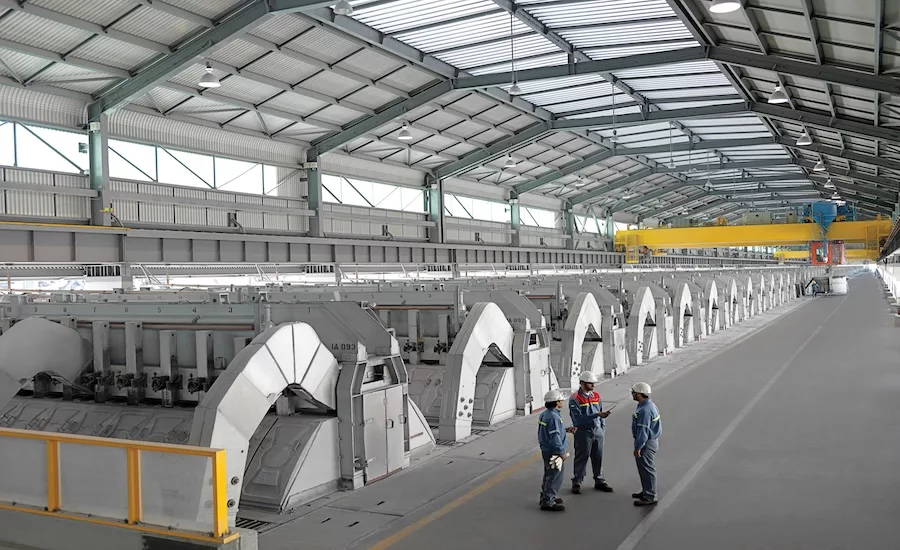
Interior of an undisclosed Emirates Global Aluminium (EGA) smelter potline facility.
Oklahoma Attorney General Gentner Drummond has sued to block a proposed $4-billion aluminum smelter in Inola—just days after President Donald Trump endorsed one of his rivals in the June 16 Republican gubernatorial primary.
Drummond, a Republican candidate, filed the petition June 2 in Rogers County District Court against Century Aluminum Co. and the project's operating entity, Aluminum Oklahoma LLC,, asking the court to halt the smelter on two grounds: anticipatory public nuisance and threatened pollution under state environmental law.
Gov. Kevin Stitt (R), who has championed the project since announcing it with Emirates Global Aluminium in 2025, accused Drummond of filing in retaliation following Trump’s backing a Drummond rival.
"As soon as President Trump made his endorsement in the governor's race, Drummond dropped the act and showed his true colors," said Stitt in a statement to KTUL. "Now he is turning his machine against one of President Trump's top priorities, once again weaponizing his office to settle scores instead of serving Oklahomans."
The plant is a joint venture between Century Aluminum and EGA, announced Jan. 26 at the Tulsa port. Designed to produce more than 750,000 metric tons of primary aluminum per year—more than doubling current U.S. output—the facility would create 1,000 permanent direct jobs and 4,000 construction jobs, with a construction start targeted by the end of 2026, the firms said..
The project has received significant federal, state and local backing. The U.S. Dept. of Energy committed a grant of up to $500 million; Oklahoma has assembled an incentive package reported to be worth up to $255 million; and the Inola officials created a tax-increment financing district to support the development, in addition to tax credits and property-tax exemptions. In February, the developers brought in Bechtel for preparatory engineering work, including modularization planning and logistics. The contractor also is coordinating with sustainability consultant ERM on environmental and social permitting efforts.
The petition identifies EGA as a United Arab Emirates state-owned enterprise, equally owned by the sovereign wealth funds of Abu Dhabi and Dubai. "The controlling hand behind the largest smelter ever proposed on American soil belongs not to Oklahomans, nor even to Americans, but to a foreign sovereign more than seven thousand miles away," the petition states.
Primary aluminum smelting is described in the filing as "among the most polluting heavy-industrial activities known," releasing fluorides, sulfur dioxide, fine particulate matter, polycyclic aromatic hydrocarbons, perfluorocarbons and hazardous spent potliner. It states that the smelter's pending air-quality permit application authorizes emissions of approximately 425 tons of hydrogen fluoride per year, which the US Environmental Protection Agenc classifies as extremely hazardous.
The petition focuses particularly on fluoride's effects on cattle, which can ingest it—and irreversibly accumulate it—through forage, resulting in dental and skeletal fluorosis.
"For a cattle operation, chronic fluoride exposure is a slow sentence of ruin—for the herd and for the livelihood that depends on it," the petition states, noting cattle ranching is Oklahoma's single-largest agricultural sector and in Rogers County sits at the heart of that industry. The facility would be located within approximately 3 miles of Inola's schools, homes and farms.
Beyond projected impacts, the petition points to Century Aluminum's operating history at other facilities. It cites a South Carolina smelter against which residents sued the developer in 2023 over alleged pollution impacts. Century later paid more than $940,000 to settle claims brought by 719 nearby property owners. The petition also notes that South Carolina regulators fined the company more than $360,000 for air-pollution violations and reporting failures.
In Kentucky, the filing cites approximately 30 violations over roughly the past 12 years involving emissions limits, hazardous waste management, monitoring and testing failures, emergency-planning deficiencies and water-quality violations.
Drummond argues that the company's compliance history raises concerns about potential impacts from the proposed Inola smelter on nearby residents, agricultural operations and the environment. The challenge also centers on the project’s energy demands.
According to the filing, the smelter would require more than 1,000 MW of continuous power—more electricity than many Oklahoma cities consume—placing what Drummond describes as an extraordinary strain on the regional grid served by Public Service Co. of Oklahoma and potentially driving up costs and straining power reliability across the region.
"A primary aluminum smelter does not belong in a community's backyard, and its emissions do not respect property lines," Drummond said. "The injury is imminent, it is grave and it is irreparable."