Earlier this month the Obama Administration breathed new life into the FutureGen experimental “clean coal” electric generating plant in Mattoon, Ill., that would trap and store carbon dioxide emissions. The administration pledged $1 billion to its development. Initially introduced by the Bush administration in 2003 as a means to develop low-emissions coal-fired power plants, the project was dropped early last year due to cost overruns. FutureGen Alliance, a consortium of coal and utility companies working to build the plan, estimate the project will cost approximately $2.4 billion to complete. A decision on whether to go forward with construction on the
Mike Kennedy arrived in Panama earlier this year to head CH2M Hill’s management of the $5.25 billion Panama Canal Third Lane Expansion. The CH2M Hill Executive Vice president is a 38-year veteran of the Denver, Col.-based firm. He previously served as the president of the company’s Transportation Business Group, handling management services for several major jobs such as London’s $22 billion Crossrail Programme and Vancouver’s $4.5 billion Gateway Program. CH2M Hill is working in close association with the Panama Canal Authority (ACP) to oversee the expansion effort and, particularly, the design/build locks contract due to be awarded this summer. Kennedy
Panamanian firm Constructora Urbana SA (CUSA) won the first dry-excavation contract in July 2007 with a low bid of $41.1 million for the Pacific locks access channel, but was outbid for the two subsequent jobs. However, CUSA offered its services to the winning firms and netted subcontracting jobs with both. “We have the equipment out there already, and we can pretty much keep doing what we have been doing,” says CUSA Executive Vice President Carlos Fábrega. “We keep our equipment operating and our people at work.” Photo: C.J. Schexnayder/ENR Non-canal expansion construction thrives in Panama. Related Links: Panama Widens Horizons
This dry excavation, requiring removal of 47 million cu m, is needed to create the Pacific locks access channel–a 6.7-kilometer link between the existing navigation channel and the new locks to be built next to the Miraflores Locks. The Cocoli River, which empties into Miraflores Lake, is being rerouted 3.5 km. The 5 km-long Borinquen Road was also relocated. All Photos: C.J. Schexnayder/ENR Finding ordinance (top), blasting (middle) and moving rivers (bottom) are all part of Panama work. Related Links: Panama Widens Horizons Another tricky aspect has been the removal of unexploded ordinance from a former U.S. Army firing range.
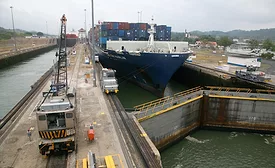
When U.S. engineer John Frank Stevens arrived in Panama in July 1905 to take over the American effort to construct the Panama Canal, he was appalled. The endeavor to build the transoceanic waterway already was a year old and had consumed more than $128 million. “I found no organization…no answerable head who might delegate authority…no cooperation existing between what might charitably be called the departments,” Stevens wrote, as reported in David McCullough’s watershed book “The Path Between the Seas.” Slide Show Photo: ACP Current Panama Canal facilities are a tight fit for ships. Related Links: Panama Canal Third Lane Expansion
Brazil’s Odebrecht has won a $2.1-billion concession for the upgrade and new construction of the Dom Pedro Highway in the state of Sao Paulo, Brazil. The 30-year concessionaire will be responsible for the upgrade and maintenance of a total of almost 185 miles of tolled roadway traversing 17 cities between Mogi Guaçu and Jacarei the northeast of Sao Paulo’s urban center. The project is part of an ongoing effort to alleviate traffic problems in the country’s largest metro area. “We will invest ... 1.4 billion in the first six years,” says Leonardo Mala, an Odebrecht spokesman. “We will start the
Construction interests in Venezuela are watching with concern as the country struggles to recast its budget to handle new economic pressures brought on by a precipitous fall in the price of oil in the past year. More than 90% of Venezuela’s export revenue comes from oil. But petroleum prices have plummeted more than 50% in the past nine months, triggering a dramatic budget shortfall in South America’s leading oil-producing country. In a nationally televised announcement on March 21, Venezuela President Hugo Chavez unveiled a package of austerity measures and tax hikes to handle the growing economic pressures. Photo: Odebrecht Contractors
Four executives with one of the largest construction firms in South America, Camargo Correa, were arrested by Brazilian police on March 25 in connection with a yearlong corruption probe. In all, 10 employees of the firm were arrested as federal police carried out a series of raids on the company’s offices in Sao Paulo and Rio de Janiero. The operation was part of an investigation named Operation Sand Castle. Photo: Hermano Luders Itaipu dam contractor faces charges. Investigators with Brazil’s federal prosecutor’s office specializing in financial crimes say Camargo Correa was laundering money through fake companies and illegal currency traders.
Four executives with one of the largest construction firms in South America, Camargo Correa, were arrested by Brazilian police Wednesday in connection with a year-long corruption probe. A total of ten employees of the firm were arrested as federal police carried out a series of raids on the company’s offices in Sao Paulo and Rio de Janiero — part of an investigation named Operation Sand Castle. Photo: C.J. Schexnayder The Campos Novos dam in southern Brazil built by Camargo Correa and completed in 2006. Investigators with Brazil’s federal prosecutor’s office specializing in financial crimes say Camargo Correa was laundering money