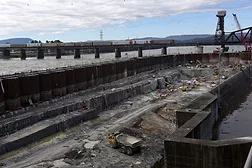
The second of two major sediment diversion projects in Plaquemines Parish, La., is closer to construction following the naming of a contractor to build the $700-million structure that will use mud from the bottom of the Mississippi River to help rebuild the state’s disappearing wetlands.
The road to innovation can be a long and winding one, but it might be hard to rival the path followed by the Ocean Renewable Power Co., of Portland, Maine, and its RivGen submersible electric power generating system, which is designed for installation on riverbeds and is based upon the company’s tide-driven units for maritime locations.
The California Dept. of Water Resources (DWR) began releasing water from Oroville Reservoir earlier this month for the first time since the two-year, $1.1-billion emergency spillway reconstruction project was completed late last year.
Despite submitting long-awaited drought contingency plans to Congress, the states of the Colorado River Basin expect to continue operating largely as they have, focusing on conservation, rather than new infrastructure.
Environmental Protection Agency water quality rules are contradictory and have the effect of allowing municipal dischargers in Montana an “escape clause” from compliance with state water-quality standards, ruled a U.S. federal court judge in Great Falls, Mont., on March 25.
Add ponds, lakes and reservoirs to the list of “things” on the internet of things—or at least that’s what one Dutch company is starting to do to help keep waters clean.
While the Federal Emergency Management Agency (FEMA) approved $205 million in federal funds to reimburse California for costs to reconstruct the Oroville Dam spillways damaged by 2017 flooding, it declined to pay the remaining $306 million that the state’s Dept. of Water Resources (DWR) had requested.
 RSS
RSS