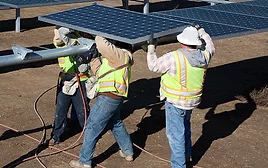
Promulgators of the Living Building Challenge, acknowledged as the most demanding certification program for the production of ultragreen buildings, are on a campaign to scale up the size of the projects that register for the rigorous net-zero annual energy- and water-use performance categories.
A new study by Dodge Data and Analytics, published this February in the “World Green Building Trends 2016 SmartMarket Report,” confirms that green design and construction is accelerating as an important global trend.
State transportation departments are considering using high-tech maps to measure how much fuel is saved from driving on repaved highways, thanks to a new pavement-vehicle-interaction test developed at MIT.
A Senate floor vote could come by Feb. 5 on a sweeping energy bill, which, if enacted, would be the first comprehensive energy legislation to make it through Congress since 2007.
The people claiming that our economy will collapse under the burden of efforts to reduce greenhouse-gas emissions are the same ones who tout the free market’s infinite ability to solve technical problems.
A top U.S. engineer has called for building codes to include limits on carbon dioxide released by the production of construction materials to reduce greenhouse-gas emissions.
Environmental advocates are holding out hope that 150 world leaders and 40,000 delegates at climate talks—held in Paris on Nov. 30- Dec. 11—can reach a binding agreement to hold average global temperatures to an increase of less than 2° C, the level scientists say is necessary to prevent irreversible changes to the earth’s ecosystems.
While the U.S. Green Building Council is busy making a business case for a greener globe, other environmentalists are busy making greener buildings, communities and cities.
 RSS
RSS