Transportation
$4.4B Gordie Howe Bridge Opens, Ending Political Standoff Over Border Crossing
Agreement follows weeks of uncertainty over the completed Detroit-Windsor, Ontario crossing
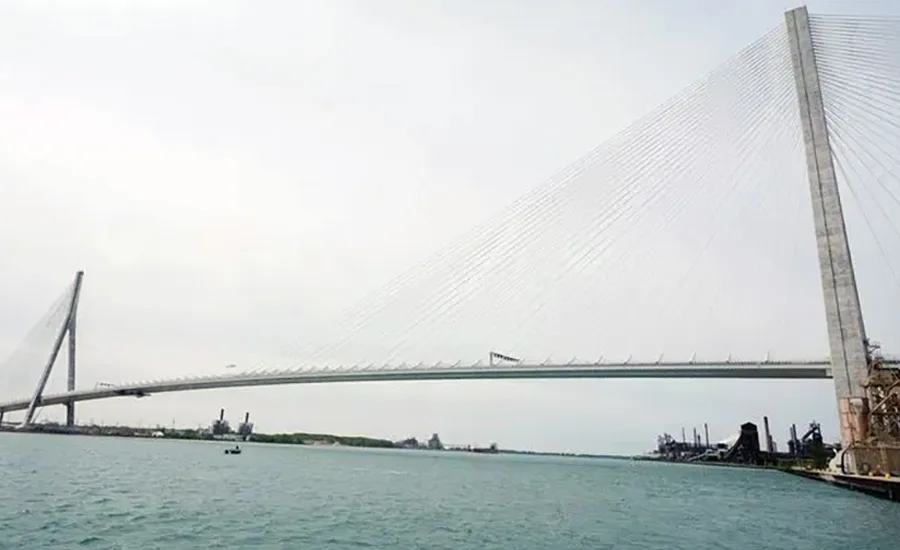
The Gordie Howe International Bridge opens to traffic July 27, completing a $4.4-billion, six-lane crossing between Detroit and Windsor, Ontario. The cable-stayed span is the longest of its kind in North America and culminates a project that spent years in construction before political negotiations delayed its opening.
Updated 12:08 p.m. ET, July 27, 2026
The $4.4-billion Gordie Howe International Bridge opened to passenger and commercial traffic at noon July 27, six weeks after Washington requested a postponement and after Canada agreed to share bridge revenues and give the U.S. government a role in certain toll changes.
The opening answers the immediate question ENR’s editorial board raised June 22: Why was a completed international crossing still sitting unused?
The Windsor-Detroit Bridge Authority had said only that Canada and the U.S. needed time to resolve “outstanding issues,” while Canadian Prime Minister Mark Carney said the delay came at Washington’s request.
The terms announced as the basis for opening were set out in a proposed agreement in principle between the U.S. and Canadian governments. Canada agreed to make annual payments equal to 50% of net bridge and crossing-related revenues during the first 15 fiscal years of operations to an economic development fund established and solely controlled by the U.S. government.
The bridge authority must also obtain U.S. consent for raising toll fees, including increases exceeding 10% that would put rates above comparable regional crossings.
The agreement explicitly says it does not amend the 2012 Canada-Michigan Crossing Agreement or its ownership, governance and financial framework. Canada financed the bridge, the U.S. port of entry, the Interstate 75 interchange and related Michigan land acquisition, while ownership is shared by Canada and Michigan.
Looking for quick answers on construction and engineering topics?
Try Ask ENR, our new smart AI search tool.
Ask ENR →
Michigan Gov. Gretchen Whitmer said the bridge “has always been a great deal for our state,” adding that it will speed auto production, lower costs, ease traffic and strengthen agriculture. Whitmer posted a video of herself on social media driving across the bridge ahead of the official noon opening.
"This morning, I got behind the wheel of a Michigan-built Ford Mustang to mark the official opening," she wrote on X. "I fought to open this bridge to build the economy and connect Michiganders to opportunities on both sides of the Detroit River."
The political dispute resurfaced before a July 24 ribbon-cutting. Canadian officials dropped plans for a joint ceremony with U.S. and Michigan representatives after President Donald Trump threatened 50% tariffs on a range of Canadian goods, then held an event in Windsor without the U.S. delegation. Trump responded on Truth Social that the original bridge deal “no longer stands” and said the U.S. would receive “50 percent of the Profit.”
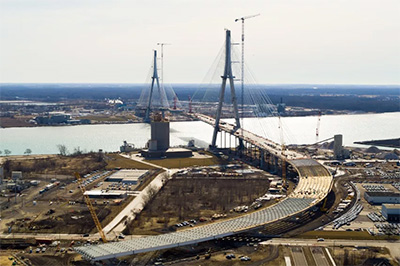
Viewed from the U.S. side before completion, the Gordie Howe International Bridge carries its approach spans over the new Interstate 75 interchange toward the Detroit River. The project combined the 1.5-mile cable-stayed bridge with new U.S. and Canadian ports of entry and highway connections that entered service July 27.
Photo courtesy of Bridging North America
The proposed agreement would provide for the U.S.-controlled fund to receive half of net bridge and crossing revenues for 15 years. But its preservation of the 2012 framework conflicts with Trump’s assertion that the original agreement no longer stands.
The first new Ontario-Michigan crossing in more than 60 years, the six-lane, 1.5-mile cable-stayed bridge creates a direct highway connection between Interstate 75 and Ontario Highway 401. Its 2,799-ft main span is the longest cable-stayed span in North America.
The broader crossing includes 16 toll lanes and 60 U.S. and Canadian inspection lanes, giving commercial trucks an alternative to the privately owned Ambassador Bridge. The Detroit-Windsor corridor handles roughly one-quarter of U.S.-Canada trade by value.
Bridging North America began construction in October 2018. Pandemic disruptions and unforeseen conditions at the Michigan Interchange pushed completion beyond the project's original 2024 target. After crews connected the bridge deck in mid-2024 and installed all 216 stay cables, work shifted to systems installation, testing and commissioning ahead of the July 27 opening.
The Bridging North America P3 consortium includes ACS Infrastructure, Fluor and Aecon. Its design-build team included FlatironDragados, Fluor and Aecon, with AECOM serving as bridge design engineer.
More than 15,800 people worked 20.1 million hours on the project. Bridging North America CEO David Henderson credited workers’ “work ethic, precision and collaboration” as the foundation of its success. With substantial completion achieved, the consortium now begins a 30-year operations, maintenance and rehabilitation term. The toll-free multi-use path is scheduled to open Aug. 5

Bryan Gottlieb is the online editor at Engineering News-Record (ENR).
Gottlieb is a five-time Society of Professional Journalists Excellence in Journalism award winner with more than a decade of experience covering business, construction and community issues, including finance, law and real estate. He has reported for Adweek and the San Diego Daily Transcript and led a community newsroom in Santa Monica, Calif. He served as editor-in-chief of the Detroit Metro Times and as managing editor at Roofing Contractor, where he helped shape national industry coverage. At Engineering News-Record, Gottlieb covers breaking news, large-scale infrastructure and megaprojects, regulatory developments and business trends across the U.S. and global construction sectors.
email: gottliebb@enr.com | office: (248) 786-1591