Dam Safety
Granite to Replace Spillway at PG&E Dam After Post-Oroville Safety Review
Hydraulic analyses found Tiger Creek's existing spillway could safely pass less than half the site's probable maximum flood
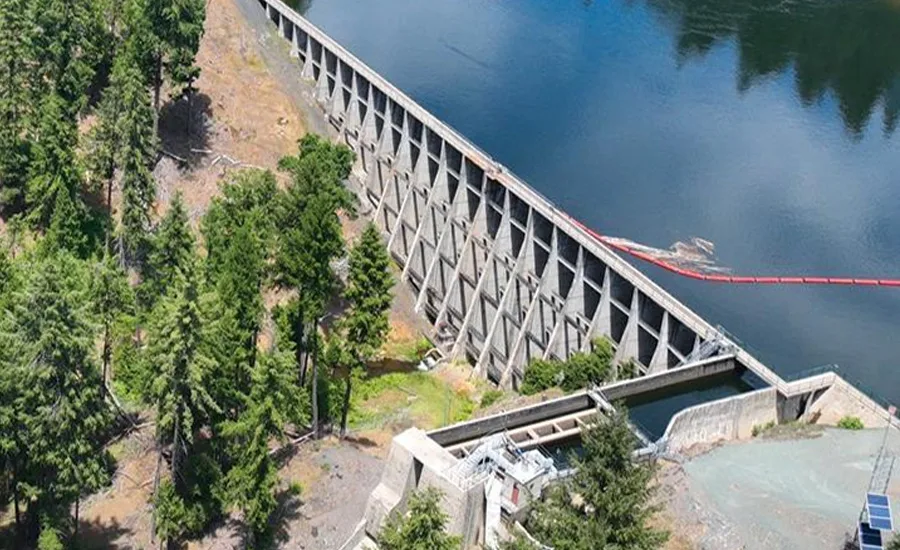
An aerial view of PG&E's Tiger Creek Regulator Dam near Pioneer, Calif. Granite Construction will build a replacement spillway along the dam's right abutment after post-Oroville safety assessments found the existing flood-release system could not safely pass the site's design flood.
Granite Construction announced July 22 that it has received a $50-million contract from Pacific Gas & Electric (PG&E) to replace the spillway at Northern California's Tiger Creek Regulator Dam, where construction began in May.
The work follows spillway assessments PG&E conducted after the 2017 Oroville Dam spillway failure prompted federal and California dam-safety regulators to require hydroelectric operators to reevaluate aging spillways using updated hydrologic modeling and engineering analyses.
At Tiger Creek, the review identified deterioration in the existing spillway chute, uncertainty over whether the dam's three spillway siphons would activate as intended and inadequate hydraulic capacity under probable maximum flood conditions.
Hydraulic modeling found the existing spillway could safely pass about 2,750 cu ft per second, less than half the site's estimated 5,653-cu-ft-per-second probable maximum flood. Because the 1931 dam was not designed to withstand overtopping, PG&E selected a replacement spillway designed to pass up to 6,000 cfs.
Tiger Creek Regulator Dam is part of PG&E's Mokelumne River Hydroelectric Project near Pioneer, Calif. State-certified project documents describe the near-century-old structure as a 486-ft-long, 110-ft-high concrete slab-and-buttress dam. Construction is scheduled for completion in May 2028.
Granite said the contract includes construction of a new spillway crest structure and concrete chute, installation of a temporary cofferdam, excavation, rock anchoring, concrete placement, abandonment of the existing spillway and construction of a permanent access road. The company previously completed an approximately $600,000 preconstruction contract that included constructability reviews and early planning for the project.
State-certified project plans call for constructing the replacement spillway along the dam's right abutment rather than modifying the existing spillway. The design includes a 40-ft-wide spillway chute terminating in a flip bucket with splitter blocks before flows discharge into an excavated plunge pool.
Looking for quick answers on construction and engineering topics?
Try Ask ENR, our new smart AI search tool.
Ask ENR →
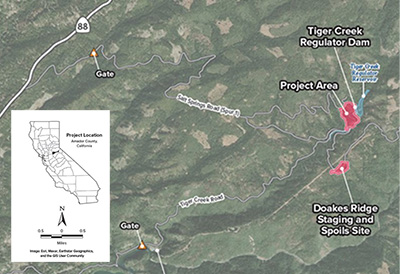
State-certified project plans show the Tiger Creek Regulator Dam project area and the Doakes Ridge staging and spoils site, where excavated material from the spillway replacement will be transported during construction.
Map courtesy of Calif. State Water Resources Control Board
The project also requires cutting a new opening through the dam's right abutment to connect the reservoir to the replacement spillway before the original spillway is permanently abandoned, replacing rather than rehabilitating the existing flood-release system.
Construction will take place behind a temporary cofferdam installed during a planned reservoir drawdown, allowing the new spillway to be built in dry conditions while reservoir operations continue.
State-certified project documents estimate the work will require approximately 35,000 cu yd of excavation and about 4,000 cu yd of structural concrete, underscoring the scale of what is effectively a new hydraulic structure rather than a rehabilitation project.
The replacement spillway is one of several dam-safety upgrades undertaken by California hydroelectric operators since the Oroville incident prompted a broader reassessment of aging spillway systems and their ability to accommodate updated flood estimates. At Tiger Creek, the solution was to construct an entirely new spillway instead of modifying the original design.
Granite and PG&E did not immediately respond to ENR's requests for additional information.

Bryan Gottlieb is the online editor at Engineering News-Record (ENR).
Gottlieb is a five-time Society of Professional Journalists Excellence in Journalism award winner with more than a decade of experience covering business, construction and community issues, including finance, law and real estate. He has reported for Adweek and the San Diego Daily Transcript and led a community newsroom in Santa Monica, Calif. He served as editor-in-chief of the Detroit Metro Times and as managing editor at Roofing Contractor, where he helped shape national industry coverage. At Engineering News-Record, Gottlieb covers breaking news, large-scale infrastructure and megaprojects, regulatory developments and business trends across the U.S. and global construction sectors.
email: gottliebb@enr.com | office: (248) 786-1591