Rich Hartman
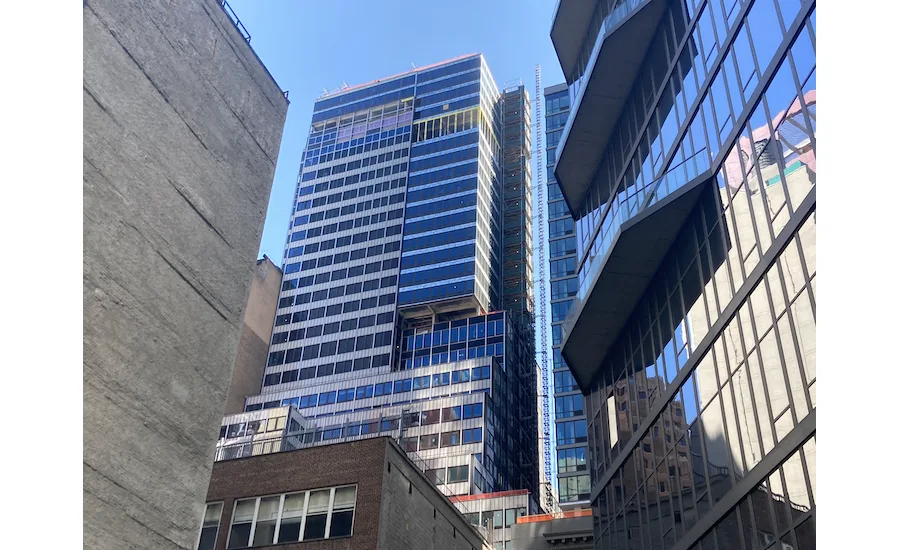
Streets remained closed surrounding the former headquarters building of pharmaceutical giant Pfizer in midtown Manhattan (seen at center) after July 7 emergency when structural columns were found to have buckled, during office-to-residential conversion under way..
While lenders are closely watching the investigation into the buckled columns and sagging floor the former Pfizer headquarters in New York City, insurers are focused on what any findings may mean for the broader market.
Whatever engineer Thornton Tomasetti and the city and state agencies investigating the incident ultimately determine could shape whether office-to-residential conversions become more difficult to insure in New York and elsewhere.
"It depends on which side of the insurance business you sit on that you can really dive into this as a case study, especially for for all of us in the construction insurance space," says Richard Hartman, senior vice president, Construction Professional Liability Broking Leader at NFP, an AON company.
"These office-to-residential conversions are very popular here in New York City and they're only growing in demand ... I think something is going to have to happen," he adds. "There's a lot of speculation and I think that we'll find out a lot over the next, you know, 6-12, 18 months as to exactly where this is going to go from a regulatory perspective."
Office-to-residential conversions have become hot commodities as they often involve faster turnarounds and lower costs than new construction. They also offer a way to revitalize downtown commercial districts struggling to find new office tenants.
But these conversions are more than a bit of new paint. Floor plates need to be reconfigured for residential apartments, and the structural load requirements for the structure can change as well. The project's structural engineer has already publicly claimed that prescribed structural reinforcements were not installed, the first of likely many assertions from members of the project team on who was at fault.

"Claims will occur where liability rests and that will take a process to determine," Hartman says. "Those are two very different things. Everybody thinks you know a claim. 'I'm going to have to pay out millions of dollars.' That may not, may or may not be true, depending upon the process, and the results of that process, the determination of who is truly responsible. I think that the first part of that determination will in the results of the regulatory bodies investigation. Whether it's the New York City Department of Buildings, the New York City Department of Investigation."
Looking for quick answers on construction and engineering topics?
Try Ask ENR, our new smart AI search tool.
Ask ENR →
Hartman said there will likely be business interruption claims and other ancillary insurance claims from businesses around as a result of their having to shut down and evacuate those buildings and similar claims from entities not directly involved in the construction project.
"it's interesting to see how this is going to play out because you're both sides already defending themselves a little bit. You hear the engineers, in an article, that say maybe the plans weren't followed, the contractor sort of went astray." says Andy O'Brien, partner and construction leader at The Baldwin Group, the third-largest insurance and financial risk advisory firm in the U.S. "We hear the same thing from the contractor side. So who knows how it'll play out, but I do think that we could see some more strict points come out of this to avoid, obviously, a near-miss catastrophe."
235 GC LLC is a single-purpose entity created by developer and contractor Metro Loft for this project to convert the old Pfizer headquarters into 1,600 apartments, and it qualified for related tax breaks. One of the benefits currently in doing office-to-residential projects in New York City is a generous tax abatement program, which exempts these developments from property taxes for up to three years during construction and 25 to 35 years after completion. The program, implemented in 2025, was intended to drive redevelopment of they city's office spaces which saw declining occupancy rates during the COVID-19 pandemic. Given the incentives, there is pressure from developers to complete conversion projects quickly to bring tax-abated residential units to market.
O'Brien agrees that investigations into the project's problems will be a lengthy process, but it remains to be seen if there will be changes to existing incentives for office-to-residential conversions.
"New York has really been looked at as kind of the pioneer city in the U.S. in terms of how to take these existing office assets and repurpose them and start to solve some of the housing crisis. New York is way ahead, a decade ahead of Boston and many other cities," says O'Brien. "And there has been a lot of success in doing that, but I wonder if this is going to sort of hit the pause button a little bit and bring some greater regulation around it."
O'Brien stresses that contractors, engineers and other members of the building team need to go into conversions with their eyes wide open and understand that existing conditions may not be what they're initially believed to be.
"I've been involved in a number of these types of conversions over my career and the ones that have been the most successful have been the ones that are really, really diligent on the front end in terms of understanding going into these projects," he says. "You have, a lot of the time, really old buildings that you're entering into and you really don't know what you're working with until you start to break down the walls and peel back the onion and evaluate he existing condition of the building."
O'Brien says he was the principal Baldwin insurer on an office to hotel conversion that started out as a $70 million project and "as they got through and they broke down walls and they started to expose the structural elements of the building, they just uncovered latent defects that they didn't know about. Really quickly, the $70 million project turned into a $120 million project because they had to install some structural reinforcements that were unforeseen."
The exploratory surgery of construction can also turn up good news. While the team behind the 79 W. Monroe office to residential conversion in Chicago found asbestos, lead pipes and conditions that required remediation, they also found a slurry wall beneath the project that made the job of holding up the street and the project above it possible.