Water Infrastructure
Water Resources Bills Advance in House and Senate
Final vote on Water Resources Development Act advanced funding measure may come before August congressional recess
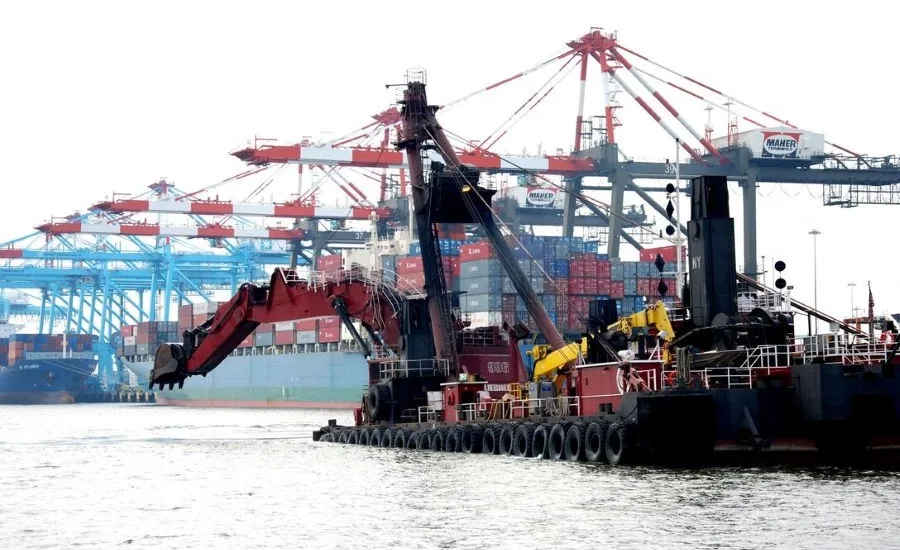
Dredging in a shipping channel in New Jersey, part of ongoing WRDA-funded work by the U.S. Army Corps of Engineers’ New York District, would deepen shipping channels in New York Harbor to improve navigational safety for cargo vessels at the port.
Different versions of the 2026 Water Resources Development Act, which authorizes funding every two years for core U.S. Army Corps of Engineers projects, advanced with unanimous committee votes in both the House and Senate on July 14.
The bill, known as WRDA, funds dredging, port and harbor improvements, inland waterway navigation systems, flood and stormwater risk management and other water resources infrastructure. Since 2014, when the bill first was first enacted, it has been one of the few measures lawmakers can pass every other year with broad bipartisan support.
Industry observers say lawmakers could bring the bill up for a floor vote in each chamber before they leave for their annual August recess. A conference committee would still need to reconcile the House and Senate versions, likely not before early September, said John Chambers, director of federal/heavy and utility infrastructure divisions for the Associated General Contractors of America.
Following passage of the bill by the House Transportation and Infrastructure Committee, Chairman Sam Graves (R-Mo.) noted in a statement helps support traditional Corps priorities and “streamlines [agency] processes, provides reforms to improve project delivery and empowers local stakeholders.”
A notable addition to the Senate bill is a significant boost to U.S. Environmental Protection Agency state revolving fund (SRF) programs for drinking water and wastewater projects.
Tthe Environment and Public Works Committee-approved bill authorizes $16.5 billion for the drinking water SRF and $14 billion,for the clean water SRF, both between 2027 and 2030. The Senate version also authorizes $260 million for the Water Infrastructure Finance and Innovation Act (WIFIA).
David LaFrance, CEO of the American Water Works Association, described funding increases in the Senate bill as a “positive step,” adding that his group is encouraged that the committee “recognizes the importance of reauthorizing core water infrastructure financing programs, including the SRFs and WIFIA, at robust levels.”
Looking for quick answers on construction and engineering topics?
Try Ask ENR, our new smart AI search tool.
Ask ENR →
Adam Krantz, CEO of the National Association of Clean Water Agencies, added thst "there has not been a time when a strong federal funding commitment has been more important, as clean water utilities and the customers they serve struggle with significant affordability challenges.”
Regulatory Changes
Policy changes in both versions of the bill allow more flexibility for use of alternative project delivery methods and more latitude for non-federal entities to partner on dredging and other water-resource activities. A House Transportation and Infrastructure Committee press release stated that policies in the House bill “will improve non-federal interests’ ability to obtain valuable technical assistance and to fund construction more quickly, as well as to encourage the Corps to increase use of multi-year contracts.”
AGC’s Chambers told ENR that policy provisions in both the House and Senate versions of the bill allowing more participation for non-federal entities would reduce costs and enable project participants to be both more nimble and more efficient, reducing burdens on taxpayers.
The Senate version directs the Corps to brief Congress on opportunities to contract with the private sector for design and procurement of dredging vessels for water resource projects, which has been high on AGC’s wish list, Chambers added. “I think this opens up a good conversation with the Corps and Congress and us and our industry stakeholders to make sure that they can use the private sector as much as possible,” he said.
The Senate bill also directs the U.S. Environmental Protection Agency to study technologies to detect, monitor, capture and potentially remove microplastics and nanoplastics and report findings back to Congress within 18 months of enactment of WRDA 2026.
The American Society of Civil Engineers has praised the House bill inclusion of a five-year reauthorization of the High Hazard Potential Dam Rehabilitation Grant Program to fund repair and rehabilitation of dams that would cause the most damage if impaired or non-operational, calling the measure one of the group’s “top priorities.”