Energy Megaproject
East Africa $5.6B Oil Pipeline Nears Finish, With Friends and Foes Watching
Uganda and Tanzania tout economic boost of 1,443-km regional oil link, but opponents still fear lasting environmental impacts to Africa, with UK suit filed on July 7
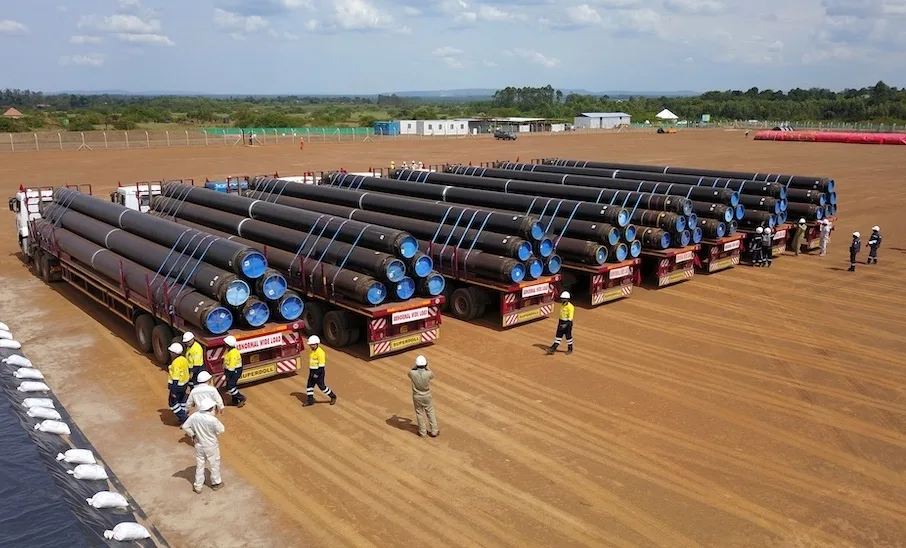
One project contractor, China Petroleum Pipeline Engineering, received delivery of insulated line pipe at the project main camp in Uganda in 2024 for installation. Australia-based Worley is firm's joint venture partner on project
During a late June visit to a construction site of the 1,443-km East African Crude Oil Pipeline (EACOP), Tanzania Minister of Energy Deogratius Ndejembi instructed the national utility company Tanzania Electric Supply Co. Ltd. to ensure that power lines extend to the megaproject that will transport crude oil from Hoima, Uganda to an Indian Ocean export terminal in Tenga, Tanzania.
The minister identified the power hook-up as one of the final challenges facing the $5.6-billion oil line that will be the world’s largest to be heated by electrical power. He said final mechanical construction and hydro-testing are set to finish in the second half of 2026 and that first oil would be delivered to the Chongoleani export terminal in January.
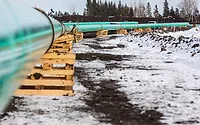
To keep Uganda’s highly viscous oil moving, the entire 24-in. pipeline must be continuously insulated and kept at a temperature of 122°F using a specialized electrical trace heating system. The pipeline is set to carry up to 230,000 barrels per day, with plans also to power most pipeline operations with solar energy.
Ernest Rubondo, CEO of the Uganda Petroleum Authority, has described the line as “the backbone of Uganda’s crude oil exports and a key driver for economic transformation.” An estimated 6.5 billion barrels of oil reserves were discovered in 2006 in two fields near and beneath Lake Albert in western Uganda. Infrastructure to develop the Tilenga and Kingfisher oil fields is being constructed in conjunction with the pipeline.
Project development is being led by France-based TotalEnergies, which has a 62% stake. Uganda National Oil Co. and the Tanzania Petroleum Development Corp. each hold 15% and China National Offshore Oil Corp. has an 8% stake.
The engineering, procurement and construction contract was awarded in 2022 to a joint venture of Australia-based Worley Lid. and China Petroleum Pipeline Engineering. Project development involved creation of what Ndejembi said were an estimated 10,000 jobs
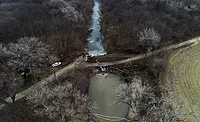
The pipeline is set to cross wetlands, rivers and numerous protected ecosystems such as Murchison Falls National Park, the latter considered a significant haven for wildlife in Africa
Looking for quick answers on construction and engineering topics?
Try Ask ENR, our new smart AI search tool.
Ask ENR →
Although the original pipeline development plan called for 60% of financing to come from bank loans and 40% from shareholders, the latter have actually provided 90% of funding, since dozens of commercial banks refused to finance the project directly due to environmental, social and climate risks, according to opponents and media reports.
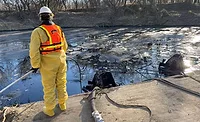
International environmental action groups, climate scientists and other opponents cite the project as a ‘carbon bomb’ that will release more than 379 million tons of CO2 during its lifetime. A June 25 report in Yale Environment 360, an independent nonprofit publication of the Yale University School of the Environment, cited energy engineering experts in noting myriad environmental impacts, with a defense from TotalEnergies.
Several court cases brought against the project and TotalEnergies have been dismissed on technicalities, but more legal challenges are likely. Ugandan farmers filed suit July 7 in the high court serving England and Wales, where EACOP Ltd, is registered, according to a Reuters report. It seeks to stop the line from operating, pointing to claimed impacts on land acquisition, water systems and protected habitats.