Government Spending
AGC Survey: Broad Support for Highway Bill Moving Through Congress
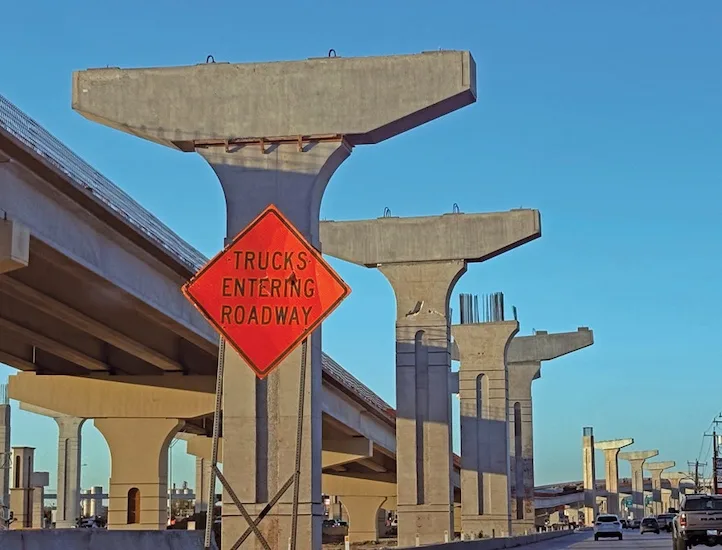
AGC argues the surface transportation bill now being considered by Congress contains widely popular funding for infrastructure such as this San Antonio highway expansion project and should advance.
Most voters nationwide want to see Congress act before major funding for surface transportation infrastructure runs out when the fiscal year ends on Sept. 30, according to a new survey of 10,000 bipartisan voters released July 2.
With 81% supporting the bill, there was strong sense of urgency to pass the bipartisan funding reauthorization measure now pending before Congress. At roughly $580 billion, it would provide funding for highway and rail projects for five years, but the legislation is stuck in a deadlocked Congress that has left Washington, D.C., for a two-week recess. When lawmakers return on July 13, they are set to face debate on a number of other major bills before they break for the long August recess.
“The good news is that most state and local officials have long understood the wisdom of investing in transportation, and more often than not, they have had a good partner in the federal government when it comes to funding roads, bridges and transit systems,” Jeff Shoaf, CEO of the Associated General Contractors of America, said at a July 2 press conference to announce the survey results. “But whether the overall economy and construction employment continue to grow is at risk because it requires Congress to act.
The survey also shows that 80% of surveyed voters, located in all 50 states, want federal funding kept at least as strong as it is now.
The reauthorization bill would provide about 80% of funding for major transportation projects but it relies on Congress to pass it, Shoaf said. “That’s what we’re worried about.” He said that Congress struggles to get bills passed on time and if lawmakers do not pass this bill, state transportation projects that spur broader economic growth and a wide range of new construction work would suffer.
“We worry Washington will focus on bipartisan bickering rather than the difficult work of finishing, drafting, debating and passing a new surface transportation bill by the end of September,” he said.
When asked about the likelihood of the bill expiring this year, Shoaf noted that it passed out of its House committee with widespread bipartisan support and that it is something lawmakers can “get behind” and use as a platform in the November midterm elections.
Looking for quick answers on construction and engineering topics?
Try Ask ENR, our new smart AI search tool.
Ask ENR →
About 76% of voters are more likely to support a member of Congress who helps get the bill passed, the survey noted..
The survey asked several questions on major issues that AGC supports. These include a first-of-its-kind requirement that owners of electric vehicles and plug-in hybrid vehicles pay a $130-per-year federal road fee to use the nation's transport system, a measure backed by 68% of respondents.
Another AGC priority raised in the survey is a requirement that would establish advanced safety features such as barriers and speed cameras at highway work zones to protect workers, a move that 75% of respondents supported. Work zones are the most dangerous roasway areas for workers, AGC said.
AGC, which commissioned pollster Morning Consult to conduct the survey, also launched in May a $2 million digital and social media advertising campaign, dubbed America’s Moving Forward, to educate the public and urge voters to pressure congressional representatives to pass the bill.
The ads focus on benefits of having federal funding in place, Shoaf said. “We are asking people to visit the page, learn even more about the benefits of having a new federal transportation bill in place, and then use the links provided to contact their members of Congress and tell them to make this a top priority,” he said. Responses from those ads have so far echoed the polling results, he claimed.
To date, ads have run in 12 states and generated 30,000 letters to members of Congress urging them to pass the bill, Shoaf said.