Military Projects
Navy Maps Out Four Packages for Planned $10B Bremerton Dry Dock Rebuild
Project documents detail construction phasing at the Dry Dock 3 waterfront at Puget Sound Naval Shipyard and outline marine, dry dock, infrastructure and caisson contracts
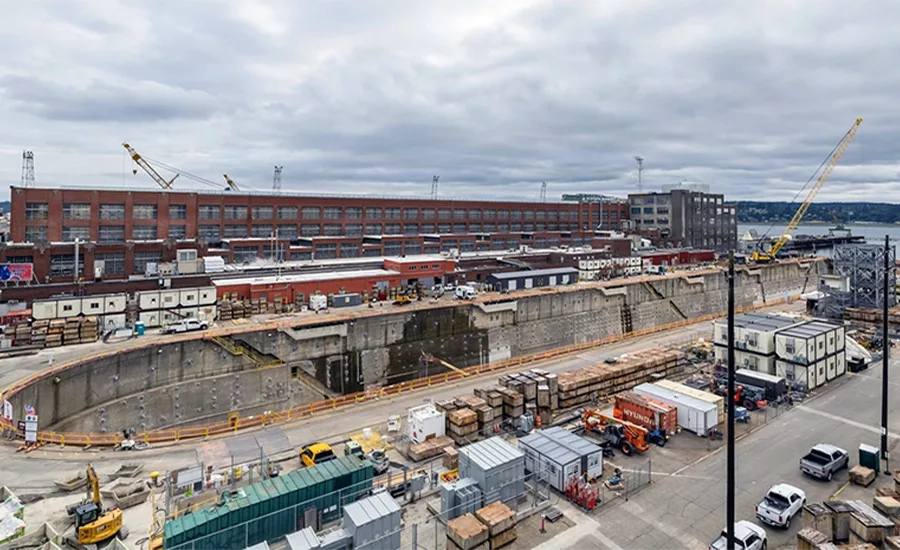
Dry Dock 4 at Puget Sound Naval Shipyard in Bremerton, Wash., is shown following completion of a seismic upgrade project. The facility is among the shipyard assets being modernized as the Navy advances planning for a new Multi-Mission Dry Dock.
The U.S. Navy on June 15 launched a dedicated website and new industry outreach effort for a planned $7- to $10-billion rebuild of the Dry Dock 3 waterfront at Puget Sound Naval Shipyard in Bremerton, Wash., centered on construction of a new dry dock for aircraft carriers and submarines.
The new website and procurement materials offer the most detailed public look yet at the engineering scope, construction sequencing and contracting strategy for the proposed Multi-Mission Dry Dock. The project is a key part of the Shipyard Infrastructure Optimization Program, the Navy's long-term plan to modernize public nuclear shipyards in Washington, Hawaii, Virginia and Maine.
Mark Edelson, the Navy's program executive officer for infrastructure and expeditionary programs, said the dry dock itself represents only part of a broader $14.8-billion modernization effort that includes new piers, support facilities and other infrastructure.
While planning documents estimate the dry dock at $7 billion to $10 billion, he said the administration has requested congressional authorization for the larger project. A $30-billion contract vehicle is intended to provide capacity for additional waterfront work expected across the region.
Project documents describe a reinforced-concrete, pressure-relieved dry dock with a floating caisson gate capable of servicing Ford-class and Nimitz-class aircraft carriers as well as all classes of fleet nuclear submarines.
The project's unprecedented scale is driven largely by the need to accommodate Ford-class carriers, according to Edelson.
"There is nothing intrinsically hard about it; it's just to fit a Ford-class nuclear aircraft carrier, we have to build a very large dry dock," he said. "Everything just gets big, and that's why it's the largest infrastructure project done to date in the Department of Navy."
Looking for quick answers on construction and engineering topics?
Try Ask ENR, our new smart AI search tool.
Ask ENR →
The operation would replace facilities within the existing Dry Dock 3 area and require extensive marine construction, excavation, utility relocation, dredging and waterfront infrastructure work over a construction period targeted at less than eight years.
Planned work includes groundwater cutoff walls, cofferdam systems, bulkheads, quay walls, utility galleries and tunnels, flooding and dewatering systems and portal crane infrastructure.
Edelson said the most technically challenging aspect will be the in-water work required to remove existing piers and construct a double-wall cofferdam that will allow more work to proceed in dry conditions.
The preferred location encompasses the footprint of the existing Dry Dock 3 and portions of Piers 6 and 7. Supporting work would include dry dock drainage, flood and dewatering systems, roadways, rail infrastructure, communications systems and demolition of existing facilities and utilities.
The project remains under National Environmental Policy Act review. Edelson said the Final Environmental Impact Statement and Record of Decision remain on track and are expected before the end of the calendar year.
Project materials outline a three-phase construction sequence that begins with demolition and site preparation, proceeds through excavation and construction of the dry dock structure and concludes with installation of utilities, the caisson gate and portal cranes.
RELATED
JV Wins $2.8B Pearl Harbor Dry Dock Contract
Navy Plans Four Major Construction Packages
NAVFAC first sought industry feedback on the project through a March request for information, with responses due April 17. Procurement notices released in June provided additional details on the planned contracting approach.
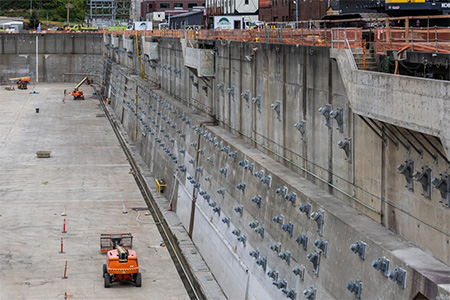
The renovated Dry Dock 4 at Puget Sound Naval Shipyard in Bremerton was completed five months early after a seismic retrofit, boosting resilience and enabling more modernization projects.
Photo: Jeb Fach/U.S. Navy
Those notices state that NAVFAC plans to issue a multiple-award construction contract solicitation in September and anticipates awarding approximately five indefinite-delivery, indefinite-quantity contracts with a combined ceiling value of up to $30 billion.
The vehicle would support construction of the dry dock as well as other waterfront and marine construction projects associated with the Shipyard Infrastructure Optimization Program.
Firms seeking contracts must demonstrate a single-project bonding capacity of at least $2 billion. Task orders are expected to range from $2 billion to $6 billion, though smaller awards might be issued for early contractor involvement and alternative technical concepts.
Current planning divides the work into several major packages:
A marine package estimated at $2 billion to $3 billion would include demolition work, dredging, construction of an upland shoring and cutoff wall, construction of a double-wall cofferdam and ground improvements.
A dry dock package estimated at $3.5 billion to $4.5 billion would include dewatering, excavation, demolition of Dry Dock 3, construction of pressure-relief systems, construction of the dry dock structure and installation of pump wells.
An infrastructure package estimated at $3.5 billion to $4.5 billion would include support buildings, electrical substations, utility tunnels, partial replacement of the Farragut Avenue tunnel, installation of permanent utilities, paving, crane rail installation, process equipment, fendering systems and testing and commissioning.
A fourth package, estimated at $200 million to $300 million, would cover fabrication and delivery of the caisson gate.
The same procurement documents indicate officials are evaluating several project-delivery and risk-management measures, including early contractor involvement, economic price-adjustment provisions, award-fee incentives and limits on task-order performance bonds.
RELATED
ENR Best Projects — Specialty Construction: Seismic Repair of Dry Docks
Industry participants were also asked to provide feedback on bonding requirements, labor availability, supply chain risks, competition, schedule optimization and alternative contracting approaches.
Edelson said construction sequencing is designed to allow the shipyard to continue operating throughout the project. Maintaining maintenance and modernization work while building the new facility will be a significant logistical challenge, he said.
The current acquisition schedule calls for issuing the multiple-award construction contract solicitation in September, receiving Phase I proposals in October and awarding contracts in May 2027. Planning documents indicate the first major construction task order, the Marine Package, could be awarded in mid-2028.
"They're not losing any work while we're doing the largest project in the history of the Navy," Edelson said.

Bryan Gottlieb is the online editor at Engineering News-Record (ENR).
Gottlieb is a five-time Society of Professional Journalists Excellence in Journalism award winner with more than a decade of experience covering business, construction and community issues, including finance, law and real estate. He has reported for Adweek and the San Diego Daily Transcript and led a community newsroom in Santa Monica, Calif. He served as editor-in-chief of the Detroit Metro Times and as managing editor at Roofing Contractor, where he helped shape national industry coverage. At Engineering News-Record, Gottlieb covers breaking news, large-scale infrastructure and megaprojects, regulatory developments and business trends across the U.S. and global construction sectors.
email: gottliebb@enr.com | office: (248) 786-1591