News Analysis
Ontario's $9.8B Transmission Plan Targets Toronto Grid Bottleneck
Grid operator IESO's draft plan combines 500-kV corridors from Bruce nuclear with new HVDC link to relieve a binding transfer limit

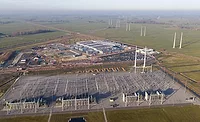
High-voltage transmission lines carry electricity toward Toronto’s skyline, where rising demand and constrained transfer capacity drive plans for major expansion, according to grid operator IESO.
Ontario's electricity system operator is preparing for a step-change in grid capacity as demand is projected to rise nearly 65% by 2050, with peak load increasing from roughly 23–24 GW today to as high as 40 GW in high-demand scenarios, according to the Independent Electricity System Operator 2026 Annual Planning Outlook.
Planning models show the most acute increases are concentrated in southern Ontario, particularly in the Greater Toronto area, where electrification of buildings, transportation and industry is driving sustained peak demand growth.
Individual large loads are amplifying that pressure. Data centers and electrified industrial facilities can add several hundred megawatts at a time, creating localized spikes that existing transmission infrastructure cannot absorb.
Ontario expects 16 more data centers to connect to its grid over the next decade, representing 13% of new electricity demand and 4% of total anticipated demand, according to analysis published in Energy Regulation Quarterly.
Toronto-Bound Power Flows Hit Transfer Limits
The system operator's reliability framework identifies transmission—not generation—as the binding constraint. The primary corridor delivering power into the Toronto area, known as the Flow East Towards Toronto interface, has a transfer capability of about 5,900 MW, according to the grid operator's planning data.
Planning materials identify this interface as a constraint during summer peak demand periods, when high temperatures reduce line ratings and demand is elevated, with limits often set by 230-kV circuits between Trafalgar Transmission Station in Oakville, about 24 miles west of Toronto, and Richview Transformer Station in Toronto's west end.
At the same time, power from the Bruce nuclear complex must move through west-to-east interfaces with transfer capabilities exceeding 5,600 MW, concentrating generation flows toward the same constrained Toronto-bound corridor.
Looking for quick answers on construction and engineering topics?
Try Ask ENR, our new smart AI search tool.
Ask ENR →
Peak demand approaching 40 GW means the roughly 5,900-MW transfer capability into the Toronto region must serve a growing share of system load, requiring several thousand megawatts of additional transfer capacity under higher-demand scenarios to maintain reliability margins.
RELATED
Ontario Opens Record Power Bid, But Adding Gas Fuels Controversy
Draft Plans Center on 500-kV Lines, HVDC Link to Toronto
IESO presented draft recommendations during an April 30 engagement session, selecting Portfolio B with an upfront capital cost of $9.8 billion, compared with alternatives priced at $9.2 billion and $9.3 billion, respectively.
The operator cited Portfolio B's leading performance on reliability, operability, resilience and broader system benefits as the basis for the selection. A final report is expected in mid-2026. ENR reached out to IESO for comment but did not receive an immediate response.
IESO's draft planning materials outline a buildout anchored by multiple high-voltage transmission corridors linking major generation sources to the Greater Toronto Area. Draft portfolios include double-circuit 500-kV lines extending roughly 140 km and 190 km from the Bruce nuclear complex into central Ontario and the Greater Toronto Area, along with a 60-km 500-kV reinforcement feeding into the northwest Toronto area.
Additional reinforcements include a 50-km double-circuit 500-kV line east of Toronto and a roughly 70-km high-voltage direct current line delivering power directly into the city's Hearn station, supported by converter facilities.
The plans also call for expanded 500/230-kV autotransformer stations and associated substation infrastructure, including breakers, buswork and reactive equipment to manage increased power flows.
RELATED
Grid Access, Not Land, Emerges as Bottleneck for Data Center Construction
Cost, Siting and Alternatives Emerge as Key Risks
IESO's planning process explains why a definitive project list has not yet been published. In its materials, the operator states that the bulk system planning process evaluates multiple infrastructure portfolios across demand scenarios to test system performance under different conditions.

IESO evaluated three transmission portfolios across six performance criteria before selecting Portfolio B—the highest-cost option at $9.8 billion—at its April 30 South and Central Bulk Plan engagement session. The operator cited Portfolio B's leading scores on reliability, operability, resilience and system benefits as the basis for the recommendation. Click to enlarge image.
Source: IESO
The scale of the buildout reflects both rising demand and structural imbalance. More than 1,800 km of transmission development is already planned or underway across the province, according to system planning materials, as it shifts toward large-scale grid expansion to accommodate electrification.
Stakeholder submissions indicate the path forward remains contested. Ontario Power Generation identified potential for up to 10,000 MW of future generation development at its Wesleyville site and recommended inclusion of multiple locations in planning studies.
TC Energy supported development of a 500-kV double-circuit line between the Bruce nuclear complex on Lake Huron and Essa, north of Toronto, tied to future generation and storage projects, including its proposed 1,000-MW Ontario Pumped Storage Project.
Hydrostor urged evaluation of bulk-connected non-wires solutions alongside transmission expansion, while the Power Workers' Union raised concerns that higher-end demand growth scenarios may not be fully captured in planning assumptions, according to IESO's feedback summary.
RELATED
Canada Completes $9.4B Darlington Nuclear Plant Rebuild Early, on Budget
Scale Signals a Decade of High-Voltage Construction
IESO's procurement framework indicates transmission expansion will proceed in parallel with new supply acquisition. Medium- and long-term procurement programs are already underway to secure additional capacity, with planning horizons extending into the 2030s.
Read More
IESO | Feedback and Responses
The planning record shows a grid under escalating strain. If advanced at the scale reported, the program would rank among North America's largest high-voltage buildouts, creating a multiyear construction pipeline tied directly to Ontario's electrification trajectory.

Bryan Gottlieb is the online editor at Engineering News-Record (ENR).
Gottlieb is a five-time Society of Professional Journalists Excellence in Journalism award winner with more than a decade of experience covering business, construction and community issues, including finance, law and real estate. He has reported for Adweek and the San Diego Daily Transcript and led a community newsroom in Santa Monica, Calif. He served as editor-in-chief of the Detroit Metro Times and as managing editor at Roofing Contractor, where he helped shape national industry coverage. At Engineering News-Record, Gottlieb covers breaking news, large-scale infrastructure and megaprojects, regulatory developments and business trends across the U.S. and global construction sectors.
email: gottliebb@enr.com | office: (248) 786-1591