Transportation
$10.5B Georgia Express Lanes P3 Project Finally Gets Rolling

Barrier-separated express lanes will be built along a 16-mile stretch.
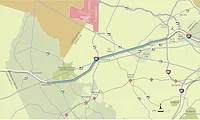
Once deemed too expensive to build, Georgia’s largest-ever infrastructure project has finally reached the construction phase with the April 22 ceremonial groundbreaking for the SR 400 Express Lanes project.
Totaling $10.8 billion, the public-private partnership between the Georgia Department of Transportation (GDOT), State Road and Tollway Authority (SRTA), and the SR 400 Peach Partners, LLC consortium will add dynamically priced, barrier-separated express lanes in both directions along a 16-mile stretch of one of metropolitan Atlanta’s busiest corridors. Scheduled for completion in 2031, the project includes construction of three new stations for the the city’s planned bus rapid transit system.
SR 400 Peach Partners—comprised of ACS Infra (IRIDIUM), Acciona and Meridiam as developer and equity sponsors—will deliver the project in partnership with GDOT and SRTA under a long-term P3 agreement. Along with carrying out the estimated $4.6-billion design and construction phase, SR 400 Peach Partners will finance, operate and maintain the new express lanes for 55 years.
FlatironDragados and Acciona will lead the construction, with Parsons serving as the lead design engineer.
Long envisioned as a means for alleviating congestion in Atlanta’s rapidly-growing northern suburbs, the SR 400 Express Lanes project was derailed in 2021 when GDOT rejected the sole responsive bid to its original P3 procurement, which used an availability payment model, for exceeding the state’s budget allocation. At that point, the project had already been sidelined two years following refinements to GDOT’s Major Mobility Investment Program.
The agency’s relaunched search for a P3 partner included adapting the procurement to a revenue risk model, leading to the selection of SR 400 Peach Partners for the project in August 2024. The financial package, finalized last year, includes a nearly $3.9-billion TIFIA loan—the largest loan ever awarded to a single borrower.
GDOT says major construction activities are underway in Fulton and Forsyth counties, including site mobilization, survey and geotechnical work, utility coordination, clearing and grading operations, maintenance of traffic installations and foundational work for structures and retaining systems. Georgia DOT project manager Beau Quarles says maintaining traffic along one of Atlanta’s busiest corridors will be a key challenge during the six-year construction.
Looking for quick answers on construction and engineering topics?
Try Ask ENR, our new smart AI search tool.
Ask ENR →
“Additional complexity includes reconstructing heavily traveled interchanges, coordinating utility relocations across multiple jurisdictions and maintaining safe and reliable access for surrounding communities and businesses,” Quarles adds.
To address these challenges, GDOT says the project is being delivered through a phased construction approach that prioritizes maintaining roadway capacity, incorporates off-peak and overnight work where feasible and sequences improvements to minimize disruption. The project team also will utilize a mix of rigid and flexible pavement strategies tailored by corridor segment, along with increased use of precast elements to accelerate installation, improve quality control, and reduce impacts to live traffic by allowing for parallel fabrication and installation.
Other innovative design and construction strategies identified by SR 400 Peach Partners include use of initial construction packages to reduce overall design and construction duration, use of steel straddle bent caps for rapid erection during nighttime lane closures and completing planned culvert rehabilitation techniques to reduce traffic impacts.