Book Review
A Bold New Vision for Construction Safety

Construction safety is in a state of creative flux. Engineering Professor Matthew R. Hallowell has made the University of Colorado at Boulder a wellspring of innovation and home of the industry-supported Construction Safety Research Alliance. He and his colleagues have toppled on its side the already well-debunked Heinrich’s Pyramid, which linked minor injuries to severe and fatal injury prevention, and have criticized the over-reliance on total recordable injury rates, which Hallowell showed are statistical nonsense unless they cover at least 10 million hours of work.
Hallowell’s new book, “Energy-Based Safety: A Scientific Approach to Preventing Serious Injuries and Fatalities” (Taylor & Francis, 2025), presents its subject as a coherent system which, if fully adopted, Hallowell admits, may discomfit employers used to the old ways that have succeeded in preventing many less than severe or fatal injuries.
One of the most interesting sections of the book is Hallowell’s recollection of meeting with some corporate boards where, he recalled, “they argue that all injuries are important, and a SIF- [severe injury or fatality]focused strategy might even lead to higher injury rates. When faced with this perspective, I ask a provocative question: ‘How many recordable injuries would you trade for one life?’ Faced with uncomfortable silence, their first instinct, whether they say it out loud or not, is usually ‘all of them.’ If this were true, then our safety efforts should focus exclusively on SIF prevention.”
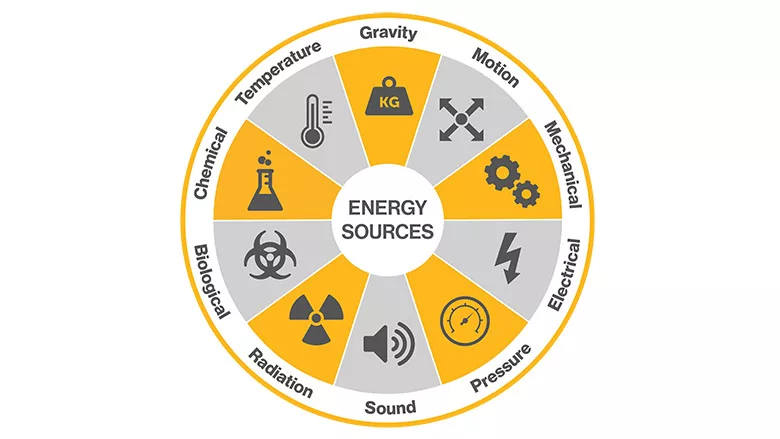
Energy-based safety is often known through its key hazard recognition communication device, the Energy Wheel, which Hallowell believes may have first been introduced by Chevron Corp. It organizes easy-to-recognize icons representing different categories of potentially hazardous energy, such as gravity, electricity or temperature, into a circle. Some safety experts had not heard about the energy wheel until Hallowell’s 2021 article in Professional Safety magazine on energy-related safety. His article has helped the wheel become a part of many contractors’ safety communication programs. But that is perhaps the easiest part of energy-based safety.
Hallowell explains that the inevitability of human error, a premise of the human and organizational performance paradigm, requires that successful controls be put in place to prevent the unexpected transfer of energy into the human body. As in being hit by something heavy. Or shocked.
It isn’t a simple matter.
Part of the challenge is devising definitions about what constitutes a severe injury—a challenge that several employers have already taken on. As with probability, human judgment of severity is often off the mark, Hallowell writes, clouded by murky thinking and human biases. So energy level assessment “is a better approach” to what’s severe.
Reality checks are needed, too, when it comes to controls. A safety plan or program shouldn’t be confused with a timely, tangible and targeted control, like a guard rail or a lockout-tagout system, Hallowell writes.
Looking for quick answers on construction and engineering topics?
Try Ask ENR, our new smart AI search tool.
Ask ENR →
Hallowell describes the need for a high-energy control assessment (the acronym HECA is trademarked) that will protect against life-threatening hazards. Such assessments are “the crown jewel of energy-based safety,” he writes, and the controls must guarantee elimination of a high-energy hazard. The assessment’s score is calculated using the number of direct controls and dividing it by that number and the number of remaining exposures.
Because many companies have established norms where zero injuries or 100% compliance “are the only acceptable outcomes,” Hallowell writes, the change could be rough. “Mature” North American companies generally score between 60% and 70%, meaning, about one-third of life-threatening hazards lack adequate control. Heavy mobile equipment operating near workers on foot could present “an insurmountable challenge,” and the percentage “will not look good on traditional corporate scorecards.”
“It will be uncomfortable initially” to measure safety as the presence of safeguards, says Hallowell, and shared learning and benchmarking will be “crucial.”
A few CSRA members and owners are using HECA, I’m told. How many others will adopt it? No one can tell, but in any case, this book belongs on a shelf with prior safety classics that broke new ground.