Best of the Best Winners
Atlantic Council Relocation
Atlantic Council Relocation
Washington, D.C.
Interior/Tenant Improvement
Submitted by: DAVIS Construction
Region: ENR East
Owner: Atlantic Council
Lead Design Firm: Michael Graves
General Contractor: DAVIS Construction
Structural Engineer: SK&A Structural Engineers
MEP Engineer: Loring Engineers
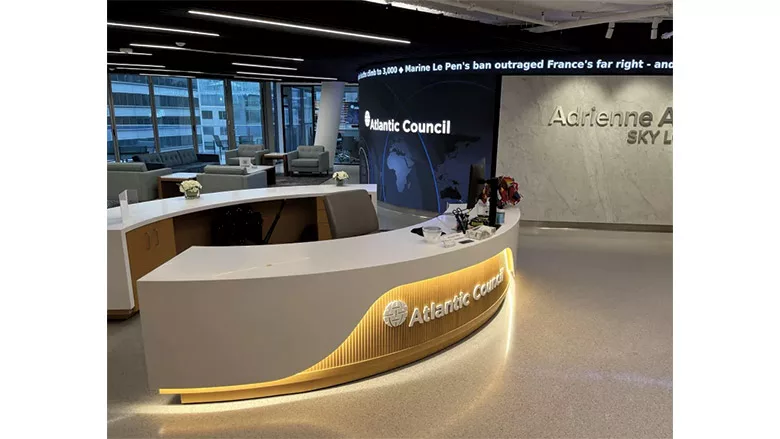
Designing and building the $18.3-million headquarters for a think tank that advances U.S. leadership and international cooperation and host dignitaries, delegates and top-tier speakers required extraordinary structural intervention and precise coordination. The five-floor, 75,000-sq-ft phased fit-out involved building a two-story multipurpose room—the heart of the organization’s event programming—and an exterior terrace for receptions and diplomatic gatherings. A custom-built interconnecting stair joins the multipurpose room floor to the level above it, where a sky lounge terrace is located.
Creating the two-story, 3,000-sq-ft multipurpose room required removing a 40-ft by 80-ft section of floor slab. To address fall protection and debris control, the project team enclosed the work area with full temporary barriers, including a custom air filtration system to mitigate silica dust and prevent elevator shaft contamination. A field engineer monitored slab deflection in real time during post-tension beam installation, ensuring structural integrity and worker safety. Four cast-in-place, post-tensioned concrete beams, each poured using a tightly orchestrated truck sequencing plan, now span that void.

The five-floor fit-out includes a custom-built interconnecting stair that links the multipurpose room floor to the next level.
Photo courtesy Davis Construction
Julie Varghese, Atlantic Council’s chief operating officer, said the team “blew us away with their expertise, organization and professionalism, but also with their camaraderie to partner on real-time adjustments, both large and small.”
Adjacent to the multipurpose room is a high-elevation balcony 11 stories above grade, built from a cantilevered scaffolding platform suspended off the 10th floor. Eliminating vertical shoring and ensuring uninterrupted access for building occupants allowed installation of upturned concrete beams and steel, finish work and access to the terrace’s perimeter without touching the building’s public amenities terrace on the third floor. Phasing and sequencing dictated by weight limits on the structure as millimeter-level alignment with existing curtain wall systems was required to construct the balcony.
Despite a three-month permitting delay, the project was delivered at budget and on time.
Looking for quick answers on construction and engineering topics?
Try Ask ENR, our new smart AI search tool.
Ask ENR →