News Analysis
Section 122 Tariffs Leave Construction Cost Exposure Largely Intact
Trump’s 10% Section 122 surcharge keeps tariff rates elevated, preserves Section 232 steel duties and leaves contractors managing pricing and contract risk
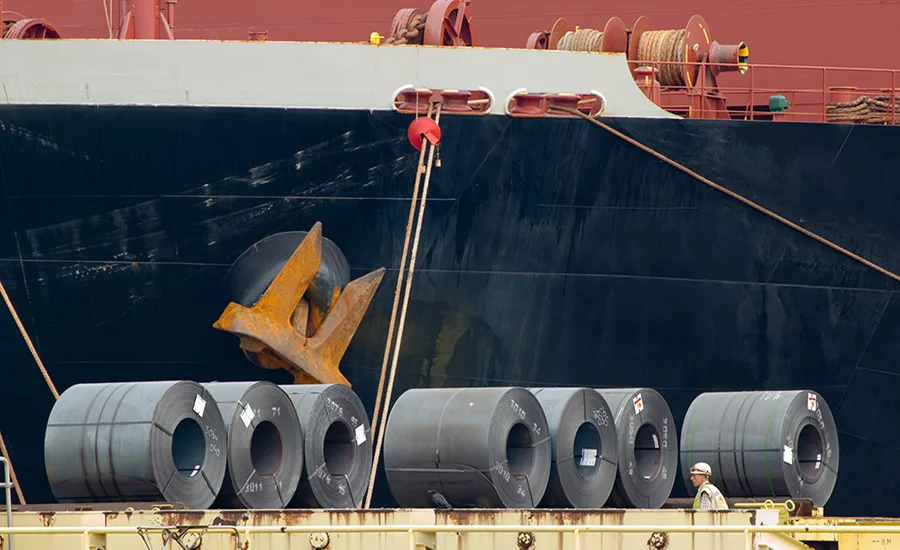
Imported steel coils sit at a U.S. port. Covered steel remains subject to Section 232 tariffs, while other construction equipment and materials now face a 10% Section 122 surcharge.
The Supreme Court voided President Donald Trump’s use of the International Emergency Economic Powers Act to impose broad tariffs on Feb. 20—removing the legal basis for much of his administration’s 2025 trade program; however, for construction firms, cost exposure remains largely intact.
Within hours of the ruling, the White House invoked Section 122 of the Trade Act of 1974, imposing a 10% ad valorem surcharge on most imports effective Feb. 24. The statute authorizes a surcharge of up to 15% and limits it to 150 days unless Congress acts. The measure applies broadly across imports from all countries, except where it is negated by existing Section 232 national-security tariffs or by goods qualifying for duty-free treatment under the U.S.-Mexico-Canada Agreement.
Global Trade Alert, a trade-policy monitoring group, estimates the U.S. trade-weighted average tariff rate now stands at 13.2%—below the pre-ruling 15.3% level but well above the 8.3% rate that would have applied absent a replacement measure.
For construction, what matters most is what did not change. Section 122 does not stack on covered primary steel and aluminum already subject to Section 232 tariffs. Those inputs remain tariff-embedded. Equipment, fabricated assemblies and other manufactured components outside the 232 categories now face the 10% surcharge. That includes items such as switchgear, transformers and specialized heavy equipment sourced globally for infrastructure projects.
S&P Global Ratings said in a Feb. 23 update that tariff levels remain historically elevated and that its forecasts for GDP, employment and interest rates are largely unchanged. From a credit standpoint, trade friction persists.
Deniz Mustafa, senior director of infrastructure finance at the Associated General Contractors of America, said lenders and bond markets largely anticipated a swift policy response if the high court invalidated the prior regime.
“I don’t think anyone that’s been keeping close track of this story was thinking that that would be it—there would be no more tariffs and we’re done,” Mustafa said. In the near term, he added, it is too early to see measurable shifts in credit spreads or underwriting assumptions. But questions remain about what follows the 150-day window.
Looking for quick answers on construction and engineering topics?
Try Ask ENR, our new smart AI search tool.
Ask ENR →
Contracts and Cost Allocation Risk
“The new tariffs imposed under Section 122 will affect the construction industry in two distinct ways,” Anirban Basu, chief economist for Associated Builders and Contractors, told ENR by email. “First, and most directly, this broad 10% levy will put renewed upward pressure on certain construction materials prices.”

A Global Trade Alert analysis shows that the U.S. trade-weighted average tariff rate ranges from 8.3% to 15.3% across different policy scenarios. Under a 10% Section 122 surcharge, the effective rate stands at 11.6%, rising to 13.2% if increased to 15%.
Graph courtesy of Global Trade Source
The direct effect is limited by Section 232 carve-outs and USMCA compliance, Basu said, but price volatility remains a factor.
Josh Zive, a partner at Bracewell who focuses on international trade and customs law, said Section 122 presents immediate exposure precisely because it has little litigation history.
“The most immediate threat is the Section 122 tariffs that have already been put in place,” Zive said. The global surcharge “covers a wide range of materials,” and “a vast amount of construction equipment will end up touched by those tariffs.”
Legal exposure may also sit closer to contractors than many assume.
“The importer of record is the party legally responsible for customs compliance and payment of duties at entry under federal law,” said Trent Cotney, head of the construction practice group at Adams & Reese and general counsel to the National Roofing Contractors Association. If a contractor coordinates importation, Cotney said, it may bear the legal obligation to pay tariffs and ensure accurate entry.
Refunds, where available, flow to the entity that paid the tariff invoice — typically importers or logistics firms, not contractors, Mustafa explained. Recovering costs through supply chains can become complex, involving suppliers, manufacturers and price agreements. “The whole refund process is going to be a mess,” he added.
Pass-through risk, therefore, hinges on contract language. Many agreements treat duties and taxes as part of the contractor’s cost of work unless a change-in-law or tax-adjustment clause expressly captures tariff increases. Where owners reject that interpretation, contractors may be forced to absorb the cost.
Mustafa said that during prior tariff episodes, suppliers shortened quote validity windows, in some cases from months to weeks, forcing contractors to build contingencies into bids. If suppliers hold pricing for one week but owners require bids to remain valid for a month or more, “that’s when you build in that contingency,” he said.
RELATED
US Supreme Court Ends Trump’s IEEPA Tariffs in 6-3 Decision
Public Owners and Project Pipeline
For publicly funded projects with fixed appropriations, flexibility is often limited.
Mustafa cited previous federal infrastructure programs, such as the Infrastructure Investment and Jobs Act, where inflation alone reduced purchasing power, forcing local agencies to cover cost increases through bonds, taxes, or scope reductions.
Citing a study by the Eno Center for Transportation, Mustafa noted how the IIJA returned nearly $60 billion in value due to inflation. Federal aid programs may allow escalation mechanisms in some cases, but “usually the locals will have to try to find it somewhere else,” he said.
Drilling Down
Yale Budget Lab | State of Tariffs
Economic modeling reinforces the pressure. The Budget Lab at Yale finds that, even without IEEPA tariffs, the remaining tariff stack falls most heavily on metals, vehicles and electronics—inputs central to infrastructure and energy construction. Yale projects that while manufacturing output expands modestly under the current environment, construction output contracts 2.4% in the long run.
Mustafa expects policy volatility—more than the 10% rate itself—to weigh on decision-making.
“Yes, because there’s uncertainty about what’s going to happen in the next 150 days,” he said when asked whether the surcharge could affect project starts or backlog in the next six to 12 months.
RELATED
3Q 2025 Cost Report: Prices Rise as Delayed Impacts of Tariffs Hit Jobsites
The administration has signaled additional Section 301 actions and is advancing multiple Section 232 investigations that could conclude in the coming months. Those authorities allow country- or sector-specific tariffs, and are not time-limited like Section 122.
The Court curtailed one executive tool. For construction firms, importer-of-record liability, contract allocation risk and tariff-embedded material costs remain intact—and may yet shift under new investigations.
While the mechanism changed, the exposure did not and now the volatility moves with it.

Bryan Gottlieb is the online editor at Engineering News-Record (ENR).
Gottlieb is a five-time Society of Professional Journalists Excellence in Journalism award winner with more than a decade of experience covering business, construction and community issues, including finance, law and real estate. He has reported for Adweek and the San Diego Daily Transcript and led a community newsroom in Santa Monica, Calif. He served as editor-in-chief of the Detroit Metro Times and as managing editor at Roofing Contractor, where he helped shape national industry coverage. At Engineering News-Record, Gottlieb covers breaking news, large-scale infrastructure and megaprojects, regulatory developments and business trends across the U.S. and global construction sectors.
email: gottliebb@enr.com | office: (248) 786-1591