Nuclear Power
Tasks Delay Restart of Palisades Nuclear Site Until Possibly Late March
Steam generator components are key focus to turn on 800 MW, 55-year-old Michigan power station, with numerous inspections still needed
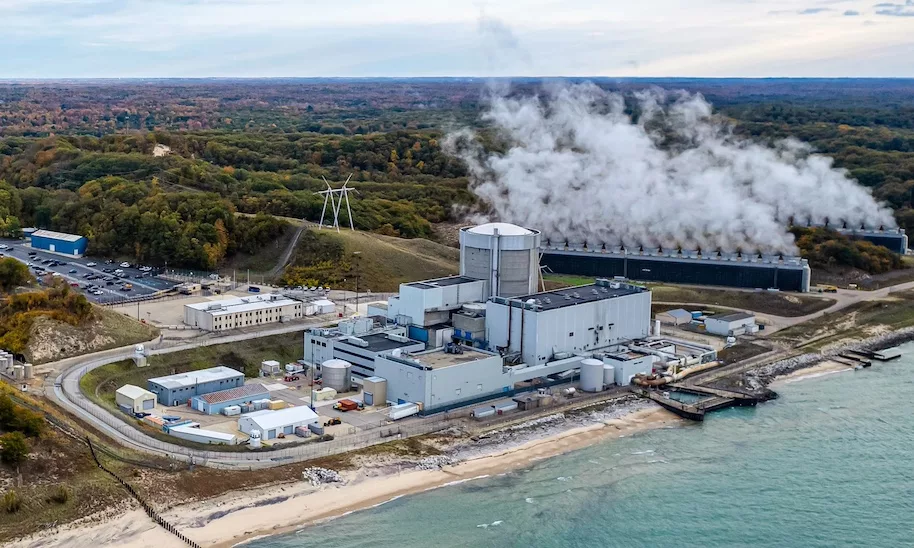
Palisades nuclear power plant, an 800-MW facilkty in Covert, Mich., built in 1971 but in decommission status since 2022, was set to restart in December
Crews are pushing to achieve restart of the Palisades nuclear power plant in western Michigan, originally touted to happen in December, but owner and developer Holtec International has pushed back the schedule to possibly late March, with officials citing needed component upgrades.
The 800-MW plant’s announced recommissioning has been propelled by the Trump administration to expand operating domestic nuclear power to boost American energy needs generated by data center development associated with the huge demand for artificial intelligence. Palisades was completed in 1971 and has been decommissioned since 2022.
The firm had initially predicted it would restart last October but confirmed in press statements that completion of needed work and other unspecified project actions are causing the latest delay. "We are planning for a Palisades restart in early 2026, following completion of ongoing project activities,” said Holtec spokesperson Nick Culp.

Plant owner Holtec also seeks to add two small modular nuclear reactors at the Michigan site, each about 340 MW.
Rendering courtesy of Holtec International
Holtec has not released the estimated restart cost, but the U.S. Energy Dept. in October issued to the firm the sixth loan disbursement of a $1.52-billion agency loan granted in 2024. There are about 600 full-time jobs that have been created or retained as of December, Holtec said. Last year. the plant received 68 fuel assemblies now in secure storage until the U.S. Nuclear Regulatory Commission allows them to be loaded in the reactor core.
According to nuclear trade press reports, major equipment restoration work is underway. Reassembly of the main turbine generator is progressing after more than a year of inspection, testing and maintenance work. The plant, which also recently received and installed the second of two fully refurbished primary coolant pump motors, now is undergoing more inspections, maintenance and system reassemblies under commission oversight.
Steam Generators Are Focus Area
Steam generator upgrades are a critical area of work after an inspection last year found that 1,400 cooling tubes were cracked and needed repair, according to a local report. Holtec is performing "sleeving" and plugging on the cracked tubes as an alternative to a full generator replacement, and "deep cleaning" of secondary systems. Workers are also reassembling large turbine and generator components, following detailed inspections, and taking steps to decontaminate the primary coolant system to reduce radiation hazards for workers.
Ongoing inspections are verifying integrity of the reactor vessel and hundreds of piping welds to ensure they are not significantly degraded. Inspectors also have verified plant readiness to withstand heavy rainfall and external flooding, specifically for the service water system and turbine building. Also to be verified as meeting operating standards are cybersecurity and fire protection systems, while licensed operators undergo requalification training and emergency response exercises with state and local agencies.
Looking for quick answers on construction and engineering topics?
Try Ask ENR, our new smart AI search tool.
Ask ENR →
To manage the high volume of final restart tasks, the commission authorized a 60-day exemption starting Jan. 6, allowing the plant to use less restrictive work-hour controls to finish restart activities.
Unexpected worker safety issues already have happened, including a contractor technician conducting radiological assessments who fell into a pool of radioactive water above the reactor last October, said Holtec. The recommissioning effort is supported by more than 1,000 contractors, vendors and suppliers, according to the firm.
“The plant will return once all restart activities are complete to support long-term safe, reliable operation," says Culp.
At the time it was taken out of service, Palisades was licensed to operate until 2031. Holtec notified the commission last year that would seek a subsequent plant license renewal to extend its operating period to 2051.
Holtec Seeks Small Reactor OK at Plant Site
In January, Holtec said it also submitted its first major licensing application to the commission to approve construction start and environmental review of its two-unit SMR-300 pressurized water small modular reactor to be built adjacent to the Palisades plant. Each has about 340 MW of capacity. The application specifically seeks a limited work authorization to begin preliminary construction activities on site such as soil compaction, backfilling and installing foundations.
The new SMRs would support more than 2,000 jobs during peak construction, according to Culp. Holtec has requested the commission to approve its application by Dec. 31, 2026. The Energy Dept. is providing $400 million in funding for the small reactors, set to finish in the early 2030s.
Longtime opponent group coalition Beyond Nuclear criticizes the latest delay in restarting the Palisades plant and believes it won't be the last. "For several long years now, Holtec International has repeatedly stated, with false confidence, its unprecedented* restart of the Palisades plant, said Kevin Kamps, spokesperson. "The plant has outdated, deteriorating machinery and equipment that Holtec and the [commission] have not accounted for, including steam generator tubes." The group added that the two planned SMR-300s “would exacerbate safety risks."
But proponents see restart of older decommissioned reactors such as Palisades, Unit 1 of the Three Mile Island plant in Pennsylvania and the Duane Arnold power station in Iowa as the only near-term option to add more nuclear power to the grid, with new builds at least half a decade or more away.
The Pennsylvania plant, now owned by Constellation, recently accelerated its operating target to 2027 from 2028 due to fast-tracked grid link approvals from regional grid operator, PJM Interconnection. The Energy Dept. closed a $1-billion loan last November to help finance the estimated $1.6-billion project, with the first advance expected in the next three months, it said. Constellation signed a 20-year power purchase agreement with Microsoft for its data centers in 2024.
Work is underway to restore the turbine, generator, main power transformer, and cooling systems, the firm said. As of late 2025, the project was nearly 80% staffed. Federal approval for security, safety and environmental issues is underway, a primary focus for 2026, the project team added.
The 615-MW Duane Arnold nuclear plant in Iowa, shut down in 2020, is being restarted by NextEra Energy with a goal to be online by early 2029. It has an October-announced 25-year power supply deal with Google. The project still requires a number of approvals from the commission and state agencies,
First Japan Nuclear Restart Since Fukushima Delayed
Meanwhile, a technical glitch pushed back partial restart of the world's largest nuclear power plant, in Japan, according to its owner-operator on Jan. 19, as reported by Japan Times and others one day before it was set to go online. Tokyo Electric Power Co. (TEPCO) said it needed further time to check a nuclear fission control rod safety alarm error that occurred on Jan. 17.
But the company then reversed on Jan. 22 its announced restart on Jan. 21 of one of seven reactors at the 8.2-GW Kashiwazaki-Kariwa plant 135 miles northwest of Tokyo, with faulty fission control rods forcing that shutdown and a new investigation, according to media reports of company statements. The restart had been approved by Japanese nuclear safety regulators.
The TEPCO news website had no update on the latest event or duration of the new operating halt, but a spokesperson said there are no safety issues or radioactive leaks and "the reactor is stable," industry onine publication NucNet said.
The plant had been offline since 2011 after a giant earthquake and tsunami caused a meltdown of three reactors at Japan's Fukushima nuclear facility, also owned by the utility company. The Kashiwazaki-Kariwa 1.3-GW reactor unit is the first TEPCO-owned plant that the firm sought to start up since the event, but full commercial operation it said would be in late February appears unlikely.

A 1.3-GW unit at Japan's Kashiwazaki-Kariwa nuclear power plant, owned by utility firm TEPCO. failed to restart Jan. 21 after a second delay caused by a fission rod alarm error. It has beens offline since the 2011 earthquake-caused meltdown of the Fukushima plant, also owned by the firm. Photo courtesy of TEPCO
Nuclear power restart remains a divisive issue in Japan, reports say. The power company "only mentions a possible delay. But that's not enough," said Takeshi Sakagami, president of the Citizens' Nuclear Regulatory Watchdog Group. "A full investigation is needed, and if a major flaw is confirmed, the reactor should be permanently shut down."
All 33 nuclear reactors in Japan closed after the Fukushima accident, but 13 smaller plants owned by other power companies have since restarted. Nuclear power accounted for 30% of the country's energy before 2011 but was at 5% in 2023. The Japanese government had said it aims to have nuclear power producing up to 20% of its national energy..