ENR 2025 Top 25 Newsmakers
Todd Keller: Pushed for Collaborative Delivery of a Crucial Bridge in the Alaskan Wilderness

Keller (second from left) was key in fostering a collaborative spirit for the team building the Polychrome Bridge.

Related Article:
Crews Launch Alaskan Wilderness Truss With Help From Advanced Digital Modeling
Back to:
25 Top Newsmakers
Todd Keller could not decide what he wanted to do career-wise as he neared the end of his stint at a college preparatory school in the late ’80s. “I struggled with what I wanted to be when I grew up,” he recalls.
He enrolled in Northern Arizona University, and discovered that there was a construction management program. “A light bulb went off,” says the vice president with Granite Construction Co.
After graduating, he applied to contractors with an Arizona presence, and Granite responded right away. After around a decade, he left to join another firm in New Zealand. “The grass was definitely ‘greener,’ he says humorously, “but Granite was ultimately my home.”
Granite beckoned him back after three years to run a big federal business program. He now runs business development for several states, including his other home of Arizona, but his main passion is tackling unique, challenging projects with collaborative delivery models.
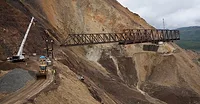
The approximately $200-million Polychrome Bridge project in Alaska’s Denali National Park was exactly that. When Granite’s team looked at the design-build solicitation from the Federal Highway Administration to reconnect Denali Park Road after the Pretty Rocks landslide, the risks were too daunting—the remoteness of the site would complicate materials delivery. The construction season was extremely short. And the geological conditions were extremely unstable, with the landslide still actively eroding the mountainside. Keller suggested that Granite respond to the solicitation, but with the caveat that it would only bid on the job if the FHWA pivoted to the construction manager-general contractor delivery method.
The agency, and the National Park Service, agreed. “FHWA was right with us the entire time,” says Keller.
Granite assembled a team to tackle each of the job’s complex challenges. KWH Constructors Inc. and its Somerset Engineering division did the truss structural detailing, construction engineering, preassembly, on-site erection and launching. They and DBM Vircon, the 3D integrated design-detailer, worked in lockstep with FHWA’s consultant, Jacobs. The team included steel supplier and fabricator Gunderson-Greenbrier; Hamilton for the substructure and crane operational support; DBM for underground elements; Arctic Foundations providing thermosiphons; and Advanced Blasting for rock demolition.
Looking for quick answers on construction and engineering topics?
Try Ask ENR, our new smart AI search tool.
Ask ENR →
“The Polychrome project is a unique, tough environment, with a complicated team structure,” says Keller. “There are lots of different personalities and experience levels to deal with. To bring them together, we have communicated and adopted a ‘best for project’ philosophy.”
The team successfully launched the 475-ft steel truss in August.
“Todd’s leadership was instrumental in forming a successful owner-designer-constructor team,” says Gary Conner, Jacobs senior bridge engineer. “His positive approach to finding solutions to the challenges posed by this unique project helped foster a collaborative and enjoyable working environment.”
Tyler Vander Linden, KWH general manager, adds: “The first thing that comes to mind when thinking about Todd is ‘best for project’ mentality. That phrase comes from Todd’s mouth almost continuously. And I wouldn’t say that saying is new or unheard of, but I’d say Todd was the first person I have worked closely with who really believed in that saying and executed that saying unrelentingly.”
He notes that “Todd really believed in the KWH team, even though we had no history together. He did his homework and once he was convinced we were the right partner for the team, he did everything in his power to help us and make us successful. He knew that the only way the project was going to succeed was if KWH and all the subcontractors were going to succeed.”