News Analysis
Construction’s Labor ‘Relief’ Masks Structural Risk as Demand Cools
ABC’s latest workforce estimate reflects slowing construction activity, not a fix

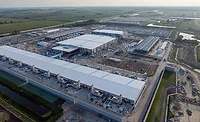
Data centers and other megaprojects continue to absorb electricians and mechanical trades even as ABC projects lower overall construction hiring needs for 2026.
The construction industry needs about 349,000 net new workers in 2026, according to a new Jan. 15 report by Associated Builders and Contractors—lower than recent years—reflecting reduced demand but not solving the ongoing labor shortage.
The estimate marks the lowest annual workforce gap the association has projected since 2021. However, ABC Chief Economist Anirban Basu said the smaller figure should not be seen as a turning point for labor availability. Instead, it indicates a cyclical slowdown in construction activity layered on top of a workforce still limited by demographics, retirements and skills mismatches.
“Nothing changed in the model,” Basu said in an interview with ENR. “What changed is the cycle. There’s a structural component tied to retirements and demographics, and a cyclical component tied to demand. The cyclical side has softened.”
RELATED
Construction's December Job Declines of 11K Workers Portend Slow Start to 2026
Demand is Cooling—The Workforce Problem Is Not
More than half of the 349,000 workers needed in 2026 will be required simply to replace retirees rather than support incremental growth, Basu said. About 20% of the construction workforce is over age 55, and exits tied to age, physical demands and career churn continue to outpace the inflow of younger workers, even as interest in skilled trades improves.
Construction demand has also slowed meaningfully. Basu said nominal construction spending declined about 1.5% over the past year, translating into roughly a 5% decline in real terms after inflation. Under normal conditions, that level of contraction would reduce labor demand if productivity holds steady.
Basu's confidence that the easing is genuine, he said, stems from the alignment of leading indicators. Construction job openings have trended lower, and architecture firms—the upstream pipeline for future work—have seen billings weaken steadily for nearly two years.
Looking for quick answers on construction and engineering topics?
Try Ask ENR, our new smart AI search tool.
Ask ENR →
Nonresidential construction spending remained elevated through 2025 even as construction job openings declined, according to the U.S. Census Bureau, underscoring ABC Chief Economist Anirban Basu’s assessment that easing hiring pressure reflected a cyclical slowdown in demand rather than a resolution of the industry’s structural workforce constraints.
 .
.The intersection of the two trend lines in late 2023 marked the point at which strong project activity began to coincide with fewer unfilled positions, as tighter financing conditions, longer schedules and greater employer caution tempered labor demand despite sustained spending.
Left axis: Nonresidential construction spending — U.S. Census Bureau
Right axis: Construction job openings (index, 2022 = 100) — U.S. Bureau of Labor Statistics (JOLTS)
RELATED
Construction Input Prices "Surged" in November, ABC Says
Megaprojects Keep Schedule Risk Elevated
The slowdown, however, is uneven and does little to relieve execution risk on the projects now dominating construction spending.

U.S. Census Bureau data show nonresidential construction spending rising steadily from early 2022 through late 2025, even as labor demand begins to cool—a dynamic ABC Chief Economist Anirban Basu attributes to a cyclical slowdown rather than a structural fix.
Chart courtesy of U.S. Census Bureau; analysis by Associated Builders and Contractors
Basu said workforce shortages remain acute enough to threaten schedules across most segments, particularly data centers, industrial megaprojects and large public works, where shortages of specialized trades—notably electricians and mechanical workers—have become binding constraints on delivery.
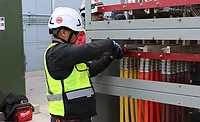
Hyperscalers racing to build artificial intelligence infrastructure are struggling to secure electricians capable of precision wiring and mechanical workers trained to install advanced cooling systems, he said, delaying schedules even as overall labor demand softens.
“These facilities need to be cooled aggressively, often using new technologies,” Basu said. “There just aren’t that many workers who can do that work quickly and satisfactorily.”
Public infrastructure faces similar pressure. Even as highway, water, and sewer work remains active late into the federal infrastructure funding cycle, Basu said labor concentration around megaproject hubs is forcing contractors to import crews from other regions—relieving shortages locally while creating secondary gaps elsewhere and extending schedules more broadly.
Beyond labor availability, Basu warned financial underpinnings of the AI-driven construction boom may prove fragile. Early waves of data center investment were funded largely through free cash flow, he said, but the scale of current buildouts has pushed hyperscalers toward debt financing at a time when construction costs are rising.
“If these projects don’t deliver a return on investment relatively quickly, you could see a sharp pullback,” Basu said. “The higher the construction costs, the more debt is required to finance them.”
RELATED
US Construction Activity Further Concentrates in Handful of States
Preparing for the K-Shaped Economy
The changing demand picture is also reshaping competition within the industry.
ABC’s contractor backlog data show that large general contractors tied to megaprojects continue to report strong or stable backlog, while many smaller and mid-sized firms—particularly those exposed to office, retail, residential and local commercial work—are seeing backlog decline.

Associated Builders and Contractors’ construction spending and employment forecast shows that while total U.S. construction spending is projected to remain elevated through 2026, employment growth flattens, leaving the industry needing to attract roughly 349,000 net new workers next year to offset retirements and maintain capacity. The shaded range reflects high, base and low economic scenarios modeled by ABC. Chart courtesy of Associated Builders and Contractors
ENR reporting on ABC’s Construction Backlog Indicator shows contractors with more than $100 million in annual revenue carrying their highest backlog since 2021, while firms with less than $30 million report their lowest levels over the same period.
Basu described the result as a K-shaped construction economy, where a small group of firms continues to have record years, while a broader population faces longer bidding lists, increased competition and growing concerns about work availability.
“Some firms aren’t that nervous about this year because they saw backlog coming into it,” Basu said. “They’re much more nervous about 2027.”
That concern is reinforced by ABC’s longer-term outlook. After easing steadily from 2022 through 2026, the association’s model shows the industry’s annual need for net new workers rebounding sharply in 2027, driven by assumptions that interest rates eventually fall below key behavioral thresholds and that a wave of announced data center and industrial projects moves from planning into active construction. Basu stressed that the rebound is assumption-driven, not guaranteed, and depends heavily on financing conditions and project follow-through.
The current slowdown, he said, provides contractors with a narrow but valuable window to prepare. Firms that use the pause to recruit selectively, invest in training and upskill their workforces—especially in high-demand specialty trades—will be better positioned when the next upcycle arrives.
“There will be firms ready for that moment,” Basu said. “Others won’t be.”

Bryan Gottlieb is the online editor at Engineering News-Record (ENR).
Gottlieb is a five-time Society of Professional Journalists Excellence in Journalism award winner with more than a decade of experience covering business, construction and community issues, including finance, law and real estate. He has reported for Adweek and the San Diego Daily Transcript and led a community newsroom in Santa Monica, Calif. He served as editor-in-chief of the Detroit Metro Times and as managing editor at Roofing Contractor, where he helped shape national industry coverage. At Engineering News-Record, Gottlieb covers breaking news, large-scale infrastructure and megaprojects, regulatory developments and business trends across the U.S. and global construction sectors.
email: gottliebb@enr.com | office: (248) 786-1591