West Coast Specialty Contractors Grow Cautiously Optimistic
Even with stronger numbers, the region’s specialty contractors remain wary due to lingering uncertainty from recent headwinds

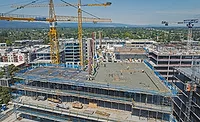
The Gonzaga Ridge Wind Project in Merced County, Calif.—being built by Clark Bros.—is an example of the region’s surging energy sector.
Related Link:
ENR West 2025 Top Specialty Contractors
Whether it’s smooth or choppy waters ahead, five years of shifting conditions have made West Coast specialty contractors more adept at navigating whatever comes next. Even while facing cost volatility, tariff concerns and hesitant owners, firms continue to see opportunities ahead.
“The first two quarters of the year were filled with uncertainty and a general apprehension,” says Lawrence Clark, president and CEO of Fresno, Calif.-based Clark Bros. Inc., a heavy-civil and high-voltage electrical contractor. He says renewable energy developers have been especially cautious despite the “glaring demand” for additional power to serve the accelerating AI and data-center build-out.
Clark sees some of that concern thawing, and “we are very optimistic about the overall direction of the construction market for the two- to five-year window,” Clark says. “Both private developers in the renewable energy space and municipal asset managers seem very aware and prepared to attack the larger state of our infrastructure within the Western U.S.”

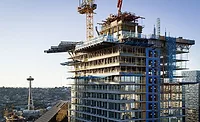
B.T. Mancini is helping construct the Gateway of the Pacific parking structure, part of the large science-and-tech campus in South San Francisco.
Photo courtesy B.T. Mancini
On the Rebound
Across the region, the outlook for specialty contractors has improved significantly. The top 10 firms on ENR West’s Top Specialty Contractors list reported total revenue of $6.29 billion for 2024, up almost 17% from the total for 2023’s top 10 firms. This is a significant turnaround from last year, when the top 10 specialty contractors in the region recorded a decline of 4% compared with 2022 revenue.
Total revenue for all firms in the region grew by 9.8% in 2024, to $10.4 billion from $9.5 billion the previous year. Nevada and the California legacy region (California & Hawaii) showed lower but still strong growth of 8% and 6.7%, respectively, while the Northwest legacy region (Alaska, Oregon and Washington) ran ahead of the pack with a 25% increase in revenue.
Despite the upbeat numbers, firms remain cautious.
“The market has been stagnant, but we’re hoping to see growth,” says Nick Mancini of B.T. Mancini Co., a 60-year-old firm that furnishes and installs architectural products, structural systems and commercial flooring across Northern California and Northern Nevada.
Looking for quick answers on construction and engineering topics?
Try Ask ENR, our new smart AI search tool.
Ask ENR →
“We’re closely tracking interest rates, unemployment rates and construction costs, particularly how tariffs are impacting material pricing. These factors will determine whether we see the uptick we’re anticipating or if we’re in for more of the same,” he says.
Rate cuts should open the door to busier times, Mancini says, adding that “we’re positioning ourselves to be ready.”

Cloudy Forecasts
That balancing act—preparing for an uptick while navigating cautious clients—is echoed across other specialties, where cost pressures continue to slow decisions.
Michael Gallagher, president emeritus of Western Allied Corp., a 65-year-old mechanical specialty-contractor based in Santa Fe Springs, Calif., says cost pressures remain. Higher prices and wilting consumer confidence, he says, “have also caused a lot of private developers to delay pulling the trigger on projects since final costs are uncertain and [they are being] held hostage to [factors] outside the developer’s control.”
Gallagher warns that “uncertainty is one of the worst market conditions [and] has always been the biggest hurdle for property development of all kinds.” Still, he says, “People can adapt at some level to almost any sort of market conditions.”
Even as developers cope with today’s uncertainties, contractors face a future full of unknowns, with Gallagher saying a “key issue over the next decade will be AI integration into both the trades and the building controls industry.” So far, he says, the verdict has been mixed. “It’s a promising tool, but let the buyer beware. It does not know what it doesn’t know.”
A bright spot in this decade’s turbulence is that Gallagher is less concerned with an aging workforce. The pandemic delivered a course correction as construction kept working while other sectors shut down. Young people took notice, and “our local apprenticeship classes are significantly larger,” Gallagher says. “The retirement demographic issue is not the problem that we were anticipating 10 years ago.”