ENR West 2025 Top Contractors: West Coast Firms Stay Cautious Amid Economic Uncertainty
Although the region’s contractors have enjoyed several years of regular growth, a pragmatic outlook prevails
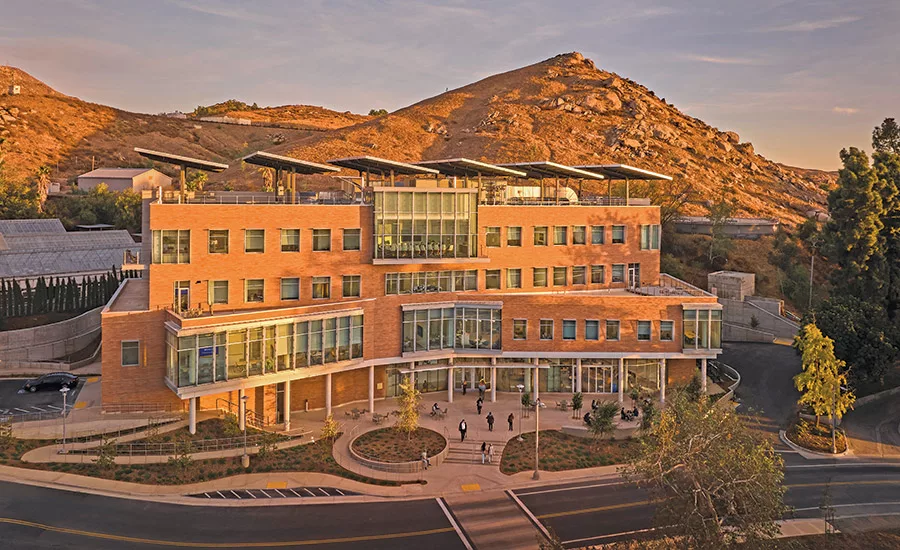
Higher education has been a bright spot, with projects like McCarthy’s work on the University of California, Riverside’s School of Business.
Related Link:
ENR West 2025 Top Contractors
After taking a battering during the pandemic, contractors on the West Coast have been enjoying the fruits of steady growth over the past few years.
Between 2019 and 2021—roughly the period of the COVID-19 pandemic—the average firm revenue for contractors in the ENR West region fell 14% to just under $560 million. (ENR West comprises California, Washington, Oregon, Nevada, Alaska and Hawaii.)
The total revenue for the Top 25 firms in the region echoed that trend, falling almost 4% to $37.75 billion.
Since then, contractors in the West have enjoyed a noticeable rebound. The average firm revenue has improved by more than a third to surpass $756 million in 2024, and the total revenue of the top 25 firms grew 23% to reach $46.52 billion. The upward trend mirrors national figures, although the uptick has been slightly less vigorous in the West. Total revenue for ENR’s Top 400 Contractors topped $600 billion this year—a 43% improvement over 2021.

Shimmick is working on the Bay Area’s first surface-water brackish desalination facility for the city of Antioch.
Photo By Bryan Grant/Shimmick
Still, the experience of the downturn and uncertainty for the future weigh on the industry. Caution remains the watchword given the host of unknowns facing the industry, including the impacts of tariffs, persistently high interest rates and a tumult of policy changes to name a few.
“Economic uncertainties are not making business decisions easier,” says Singular Builders CEO Jeff Gherardini.
In response, the fast-growing San Francisco-based contractor is stressing early planning, robust communication—and the expectation that flexibility will be required.
“We’ve adjusted our procurement strategies to secure critical materials earlier,” Gherardini says, “and we work closely with clients during preconstruction to build in realistic timelines and contingencies.”

Chart by ENR
Shifting Paradigms
Gherardini says he’s watching “how market confidence evolves in the second half of the year,” with some clients “reevaluating the scope and timing of their projects based on interest rates and return-on-investment expectations.”
“We’re keeping a close eye on a few key areas: construction material pricing trends, potential changes in local building regulations—particularly around electrification and sustainability—and the labor market,” he says. “In San Francisco, permitting and entitlement timelines continue to be a moving target, so we’re watching how the city responds to calls for streamlining those processes.”
“Economic uncertainties are not making business decisions easier.”
—Jeff Gherardini, CEO, Singular Builders
San Francisco-based Build Group is also looking for opportunities close to home. “We’re encouraged by the gradual return to office and city reinvestment efforts—especially in San Francisco, where revitalization is finally gaining traction,” says Nathan Rundel, president of the large commercial contractor.
Rundel says there are “signs of economic improvement, but we’re cautious. Ongoing tariff negotiations, currency shifts and immigration uncertainty continue to inject volatility, particularly into material costs and labor availability.”
In response, Build Group is investing more in employee development and technology. “Tools like AI-assisted scheduling, robotics and smarter field tech are no longer future-facing—they’re essential to staying competitive and keeping projects moving in a tight labor market,” Rundel says.

Affordable housing projects, like Build Group’s West LA VA Housing Phase A + Phase B, are expected to increase in number.
Photo courtesy Build Group
Scarred but Smarter
Jim Madrid, president of the Southern Pacific region at McCarthy Building Cos., says that “with technology developing at a pace never seen before,” the contractor is working to broaden its base internally and in its relationships with clients.
In employment, “there is an even wider variety of opportunities within our organization than we have had as recently as five years ago,” he says. “Rather than just recruiting construction management majors, we now recruit graduates for environmental, safety, finance, legal, marketing, logistics, architectural planning, business, programming and AI specialists.”
That, in turn, provides the company an opportunity to deepen its relationships with clients.
“We have become very diversified in not only our markets but also our offerings,” he says, including how “McCarthy can help our clients with their business decisions and investing their capital.”
Madrid says the company works to be reactive when tactical issues arise, with tight coordination among its regional CEOs, but he also notes that “our responsibility is to look over the horizon and position our company to handle the business environment as the dust settles.”

Chart by ENR
Ural Yal, CEO at Shimmick Construction, says supply disruptions during the pandemic taught resiliency, “which is allowing us to address current concerns around tariffs and price escalation through advanced planning and collaboration.”
Yal, who became CEO of the Irvine, Calif.-based heavy civil contractor late last year, says uncertainty around federal spending is lifting, “and we are seeing projects in the pipeline being released and started.”
Also, “data center and advanced manufacturing work are continuing to speed up,” he says.
While that’s the good news, Yal says staffing is a different story. “We are experiencing labor shortages for both staff and craftworkers, and we expect these shortages to get worse.”
To address this, Yal says Shimmick is “investing in training and early-career recruiting,” along with keeping abreast of “AI-based improvements across the construction industry, which are getting closer to critical mass.”