History
From the Archives: January 19, 1956

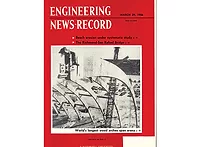
This 1956 photo shows the massive inclined ramp, known as the Helix, carrying traffic out from and into the Lincoln Tunnel on the New Jersey side of the Hudson River.
The related cover story described the construction of the tunnel’s third tube, which required widening of the Helix and other changes to the approach roads. The Helix is designed to carry traffic 160 ft upward from the tunnel mouth while making a 270° swing over the King’s Bluff Ledge, known as the Palisades, and feeding it into the New Jersey Turnpike.
The Helix is a complex structure, beginning as a concrete roadway on earth fill, changing to a heavy steel truss bridge, then to a curving trestle supported on circular piers, then to three large bridge trusses, then to a trestle supported on high concrete legs until it meets the rock of the Palisades.
The construction of the 8,216-ft-long third tube required excavation of more than 500,000 cu yd of earth and rock; use of 3,000 tons of steel in five bridges and widened viaducts; placement of 77,000 cu yd of concrete and a peak workforce of 700.
Combined annual traffic in the two existing tubes, completed in 1937 and 1945, had reached 21 million by 1955, spurring the owner, the Port Authority of New York and New Jersey, to build the third tube.
Currently the tunnel’s annual traffic volume is 43 million, making it the highest-capacity vehicular tunnel in the world.
Looking for quick answers on construction and engineering topics?
Try Ask ENR, our new smart AI search tool.
Ask ENR →