How Gateway Is Keeping Massive $16B Hudson Tunnel Project on Track
Crews target Q4 completion of the first of 10 projects to build new tunnels connecting New Jersey and New York under the Hudson River

A 600-ft cofferdam enables crews to place lightweight concrete along a section of the Hudson riverbed for safe passage of future TBMs.
Crews spread out across five construction sites are working to add a pair of tunnels under the Hudson River and nine miles of new passenger rail line to provide more reliable connectivity between New Jersey and New York City. All told, a total of 10 projects will make up the $16-billion Hudson Tunnel Project.
“We’re committed to delivering this project within scope, on time and budget,” Gateway Development Commission CEO Thomas Prendergast told reporters at a press tour marking the one-year anniversary of its full funding agreement with the Federal Transit Administration.
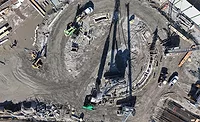
Hudson Yards Concrete Casing – Section 3, the first project to break ground in November 2023, reached 56% completion at the beginning of the month, says Leroy Antoine, senior manager of capital construction for Amtrak, the agency managing design and construction of the $692-million project. The casing, similar to two others completed in the mid-2010s to enable overbuild above the Hudson Yards development in west Manhattan, preserves the railway’s right of way and will allow developer and prime contractor Related Cos. to continue expansion of the minicity above the tracks. “We have completed our support of excavation that consists of 333 secant piles,” Antoine says. Numerous steel struts to hold back soil and water pressure have also been installed along the 500-ft-long, 60-ft-wide excavation, which ranges from a depth of 50 ft on the east side to 80 ft on the west end.
Crews have excavated about 50,000 tons of soil and removed more than 1.7 million gallons of water. Once remaining excavation is completed, crews will place the bottom concrete slab of the tunnel box first, then struts will be removed in sections to enable placement for side walls, after which re-bracing will occur in stages.
To place the roof, “we plan on putting sand inside the tunnel after we pour the bottom and the walls,” Antoine says. “The sand will serve as essentially the groundwork for us to put the formwork for the roof on top of it.” Once the top slab is placed, the sand is removed from inside the tunnel casing and placed on top of the casing as backfill.
The project also required underpinning the popular High Line elevated path tourist destination to enable crews to dig beneath it. Monitoring sensors throughout the site alert any minute movements. “We know if the High Line moves even one- tenth of an inch at all times,” Antoine says.
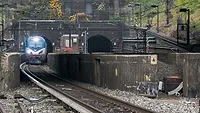
The first project to break ground on the New Jersey side of the new tunnel, the $41.1-million Tonnelle Avenue Bridge and Utility Relocation in Jersey City, remains on track for completion this fall. Crews with contractor Naik Consulting Group/Conti Civil LLC are building a new roadway bridge over new track alignment and providing construction access and staging for tunnel boring machines on the adjacent phase, the Palisades Tunnel Project.
Looking for quick answers on construction and engineering topics?
Try Ask ENR, our new smart AI search tool.
Ask ENR →
_ENRready.jpg "Tonnelle Avenue Bridge")
Tonnelle Avenue Bridge wraps up construction this fall, creating access for TBMs to begin their journey through a mile of bedrock on the New Jersey side.
Photo courtesy Gateway Development Commission
Cutting Through Bedrock
Led by Schiavone Lane Dragados JV, the $465.6-million Palisades project will use two approximately 29-ft-dia TBMs fitted with hard-rock cutterheads to excavate the first mile of the parallel tunnels up to 250 ft below the Palisades rock formation.
To deal with soil overburden at the planned TBM entry point, crews will build more than 90 concrete secant piles anchored with 5-ft rock sockets, says Kurt Paxton, Schiavone general superintendent. “From there, we’ll drill and blast down another 40 ft into rock, and when the two TBMs are here and assembled, they’ll actually penetrate the rock face.”
thrust frames will provide a platform to assemble the segments for the 350-ft-long TBMs as they penetrate the rock. The machines will also line the tunnel with concrete and waterproofing membrane to create an inside diameter of 25 ft, 2 in. TBMs will launch next year to excavate around 1,250 cu yd of rock per day, with completion expected by fourth quarter of 2027. Construction also includes a shaft on the west bank of the Hudson River in Weehawken, N.J., to allow removal of those TBMs and provide the future launch point for two new purpose-built TBMs to handle specific cutting conditions beneath the river.

Struts and secant piles hold back soil and water pressure as crews excavate along Hudson Yards.
Photo by Scott Blair/ENR
Prepping the Riverbed
Meanwhile, from barges on the Hudson River, Weeks Marine Inc. crews reinforce the riverbed to prepare for future tunnel boring as part of the $284-million Hudson River Ground Stabilization project.
Work began last summer in the middle of the channel, with crews using a 600-ft-long temporary cofferdam to create calm water conditions. They then inject grout into the silt along a 1,200-ft-long stretch of shallow riverbed and install columns of soil mixed with cement and water to create a lightweight 100-ft-wide block of reinforced earth that will allow TBMs to tunnel through without risking riverbed collapse or disturbing the underwater ecosystem, says Gateway spokesperson Stephen Sigmund. Work on the phased project restarted earlier this month, avoiding annual sturgeon runs during which work is prohibited on the river, he adds.
Back on dry land along the Manhattan shore, crews have begun to mobilize on the largest contract to date, the $1.2-billion Manhattan Tunnel Project, which will build the approximately 700-ft-long portion of tunnel that connects the Hudson Yards concrete casing to the river tunnel. This section involves penetrating the Manhattan bulkhead that holds back the Hudson’s waters in the 20th century-era fill that delineates the city’s western edge along 12th Avenue.
Contractor Frontier-Kemper Tutor Perini JV will perform ground improvement, to “put casings in the ground and freeze pipes that will circulate cold brine ... to freeze the ground and create a hardened mass,” says Benjamin Engle, Gateway senior program manager for program planning. “At that point, they’ll start to excavate using a digger shield.”
Obstructions will be removed, including the steel foundation of the former West Side Highway that was abandoned in place. Crews will backfill with low-strength concrete to create a stable environment for Hudson River TBMs to chew through before reaching a 130-ft-dia access shaft being constructed to remove the TBMs and create a future tunnel ventilation shaft.
Shortlists for two more projects were announced earlier this year, including the 7,250-ft-long section of tunnel under the Hudson riverbed. Gateway anticipates awards in the coming months.
Prendergast remains confident that despite the change in administration since the full project funding, the tunnel will be delivered on time and budget. “We’ve reached out to the Trump administration, and [it has] been very supportive [of the Gateway Program],” he says. “They know the importance of the project.”