Robotic Inspection Checks Out Tunnel in the Alps Set to Become Rail Link
Custom-built rover scans exploratory tunnel for potential hazardous conditions
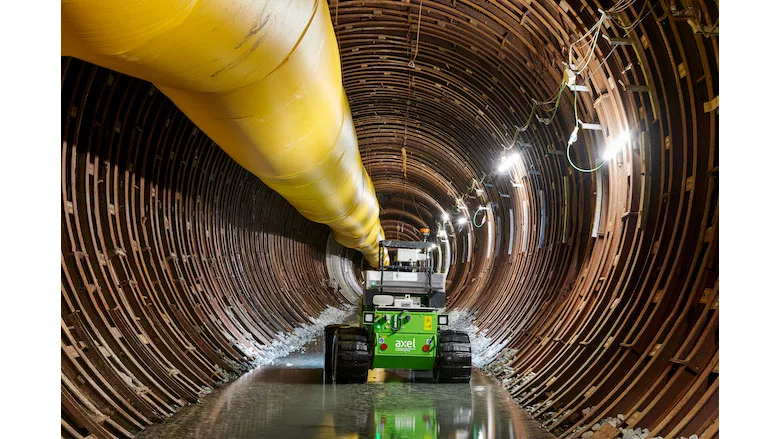
Photo Courtesy Webuild S.p.A.
Before converting a five-year-old exploratory tunnel on the new Turin-Lyons rail link into part of the main Alpine drive, Italian engineers had to assess its condition after lying idle for five years in a potentially hazardous environment.
Working with contractor Webuild Group, CIM4.0, a public-private partnership competence center, developed a wheeled, battery-powered robotic rover that can sample ambient gases and probe conditions in the last 3 km of the 7.6 km Maddalena pilot at Chiomonte, some 60 km west of Turin, Italy.
The robot has a 10-km maximum range, and can be operated from up to 2 km away from its controller. Able to detect a range of gases, the 3.5-m long, 1.8-m tall robot is equipped with cameras, sensors and antennae. It can cross 20-cm high obstacles and 30-cm deep water while operating in temperatures up to 45°C (113°F) and 80% humidity, according to Webuild.
The contractor is excavating 22 niches 4.5 m into the pilot's side to allow construction traffic. Never intended to serve as the main tunnel, the 6.3-m-dia pilot tunnel is too narrow for two-way traffic. The original plan was to start the main drive at Susa, Italy, about 7 km away.
The 270-km, high-speed Turin-Lyons railroad will cross the Alps in the 57.5 km Mont Cenis base tunnel, which is set for completion in 2030.
Looking for quick answers on construction and engineering topics?
Try Ask ENR, our new smart AI search tool.
Ask ENR →