Record Elevators and Escalators
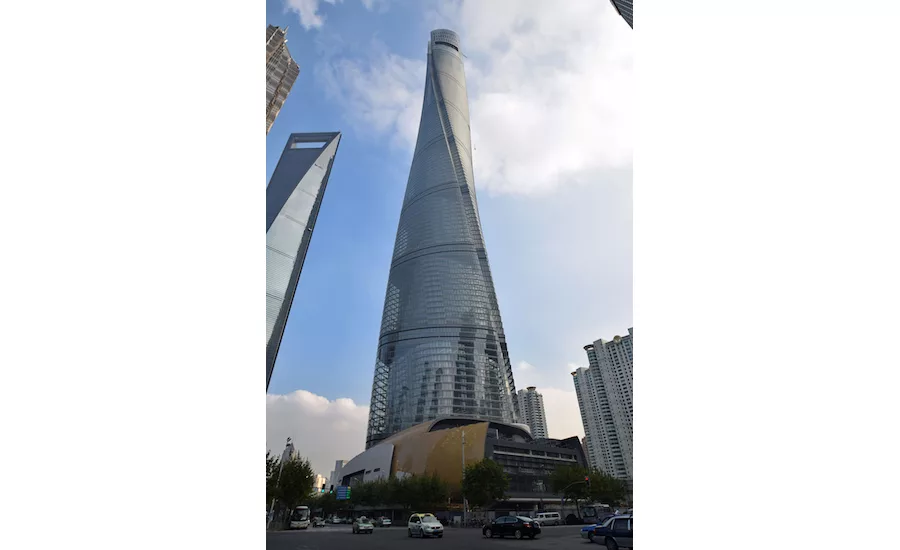
The world’s fastest elevator is in the Shanghai Tower, the world’s second-tallest skyscraper. A twisting, glass-cloaked spire rising 632 meters, it opened in 2016. The building was designed by Gensler, and its vertical transportation system, comprising a total of 108 elevators, was designed by Edgett Williams Consulting Group. Mitsubishi Electric Corp. supplied the elevator system, and its Chinese joint-venture company, Shanghai Mitsubishi Elevator Co. Ltd., installed them. Three ultra-high-speed elevators serve the observation deck on the 121st floor. One of those elevators, operating at a speed of 1,230 m per minute, is the fastest single-deck elevator ever developed for commercial building use. The three elevators serving the observation deck also hold the record for farthest distance covered, at 578.5 m.
Photo Courtesy Wikimedia Commons
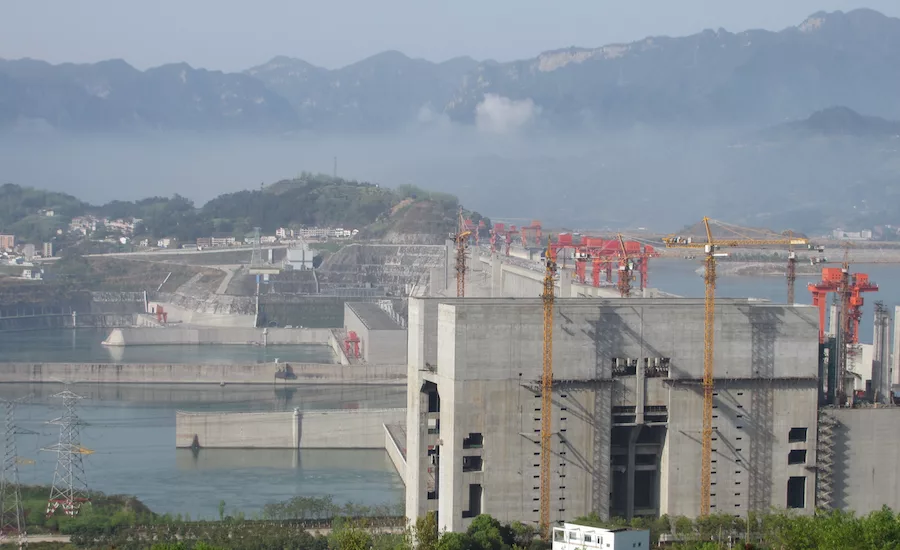
The largest and most powerful elevator of any kind in the world is the ship lift at the Three Gorges Dam. Primarily used to transfer passenger ships, it travels a maximum vertical distance of 113 meters, depending on upstream and downstream water levels, both of which fluctuate. It can lift ships up to 3,000 tonnes and is designed to accommodate ships up to 84.5 m long and 17.2 m wide, with a maximum draft of 2.65 m. The steel ship chamber has an interior length of 120 m and a width of 18 m and holds 3.5 m of water (three times as much water as an Olympic-size swimming pool). Its exterior dimensions are 132 m x 23 m. All the ship lift’s static components—foundation slab, four towers and shear walls—are reinforced concrete. The ship chamber is suspended from 256 cables that are connected with counterweights via pulleys at the top of the towers. The guided counterweights, made of concrete, run in shafts inside each tower. The moving mass (water plus the ship chamber plus the counterweights and cables) totals 34,000 tonnes. Construction of the ship lift began in 2008, as the dam was being completed and began operating in September 2016. The lift was designed by a joint venture comprising two German firms, Krebs and Kiefer International and Lahmeyer International. Lifting time is between 20 and 40 minutes, allowing ships to transit in under one hour, compared to three or four hours needed for ships to pass through the dam’s five-chamber lock system. China Gezhouba Group Co. Ltd. performed much of the construction.
Photo Courtesy Wikimedia Commons
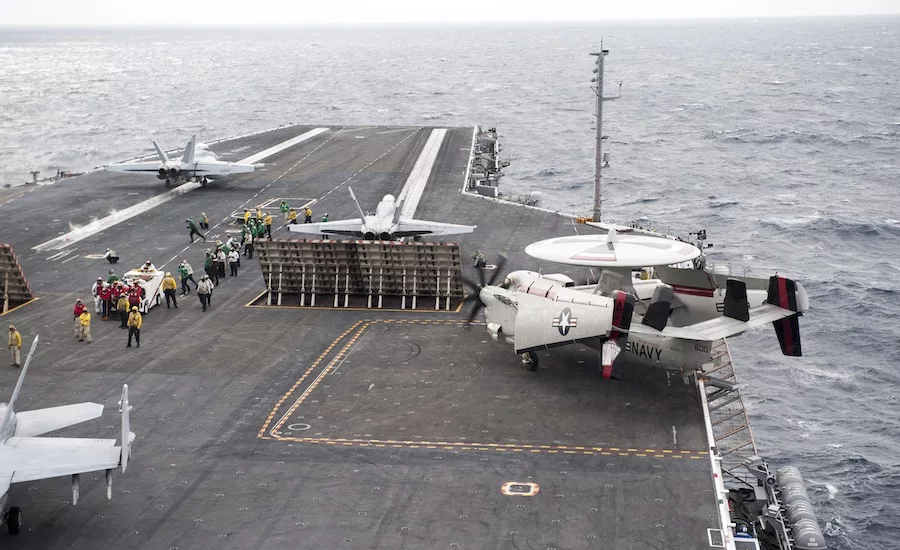
On a ship, the largest elevators are used to transport fighter planes from the holds of U.S. Navy aircraft carriers up to the flight decks. The largest such elevators are installed on Nimitz-class carriers, each of which has four elevators. Each elevator’s floor area is 85 ft long by 52 ft wide. Supplied by Northrop Grumman, they have a lifting capacity of 150,000 lb. The first of 10 Nimitz-class nuclear-powered carriers, the USS Nimitz went into service in 1975. The 10th and last carrier of this type, the USS George H.W. Bush, was commissioned in 2009. The carriers are built by Newport News Shipbuilding, which has been owned by Northrup Grumman since 2001.
Photo Courtesy of the U.S. Navy
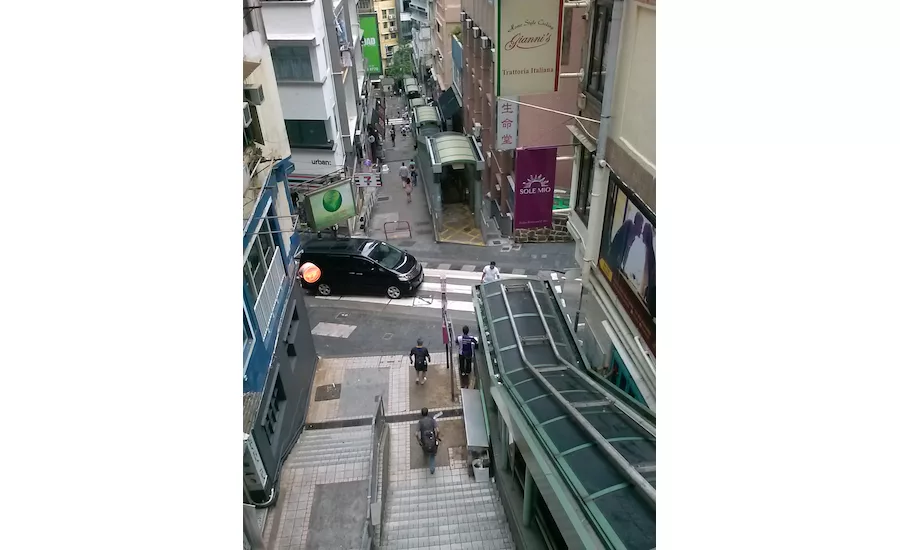
The longest escalator system in the world, consisting of multiple escalators, is the Central to Mid-Levels Escalator and Walkway System, in Hong Kong. It is an outdoor series of 18 covered escalators and three moving walkways that carry passengers 800 meters while climbing 135 m in elevation. The esalator rises from Queen’s Road Central in the city center to the Mid-Levels, a high-rise residential district. Further, it carries commuters downhill from 6 a.m. to 10 a.m. and uphill from 10:15 a.m. to midnight. Passengers can get on or off at any intersection or choose to take the stairs, which run next to it. The system connects to the Central Elevated Walkway, an extensive footbridge network covering the Central neighborhood. The average daily number of pedestrian trips was 85,000 as of 2010. Constructions Industrielles de la Mediterranee (CNIM), a French firm, supplied the escalators. P&T Architects & Engineers Ltd. designed the system, and Paul Y–Sogea Joint Venture, built it. The escalator started operation in 1993. The construction cost was $30 million. The Hong Kong government's Electrical and Mechanical Services Dept. is the owner.
Photo Courtesy Government of Hong Kong
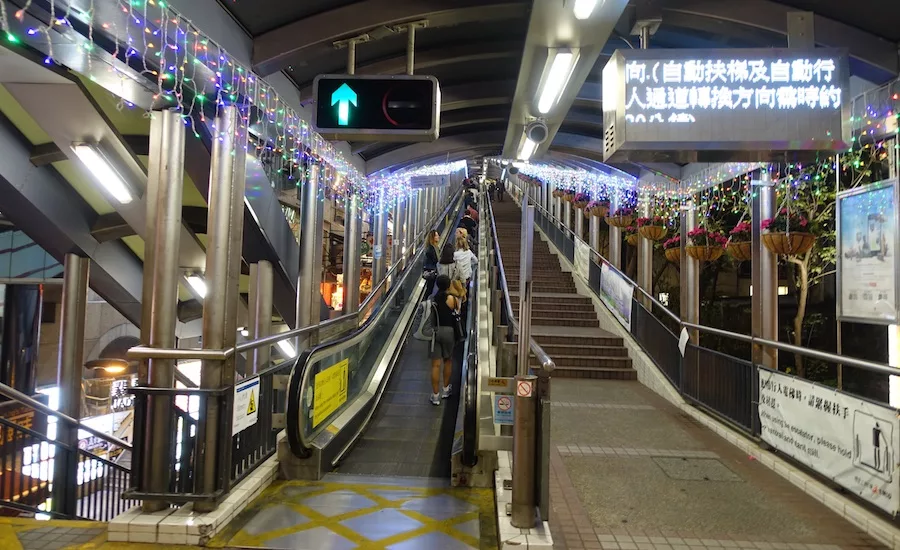
The escalator employs a one-way system, carrying pedestrians downhill each morning and uphill the remainder of the day.
As research work continues on the future of ropeless elevator technology, ENR is taking a closer look at the elevator and escalator technology, both past records and current developments.
The elevator-and-escalator market was $88.8 billion in 2015 and is estimated to reach $125.2 billion by 2021, according to market research firm MarketsandMarkets. A primary driver seen for this growth is urbanization.
“We see urbanization as an enabler of economic growth, prosperity and well-being, and it creates a significant business opportunity for us,” says Antti Pirinen, head of the volume elevator business for KONE Corp. “Over the next 15 years, over one billion people will move into cities, which means that almost 70% of the world’s population will reside in urban environments.”
High population densities typically mean taller buildings, Pirinen says. “We have seen a significant rise in the number of elevators and escalators installed per million square meters built, which is a crucial driver of growth in our industry,” he adds.
Other market drivers include rising prosperity in emerging markets; demographic changes, such as aging populations; the increasing importance placed on convenience and safety; and an emphasis on energy efficiency.
Upgrades are another major component of the vertical transportation market. The era of installed bases and safety regulations affect this, says Pirinen. “We estimate that over 50% of the equipment in use in Europe and North America is over 20 years old,” which means it could benefit from modernization, he adds.
Destination dispatch systems are one significant aspect of elevator modernization and new installations; such systems often are used in office buildings and hotels with multiple elevators. Passengers use a keypad, touch screen or proximity card to request a specific floor, then are directed to a specific elevator cab. Destination dispatch systems bring passengers to their floor faster by “batching” passengers headed to the same floor. Further, they increase overall elevator capacity in a building, say elevator experts.
Looking for quick answers on construction and engineering topics?
Try Ask ENR, our new smart AI search tool.
Ask ENR →
Schindler, a leading elevator maker, introduced the first destination dispatch system, Miconic 10, in 1992. “Paul Friedli, head of the transit management group at Schindler, is the father of destination control,” says Florian Meier, Schindler’s communications manager.
Schindler also introduced card-reader technology to elevator systems, so that passengers identify themselves via a personalized badge or ID card that is programmed with individual details.
“This transit management methodology looks at each individual’s journey through a building, from entrance to final destination, and attempts to optimize it,” says Meier. “Thanks to optimized traffic management and the resulting saving in shaft space, Schindler’s PORT technology has made possible configurations of buildings that would not have been conceivable before, especially at the high end of the market.”
Digital technologies are ushering in other improvements, as well. “By using digital and cloud technologies, elevators are becoming much smarter boxes,” says Karen Penafiel, executive director of National Elevator Industry Inc., a trade group.
Members are using sensors for monitoring equipment, which allows them to better troubleshoot problems. An emphasis on preventive maintenance can significantly cut operational costs for building owners and reduce elevator downtime while ensuring the safety of the system, says Penafiel.
In the not so distant future, elevators may “know who you are and where you are going the moment you enter the building,” she adds. This technology will help to enhance building security and further reduce wait times.
Shared-shaft elevators, featuring two independently operating cars in a common shaft, are another significant improvement. Another leading manufacturer, thyssenkrupp, in 2003 introduced its TWIN elevator system, which is now found in more than 200 buildings worldwide. The first TWIN system in a U.S. building will make its debut at the Georgia Institute of Technology’s Coda at Tech Square, a 21-story mixed-use building expected to open in 2018.
With two cars operating in one shaft, one can ferry passengers between lower floors, while the other can carry people from the middle to upper floors. When there are not enough people to keep both cars busy, the system can park one car at the bottom or top of the shaft to save energy. And with each shaft moving more people, buildings need fewer shafts, allowing architects and developers to create buildings that use space more efficiently.
TWIN elevator systems “use less energy and transport up to 40% more passengers than conventional elevators,” according to Matt Watkins, executive vice president of marketing and communications at thyssenkrupp Elevator Technology.
Another advancement in elevator technology is regenerative drives, which capture and convert the heat generated during use into reusable energy for the building.
Supertall buildings have presented another challenge to elevator design, as steel-rope technology has reached a height limit. Problems with elevator-cable girth, weight and building sway prevent conventional elevators from traveling farther than 500 meters. KONE developed an alternative material, UltraRope, a belt-like rope fabricated with carbon fiber and featuring a polyurethane coating, which it patented in 2008.
The first elevator rigged with UltraRope was installed in 2013 in a shaft in Marina Bay Sands, Singapore. However, that elevator is slightly less than 200 m. The first debut of UltraRope technology in a supertall building will be Beijing’s China Zun, a 528-m-tall mixed-use building currently under construction and expected to open in 2018. UltraRope also will play a prominent role in the elevators of the kilometer-plus-tall Jeddah Tower, previously known as the Kingdom Tower. Completion is scheduled for 2020.
Probably the biggest technological advance in elevators on the horizon is a ropeless system. The first ropeless, tall-building elevator—a compact, lightweight system that mimics a subway line—is set to enter the testing and certification stage early next year. If all goes as planned, thyssenkrupp Elevator AG expects to have its linear-drive system, designed to travel vertically, horizontally or on an incline, ready for the market in three years.
“Elevators have been a limiting factor in the past” in the development and design of tall buildings, says Markus Jetter, head of development for thyssenkrupp. “This opens a completely new dimension for buildings in height and shape.”
Critical to the schedule is completion—expected soon—of what will become, for a time, the world’s tallest elevator test tower and the first to double as an observation tower. The 246-m tower in Rottweil, Germany, equipped with 12 elevator shafts in its 21-m-dia reinforced-concrete core, will begin testing thyssenkrupp’s ropeless high-rise transportation system, called MULTI, in three connected shafts.
“MULTI generates more handling capacity and shorter waiting times independent of travel height,” said Jetter. MULTI, which has been prototyped, operates on the basic premise of a circular system. A single loop, or guideway, can contain several cabs. “It’s similar to a subway, with multiple trains using the same rail and riding in the same direction on one track.”
In the vertical mode, each cab will cantilever from its side rail and be equipped with a linear motor drive, adapted from thyssenkrupp’s Transrapid magnetic-levitation train. Applied to vertical transportation, this technology maximizes shaft efficiency in mid- to high-rise buildings because each shaft accommodates more than one cab, says thyssenkrupp. Shaft transport capacities will increase by 50%, and elevator footprints will be reduced by up to 50%, according to thyssenkrupp.
Major elevator manufacturers are busy on a wide variety of projects around the world. KONE recently was chosen to equip 29 stations of the Xi’an Metro system, in northwest China, with 327 elevators and escalators.
Schindler was chosen as the main supplier of elevators and escalators at Istanbul Grand Airport. The contract calls for the delivery, installation and maintenance of 306 elevators, 159 escalators and 183 moving walkways, at what is expected to be the world’s largest airport, with an annual passenger capacity of 200 million.
Schindler also is supplying 74 elevators and 57 escalators to the 636-m-tall Greenland Center, which is on deck to be China’s tallest building. The opening is scheduled for 2018.
thyssenkrupp recently was awarded a contract to supply, install and maintain more than 500 elevators and escalators for the Doha Metro.