Tsunami Loads Report Now in Draft Review May Become an Engineering Classic
All bridge decks in tsunami zones must be designed for hydrodynamic lateral loads as well as for both hydrostatic and hydrodynamic uplift. Buoyancy should be considered in tension anchorage designs.
PHOTO by IAN ROBERTSON
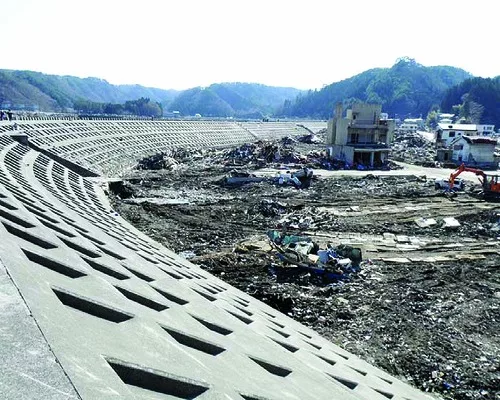
A wider base and lower slope helped somewhat, however. Even very large segmental concrete seawalls were susceptible to overturning after scouring. All seawalls in the tsunami zone must have adequate pile foundations.
PHOTO by David Kriebel
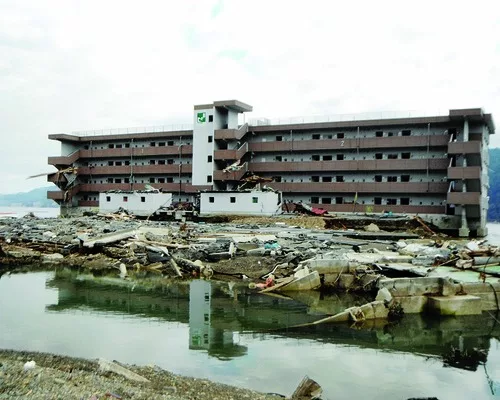
Stout Mid- to high-rise reinforced concrete buildings with robust shear walls can survive, and these can be evacuation structures if tall enough.
PHOTO by IAN ROBERTSON
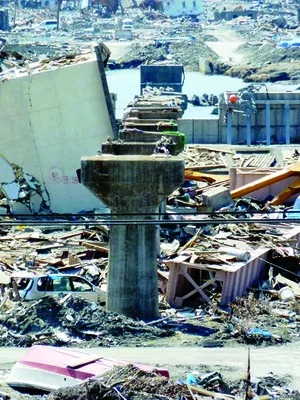
While road bridges often can be replaced with temporary structures or detours, rail bridges�due to the heavy loads and the need to maintain grades�cannot. The loss of a single rail bridge can take down a whole line for years, and evidence shows many rail bridges went down quickly.
Graphic and photos, top and bottom right, by Ian Robertson; photo bottom left by David Kriebel
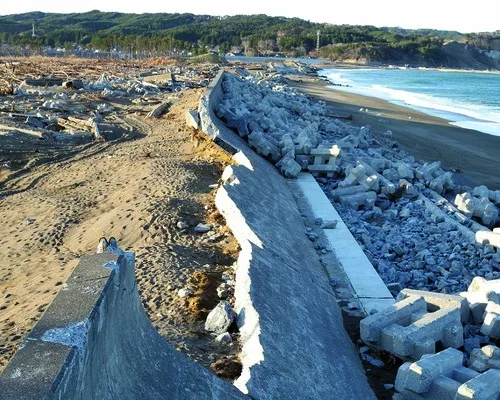
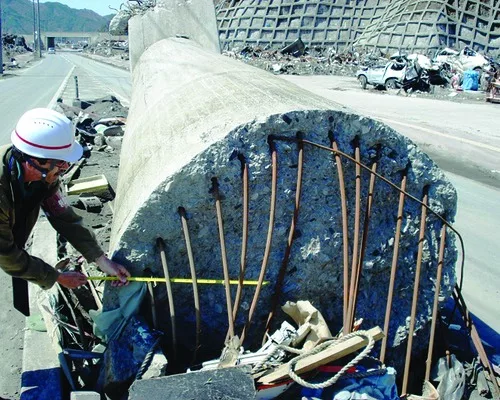
Concrete-lined compacted earth barrier seawalls were not effective.
PHOTO by Tomohiro Yasuda
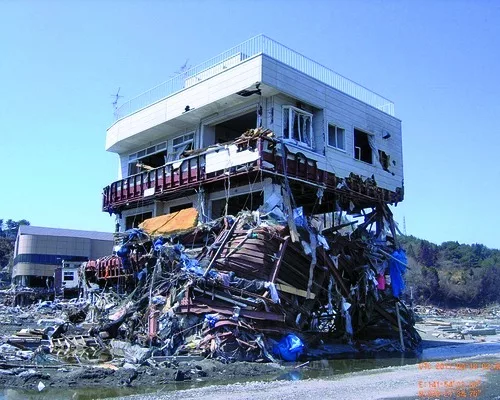
Steel buildings with robust lower stories can have similar capability.
PHOTO by IAN ROBERTSON
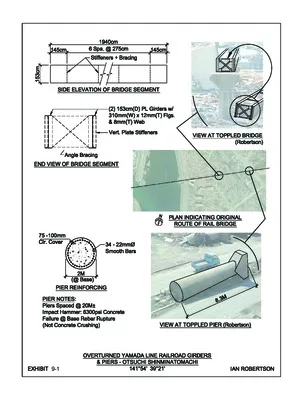
Overturned Yamada line railroad girders.
Image by IAN ROBERTSON
• Scour effects on foundations should be considered, particularly at corners.
• Flow acceleration around large buildings significantly increases the flow velocity on downstream buildings.
A 14-page summary highlighting many of the findings was published on Sept. 29 as an Earthquake Engineering Research Institute special report and can be seen at http://www.eeri.org.
Investigations