With no relief in sight from a Federal Aviation Administration requirement that all drone flights be overseen by licensed drone pilots, a San Francisco-based company that had been developing an autonomous aerial jobsite survey system is adjusting.
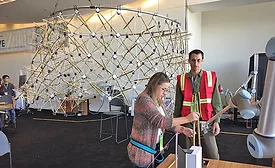
At Autodesk Inc.’s user conference in Las Vegas, Dec. 1-3, the company talked about new releases, it’s plan to move everything into the cloud and robot-human work relations.
Field tests of a high-speed video system that reveals distortion by exaggerating tiny deflections show promise as the basis for a new, flexible and relatively inexpensive structural health analysis tool.
Various “thought leaders” in the industry have been trying—some would say hitting their heads against the wall—for at least the 37 years that I have been covering buildings (and likely before that), to use technology to streamline, automate and quicken building design and construction.
Two new software products for rapidly converting collections of photos into 3D models and rapidly creating realistic environments for those models—one called ContextCapture, the other called LumenRT—demonstrate technical sophistication, data management techniques, rendering speed and ease of use that has reviewers taking notice but asking for more validation, too.
The future of wearable technology for the construction industry conjures up images of workers covered in clunky machinery—hydraulically powered exosuits multiplying the wearers’ strength, while gleaming visors with information-dense heads-up displays block their vision.
The Federal Aviation Administration on Nov. 3 convened a 26-person task force to develop ideas for a system to register unmanned aerial vehicles, or drones.
Two recent projects for helicopter hangars on U.S. military bases, one in Colorado and one in Kentucky, offer examples of how out-of-the-box thinking about crane design can overcome some big construction obstacles.
 RSS
RSS